Welcome to IMX 415 Camera Module repository
3. Target Detection
Target Detection
1. Target Detection
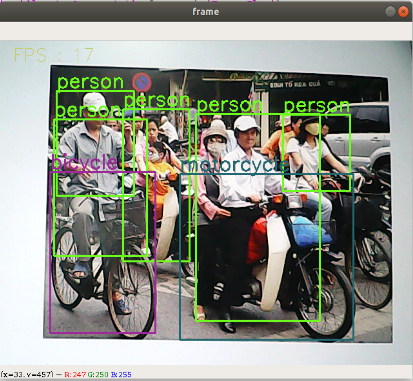
The main problem solved in this section is how to use the dnn module in OpenCV to import a pre-trained target detection network. However, there are requirements on the OpenCV version.
Currently, there are three main methods for target detection using deep learning:
- Faster R-CNNs
- You Only Look Once (YOLO)
- Single Shot Detectors (SSDs)
Faster R-CNNs are the most commonly heard neural network based on deep learning. However, this method is technically difficult to understand (especially for deep learning beginners), difficult to implement, and also difficult to train.
Moreover, even with the "Faster" method of implementing R-CNNs (here R stands for Region Proposal), the algorithm is still relatively slow, about 7 FPS.
If we pursue speed, we can turn to YOLO, because it is very fast, reaching 40-90 FPS on a Titan X GPU, and the fastest version can reach 155 FPS. But the problem with YOLO is that its accuracy still needs improvement.
SSDs were originally developed by Google and can be said to be a balance between the above two. Compared with Faster R-CNNs, its algorithm is more direct. Compared with YOLO, it is more accurate.
1.1. Model Structure
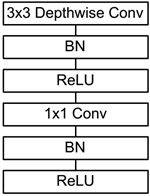
The main work of MobileNet is to use depthwise separable convolutions to replace the past standard convolutions to solve the problems of computational efficiency and the number of parameters of the convolutional network. The MobileNets model is based on depthwise separable convolutions, which can decompose a standard convolution into a depthwise convolution and a pointwise convolution (1 x 1 convolution kernel). The depthwise convolution applies each convolution kernel to each channel, while the 1 x 1 convolution is used to combine the outputs of the channel convolution.
Batch Normalization (BN) is added to the basic components of MobileNet, that is, normalization processing is performed at each SGD (stochastic gradient descent), so that the mean of the result (the various dimensions of the output signal) is 0 and the variance is 1. Generally, when training a neural network encounters problems such as very slow convergence or gradient explosion that prevent training, you can try BN to solve them. In addition, in general use cases, BN can also be added to speed up training and improve model accuracy.
In addition, the model also uses the ReLU activation function, so the basic structure of the depthwise separable convolution is shown in the figure below:
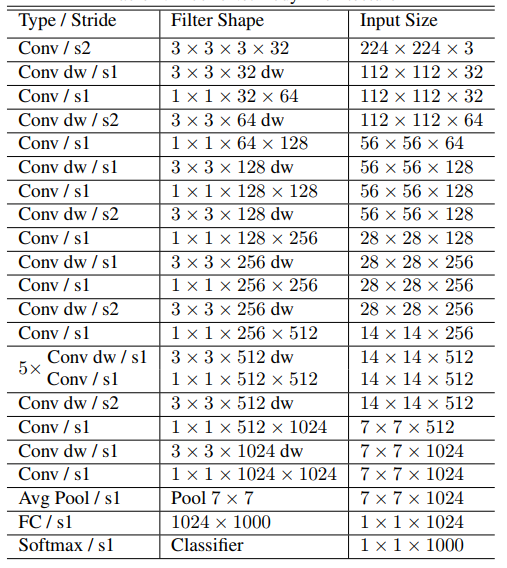
The MobileNets network is composed of many depthwise separable convolutions as shown in the figure above. Its specific network structure is shown in the figure below:
1.2. Code Analysis
The list of recognizable objects
[person, bicycle, car, motorcycle, airplane, bus, train,truck, boat, traffic light, fire hydrant, street sign,stop sign, parking meter, bench, bird, cat, dog, horse,sheep, cow, elephant, bear, zebra, giraffe, hat, backpack,umbrella, shoe, eye glasses, handbag, tie, suitcase,frisbee, skis, snowboard, sports ball, kite, baseball bat,baseball glove, skateboard, surfboard, tennis racket,bottle, plate, wine glass, cup, fork, knife, spoon, bowl,banana, apple, sandwich, orange, broccoli, carrot, hot dog,pizza, donut, cake, chair, couch, potted plant, bed, mirror,dining table, window, desk, toilet, door, tv, laptop, mouse,remote, keyboard, cell phone, microwave, oven, toaster,sink, refrigerator, blender, book, clock, vase, scissors,teddy bear, hair drier, toothbrush]
Load the categories [object_detection_coco.txt], import the model [frozen_inference_graph.pb], and specify the deep learning framework [TensorFlow]
xxxxxxxxxx# Load COCO class nameswith open('object_detection_coco.txt', 'r') as f: class_names = f.read().split('\n')# Display different colors for different targetsCOLORS = np.random.uniform(0, 255, size=(len(class_names), 3))# Load the DNN image modelmodel = cv.dnn.readNet(model='frozen_inference_graph.pb', config='ssd_mobilenet_v2_coco.txt', framework='TensorFlow')
Import the image, extract the height and width, compute a 300x300 pixel blob, and pass this blob to the neural network
xxxxxxxxxxdef Target_Detection(image):image_height, image_width, _ = image.shape# Create a blob from the imageblob = cv.dnn.blobFromImage(image=image, size=(300, 300), mean=(104, 117, 123), swapRB=True)model.setInput(blob)output = model.forward()# Loop over each detectionfor detection in output[0, 0, :, :]:# Extract the confidence of the detectionconfidence = detection[2]# Draw a bounding box only when the detection confidence is higher than a certain threshold, otherwise skipif confidence > .4:# Get the class IDclass_id = detection[1]# Map the class ID to the classclass_name = class_names[int(class_id) - 1]color = COLORS[int(class_id)]# Get the bounding box coordinatesbox_x = detection[3] * image_widthbox_y = detection[4] * image_height# Get the bounding box width and heightbox_width = detection[5] * image_widthbox_height = detection[6] * image_height# Draw a rectangle around each detected objectcv.rectangle(image, (int(box_x), int(box_y)), (int(box_width), int(box_height)), color, thickness=2)# Write the class name text on the detected objectcv.putText(image, class_name, (int(box_x), int(box_y - 5)), cv.FONT_HERSHEY_SIMPLEX, 1, color, 2)return image
1.3. Startup
xxxxxxxxxxcd /home/pi/yahboomcar_ws/src/yahboomcar_visual/detectionpython target_detection_CSI.py (CSI camera)python target_detection_USB.py (USB camera)
After clicking the image frame, press the [f] key on the keyboard to switch to human pose estimation.
xxxxxxxxxxif action == ord('f') or action == ord('F'):state = not state # function switch