Welcome to MSPM0G3507 Development Board repository
1. Introduction to MSPM0
MSPM0 Introduction
1. What is MSPM0?
The MSPM0G3507 belongs to the TI Texas Instruments MSPM0G350x microcontroller (MCU) highly integrated ultra-low power 32-bit MCU series, which is based on the enhanced Arm Cortex-M0+ 32-bit core platform and operates at up to 80MHz. These low-cost MCUs provide high-performance analog peripheral integration, support an operating temperature range of -40°C to 125°C, and operate at a supply voltage of 1.62 V to 3.6 V.
The MSPM0G3507 is an 80MHz Arm® Cortex®-M0+ MC with 128KB flash, 32KB SRAM, 2 4Msps ADCs, DACs, 3 COMPs, 2 op amps, CAN-FD, MATHACL.
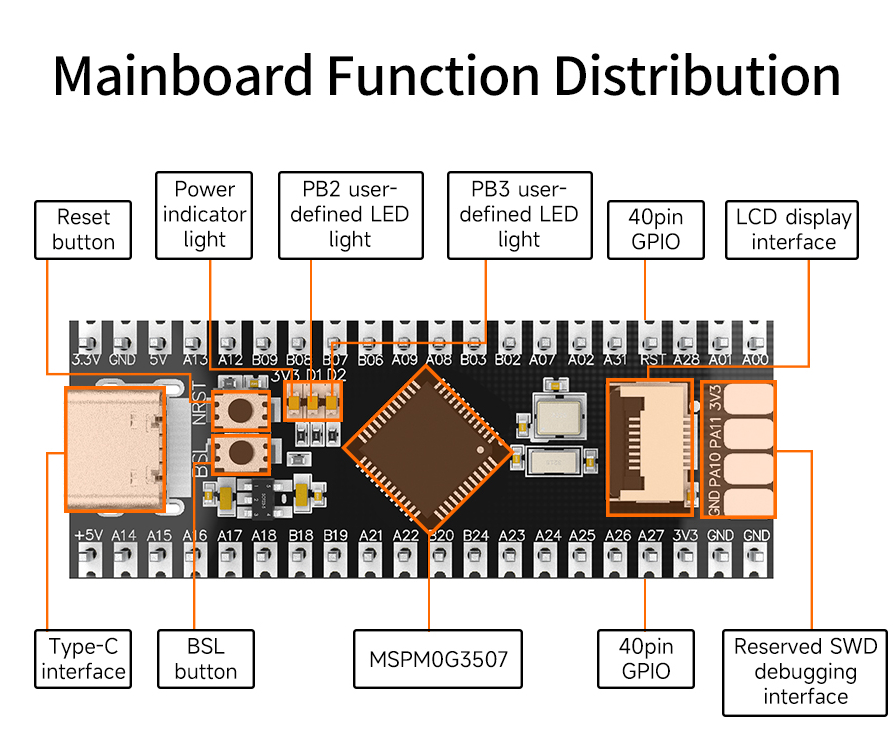
Functional Interface
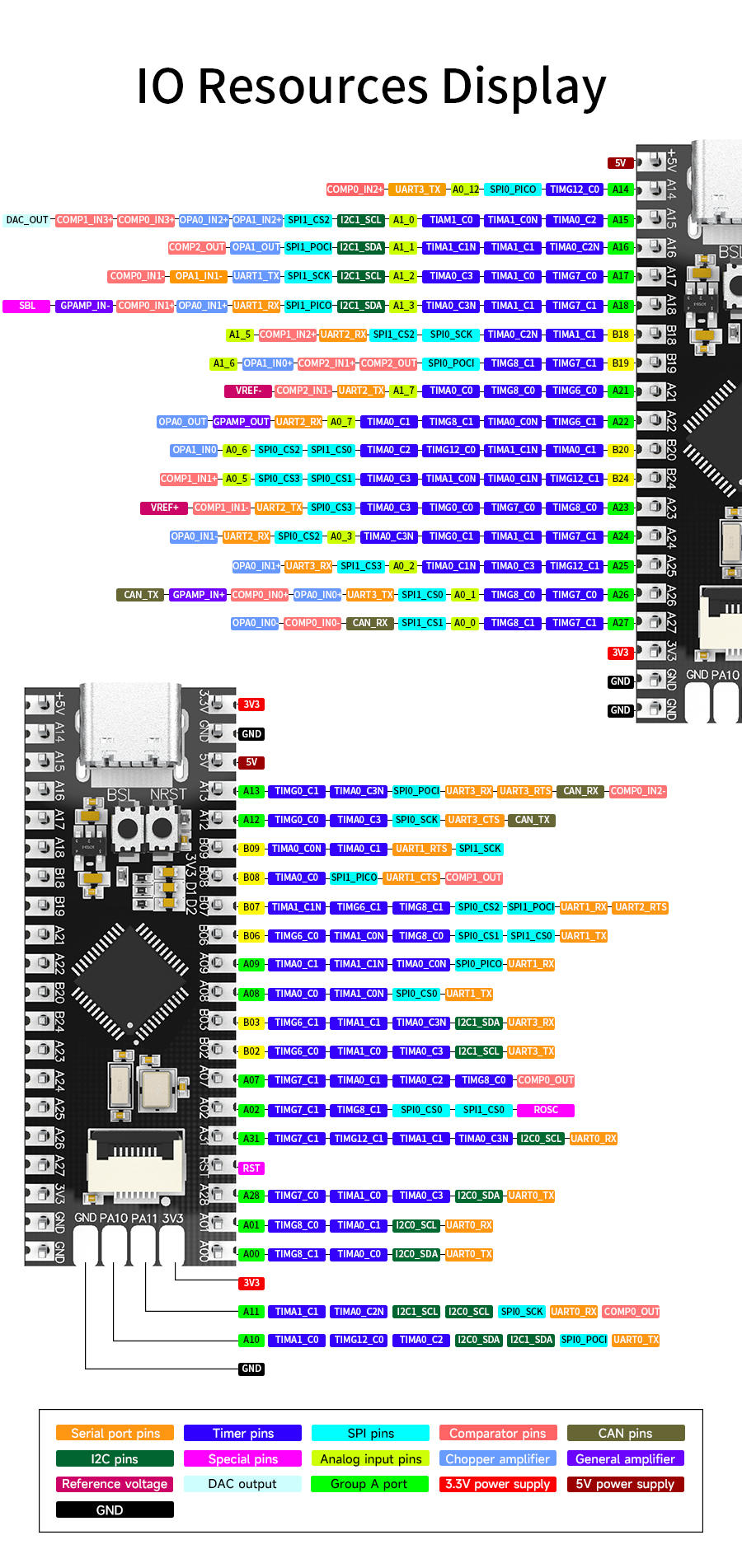
IO port introduction
2. Features of MSPM0
- Based on ARM Cortex-M0 core:
- Cortex-M0 is a low-power, high-performance 32-bit microcontroller core launched by ARM. It is the lowest performance in the ARM Cortex-M series, but still provides enough computing power for applications with strict requirements on cost and power consumption.
- Low-power design:
- The MSPM0 series has extremely low power consumption and is suitable for battery-powered devices. Its low power consumption makes it very suitable for IoT devices, sensors and embedded applications that require long-term operation.
- It has multiple low-power modes to optimize battery life under different working conditions.
- Rich peripherals and interfaces:
- GPIO: Supports multiple general-purpose input and output pins, which can be used to control external devices such as LEDs, buttons, sensors, etc.
- Timer: Includes basic timer, PWM output and other functions for precise time control and signal generation.
- Serial communication: Supports USART for serial communication with external devices.
- I2C/SPI: Supports common communication protocols (I2C and SPI), which facilitates data exchange with sensors and peripherals.
- ADC (Analog-to-Digital Converter): Used to convert analog signals into digital signals, widely used in sensor signal processing.
- Small package and high integration:
- The MSPM0 series supports a variety of package types (such as QFN, TSSOP) to adapt to different sizes and application requirements.
- It integrates a wealth of peripherals, reduces the need for external components, and helps to simplify circuit design.
- Wide application scenarios:
- IoT devices: Due to its low power consumption and small size, it is suitable for a variety of smart devices and sensors, such as environmental monitoring, smart home, health monitoring, etc.
- Consumer electronics: In battery-powered products (such as smart watches, remote controls, toys, etc.), the MSPM0 series is a common choice.
- Industrial control: It can be used in various low-power automation control systems, such as motor control, sensor interface, data acquisition, etc.
- Development tools and support:
- IDE support: TI provides a complete development tool chain, including Code Composer Studio and IAR Embedded Workbench. In addition, third-party tools such as Keil can also be used for development.
- Hardware debugging: Supports SWD debugging interface, which is convenient for developers to perform hardware debugging and program burning.
3. Comparison of MSPM0 with other ARM Cortex-M series MCUs
- Cortex-M0 core is the lowest performance in the ARM Cortex-M series, but it still provides performance suitable for basic control tasks, while having very low power consumption characteristics.
- Compared with Cortex-M3 and Cortex-M4 (with stronger computing power and more hardware acceleration functions), the Cortex-M0 core has weaker performance, but its low power consumption and low cost make it suitable for applications that do not require high performance but require strict power consumption and cost control.
4. Advantages of the MSPM0 series
- Low power consumption: Very suitable for long-term operation in battery-powered devices.
- High integration: Integrates multiple peripherals and interfaces, reduces external hardware requirements and simplifies design.
- Rich development support: Can use a variety of development tools for programming, debugging and burning.
- High cost-effectiveness: Suitable for cost-sensitive applications, especially in mass production, the cost advantage is more obvious.