yahboom
HomeLearn
Solution
Blog
Online Store
About Us
EN/中文
T-mini Plus LiDAR📖
01.Linux basic course
  • 1.Introduction to Linux system
  • 2.Ubuntu file system
  • 3.Ubuntu common commands
  • 4.Ubuntu common editors
  • 5.Ubuntu software operation commands
  • 6.Virtual machine installation
  • 7.SSH remote control
  • 8.VNC remote control
  • 9.Transfer files remotely
  • 10.Driver library and communication
  • 11.Static IP and hotspot mode
  • 12.Bind device ID
  • 13.Capacity expansion and resource allocation
  • 14.Update system software sources
  • 15.Set root user password
  • 16.sudo free password
  • 17.Connect to WiFi network
  • 18.View system version
  • 19.Customized service management
  • 20.Back up system image
02.ROS1 basic course
  • 1.ROS introduction
  • 2.ROS installation
  • 3.ROS common command tools
  • 4.ROS workspace
  • 5.ROS function package
  • 6.ROS node
  • 7.ROS topic publisher
  • 8.ROS topic subscribers
  • 9.ROS service client
  • 10.ROS service server
  • 11.ROS action client
  • 12.ROS action server
  • 13.ROS custom message reception
  • 14.ROS-launch file
  • 15.ROS-TF transformation
  • 16.ROS parameter service
  • 17.ROS-rviz use
  • 18.ROS-rqt tool usage
  • 19.Topic message recording and playback
  • 20.urdf model introduction
  • 21.gazebo introduction
  • 22.ROS distributed communication
03.ROS1 lidar course
  • 0.Instructions before use
  • 1.Preparation
  • 2.Handheld lidar mapping
  • 3.Lidar avoiding
  • 4.Lidar guard
  • 5.Lidar follow
  • 6.Lidar mapping
  • 7.rrt_exploration mapping algorithm
  • 8.Navigation
  • 9.APP Mapping and Navigation
  • 10.RTAB 3D mapping and navigation
04.ROS2 basic course
  • 1. Introduction to ROS2
  • 2.ROS2 install Humble
  • 3.ROS2 development environment
  • 4.ROS2 workspace
  • 5.ROS2 function package
  • 6.ROS2 node
  • 7.ROS2 topic communication
  • 8.ROS2 service communication
  • 9.ROS2 action communication
  • 10.ROS2 custom interface message
  • 11.ROS2 parameter service case
  • 12.ROS2 meta-function package
  • 13.ROS2 distributed communication
  • 14.ROS2 DDS
  • 15.ROS2 time related API
  • 16.ROS2 common command tools
  • 17.ROS2 rviz2 use
  • 18.ROS2 rqt toolbox
  • 19.ROS2 Launch startup file configuration
  • 20.ROS2 recording and playback tool
  • 21.ROS2 URDF model
  • 22.ROS2 Gazebo simulation platform
  • 23.ROS2 TF2 coordinate transformation
05.ROS2 lidar course
  • 0.ReadMe
  • 1.Preparation
  • 2.Handheld lidar mapping
  • 3.Lidar avoiding
  • 4.Lidar follow
  • 5.Lidar guard
  • 6.Lidar patrol
  • 7.gmapping mapping
  • 8.cartographer mapping
  • 9.Navigation and avoiding
  • 10.APP Mapping and Navigation
  • 11.RTAB 3D mapping and navigation
06.Raspberry Pi5 course
2.ROS1 lidar course
  • 0.Instructions before use
  • 1.Preparation
  • 2.Handheld lidar mapping
  • 3.Lidar avoiding
  • 4.Lidar guard
  • 5.Lidar follow
  • 6.Lidar mapping
  • 7.rrt_exploration mapping algorithm
  • 8.Navigation
  • 9.APP Mapping and Navigation
  • 10.RTAB 3D mapping and navigation
3.ROS2 lidar course
  • 0.ReadMe
  • 1.Preparation
  • 2.Handheld lidar mapping
  • 3.Lidar avoiding
  • 4.Lidar follow
  • 5.Lidar guard
  • 6.Lidar patrol
  • 7.gmapping mapping
  • 8.cartographer mapping
  • 9.Navigation and avoiding
  • 10.APP Mapping and Navigation
  • 11.RTAB 3D mapping and navigation
1.Docker course
  • 1. Overview and installation
  • 2. Common commands
  • 3. Docker images deeply understand and publish images
  • 4. Docker hardware interaction and data processing
  • 5. Enter the robot's docker container
Download
  • Code
  • VM_File
  • RPi5_SystemFile
  • Data Sheet
  • 3D_Model_File
  • PC_Software
  • ROS2_Basic_VM
Download ZIP

Welcome to T-mini Plus LiDAR repository

22.ROS distributed communication

22.ROS distributed communication

22.ROS distributed communication

A running ROS system can contain multiple nodes distributed across multiple computers. Depending on the system configuration, any node may need to communicate with any other node at any time. However, a necessary condition for implementing this distributed communication is that each machine must be on the same local area network. In this lesson, we will use Raspberry Pi and Virtual Machine as an example to illustrate how to configure and implement distributed communication.

22.1 Preparation work

22.1.1 Configuration

Require:

  • The virtual machine and Raspberry Pi are connected to the same LAN;

  • Select one as the host. The host needs to start roscore. Here, select Raspberry Pi as the host and the virtual machine as the slave. The Raspberry Pi here needs to have ros-noetic installed;

  • Install the ssh and chrony packages on each device for synchronization. You can enter the following instructions to install.

    sudo apt-get install chrony openssh-server -y

22.1.2 Check ip address

Both are connected to the same LAN, query the network IP address through the following command,

xxxxxxxxxx
ifconfig

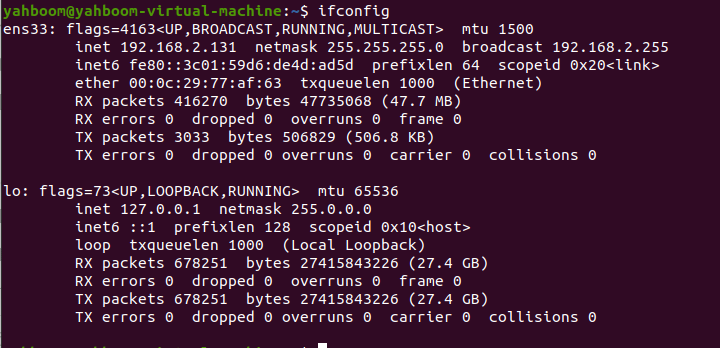
Virtual machine side,

image-20231025115453254

The address found is 192.168.2.131

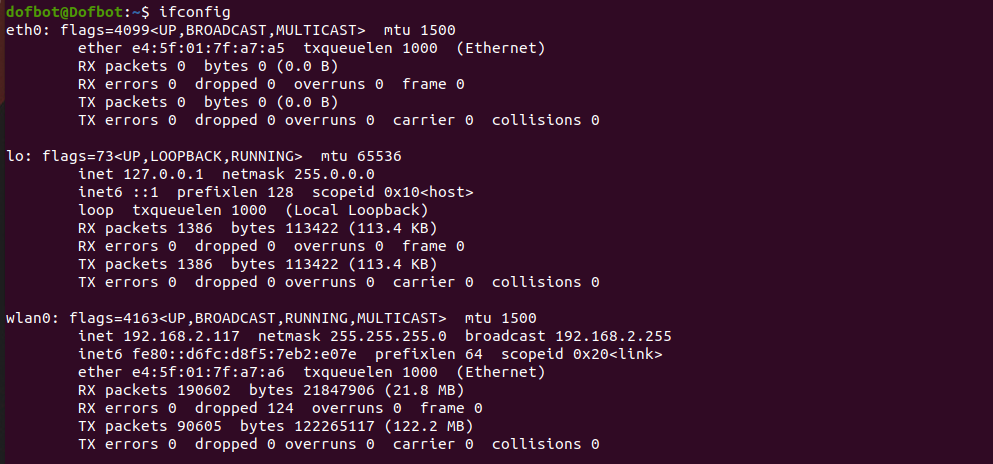
Raspberry Pi side,

xxxxxxxxxx
ifconfig

image-20231025120113573

The found address is 192.168.2.117

22.2 Modify configuration file

22.2.1 Virtual machine side

Taking the virtual machine as a slave machine as an example, you need to modify the ROS_MASTER_URI of the virtual machine to the Raspberry Pi IP. Here is the 192.168.2.117 you just queried, enter it in the terminal,

xxxxxxxxxx
sudo gedit ~/.bashrc

After entering the password, add it at the bottom of the file,

xxxxxxxxxx
export ROS_MASTER_URI=http://192.168.2.117:11311
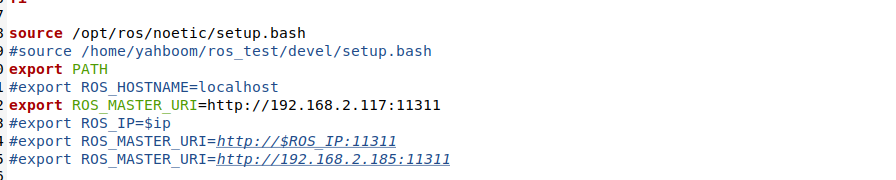
image-20231025151710358

Exit after saving and reopen the terminal to refresh the environment variables to take effect.

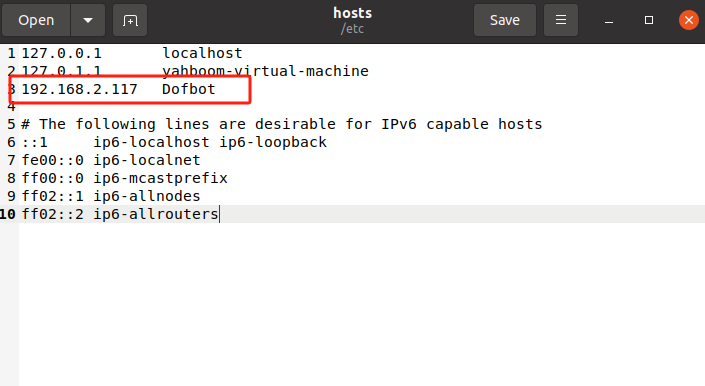
Then, modify the/etc/hosts file,

xxxxxxxxxx
sudo gedit /etc/hosts

image-20231025121908941

As shown in the picture above, add the Raspberry Pi's IP and machine name, save and exit.

22.2.2 Raspberry Pi terminal

The modified files and steps are almost the same as above. The only differenc

gazebo introduction
Instructions before use

COMPANY

  • About us
  • Team Style
  • Blog

LEARNING & EXPLORATION

  • Tutorials
  • Edge AI hardware
  • Educational robots
  • Embedded intelligent hardware

WHERE TO BUY

  • Yahboom Online Store
  • Amazon
  • Alibaba
  • AliExpress
  • Mercado

TECHNOLOGY SUPPORT

  • Email: support@yahboom.com

BE A DISTRIBUTOR

  • Email: sales@yahboom.com
QR Code
QR Code

Copyright © 2017-2026 Yahboom. All Rights Reserved.

EN/中文