yahboom
HomeTutorialsProduct
Solution
Blog
Online Store
About Us
EN/中文
Store
DOFBOT Pro📖
1. Get started quickly
  • 0.Unboxing introduction video
  • 1. First Trial
  • 2. Analysis of common problems
  • 3. Calibration offset
  • 4. Jetpack old system upgraded to SUPER system
  • 5. Precautions for DIY Robotic Arm
  • 6. Jetson Nano Version – Must Read
  • 7.Robotic arm gripping anomaly solutions
2. Assembly course
  • 1. Installation video
  • 2. Calibrate the Robotic Arm
  • 3. Install the map
3. Remote control course
  • 1. Mobile APP control
  • 2. USB handle control
  • 3. PC web page programming
4. Preparation
  • 1. Manage APP control services
  • 2. Manage JupyterLab services
  • 3. Manage OLED services
  • 4. Modifying ROS_DOMAIN_ID for Multi-Machine
5. 2D visual tracking course
  • 1. Color block positioning
  • 2. Color block tracking
  • 3. Face positioning
  • 4. Face tracking
  • 5. Label code positioning
  • 6. Label code tracking
6. 2D visual grabbing course
  • 1. Identify grab color block
  • 2. Catch game
  • 3. Color sorting
  • 4. Color stacking
  • 5. Label code sorting
  • 6. Label code stacking
  • 7. Identify gesture grab color block
  • 8. Gesture stacking
  • 9.1 Single garbage sorting(Jetson-Nano)
  • 9.2 Single garbage sorting(Orin)
  • 10.1 Garbage sorting(Jetson-Nano)
  • 10.2 Garbage sorting(Orin)
  • 11. Tracking game
7. 2D Mediapipe course
  • 1. Hand detection
  • 2. Posture detection
  • 3. Overall detection
  • 4. Facial Detection
  • 5. Face Detection
  • 6. Face effects
  • 7. 3D Object Recognition
  • 8. Paintbrush
  • 9. Finger control
  • 10. Gesture Recognition
  • 11. Gesture control robotic arm action group
  • 12. Arm posture control robotic arm
  • 13. Palm Targeting
  • 14.1 Robotic arm tracks the palm(Jetson-Nano)
  • 14.2 Robotic arm tracks the palm(Orin)
  • 15. Fingertip trajectory recognition
  • 16. Fingertip trajectory control robotic arm
  • 17. Gesture Grasp and Release Objects
  • 18. Finger Control Robot Arm
8. AI Large Model Voice Module (Must Read)new
  • 1. Introduction to AI Large Model Voice Module
  • 2. Flash the firmware (Must read)
  • 3. Modify the wake-up word and command word
9. 2D Voice Control Course
  • 1.Simple Voice Control
  • 2.Smart Voice Control
  • 3.Voice Action Control
  • 4.Memory Learning Mode
  • 5.Color Recognition with Voice Broadcast
  • 6.Color Recognition and Grasping with Voice Broadcast
  • 7.Color Recognition and Sorting with Voice Broadcast
  • 8.Voice Recognition Target Tracking
  • 9.Voice Control Stacking
  • 10.Voice Control Color Sorting
  • 11.1 Garbage Recognition with Voice Broadcast(Jetson Nano)
  • 11.2 Garbage Recognition with Voice Broadcast(Orin)
  • 12.1 Garbage Sorting with Voice Broadcast(Jetson Nano)
  • 12.2 Garbage Sorting with Voice Broadcast(Orin)
10. 3D Depth Camera Course
  • 1. Dabai_DCW2 camera
  • 2. Deep Pseudo-Color Image
  • 3. Depth camera ranging
  • 4. Color block volume measurement
11. 3D Robotic Arm Control and Inverse Kinematics
  • 1. Robotic arm ROS control
  • 2. Inverse solution
12. 3D Sorting and Grasping Course
  • 1. AprilTag ID sorting
  • 2. AprilTag abnormal height sorting
  • 3. MediaPipe Gesture-AprilTag ID sorting
  • 4. MediaPipe Gesture-AprilTag height sorting
  • 5. MediaPipe Gesture-AprilTag distance sorting
  • 6. Block color sorting
  • 7. Block abnormal height sorting
  • 8. Block different shape sorting
  • 9. Block shape abnormal height sorting
  • 10. Yolov11 garbage sorting(Orin)
13. 3D Tracking and Grasping Course
  • 1. AprilTag Tracking and Grasping
  • 2. Color Block Tracking and Grasping
  • 3. KCF Object Tracking and Grasping
14. 3D Voice Control for Grasping Course (Sorting & Tracking)
  • 1. Voice Control AprilTag ID Sorting
  • 2. Voice Control Remove Height Abnormal AprilTag
  • 3. Voice Control Tracking and Grasping AprilTag
  • 4. Voice Control Color Block Sorting
  • 5. Voice Control Remove Height Abnormal Color Block
  • 6. Voice Control Tracking and Grasping Color Block
  • 7. Voice Control Yolov11 Garbage Recognition Sorting
  • 8. Voice Control Object Tracking and Grasping
15. AI Model Basicsnew
  • 1.AI large model types and principles
  • 2.RAG retrieval enhancement and model training samples
  • 3.Embodied intelligent robot system architecture
  • 4.Embodied intelligent functions core source code
16. AI Model Developmentnew
  • 1.Register a model service provider account
  • 2. Configure API-KEY
  • 3. Introduction to Dify
  • 4. Basic Dify Features
  • 5. Deploy the RAG knowledge base
  • 6. AI Large Model Development - chatbot
  • 7. RAG knowledge base + chatbot
  • 8. AI agent workflow
17. AI Model – Text Versionnew
  • 1. Semantic understand instruction following
  • 2. Multimodal visual understand
  • 3. Text Large Model + robotic arm control
  • 4. Multimodal Large Model+video understanding
  • 5. Multimodal Large Model+robotic arm gripping
  • 6. Multimodal Large Model+robotic arm tracking
  • 7. Multimodal Large Model+robotic arm sorting
  • 8. Multimodal Large Model+robotic arm handling
  • 9. Multimodal Large Model+Color Blocks Back In Place
  • 10. Multimodal Large Model + Intent Prediction + Robotic Arm Gripping
  • 11. Text Large Model + YOLOv11 + Intelligent Garbage Classification
18. AI Model – Voice Versionnew
  • 1. Semantic understand instruction following
  • 2. Multimodal visual understand
  • 3. Text Large Model + robotic arm control
  • 4. Multimodal Large Model+video understanding
  • 5. Multimodal Large Model+robotic arm gripping
  • 6. Multimodal Large Model+robotic arm tracking
  • 7. Multimodal Large Model+robotic arm sorting
  • 8. Multimodal Large Model+robotic arm handling
  • 9. Multimodal Large Model+Color Blocks Back In Place
  • 10. Multimodal Large Model + Intent Prediction + Robotic Arm Gripping
  • 11. Text Large Model + YOLOv11 + Intelligent Garbage Classification
19. AI Model – Fun Applicationsnew
  • 1.AI Butler-Intent Inference
  • 2.AI Encyclopedia-Arithmetic Master
  • 3.AI Encyclopedia-You asked I Pointed
  • 4.AI Encyclopedia-Nutritional Analysis
  • 5.AI Encyclopedia-Problem Solving Expert
  • 6.AI Encyclopedia-English Spelling
  • 7.AI Butler-Garbage Sorting
  • 8.AI Top Chef
20. MoveIt Course
  • 1. MoveIt Configuration
  • 2. MoveIt Usage
  • 3. MoveIt Drive Real Robot
  • 4. MoveIt Random Movement
  • 5. MoveIt Forward Kinematics Design
  • 6. MoveIt Inverse Kinematics Design
  • 7. MoveIt Cartesian Path
  • 8. MoveIt Scene Design
  • 9. MoveIt Trajectory Planning
  • 10. MoveIt Collision Detection
21. YOLOv11 Development Course (ORIN)
  • 1. YOLO Environment Setup
  • 2. CLI Usage
  • 3. Object Detection
  • 4. Instance Segmentation
  • 5. Pose Estimation
  • 6. Image Classification
  • 7. Oriented Bounding Boxes Object Detection
  • 8. Model Conversion
  • 9. Dataset Annotation
  • 10. Model Training_Conversion
  • 11. Model Prediction
22. YOLOv11 Development Course (Jetson Nano)
  • 1. YOLO Environment Setup
  • 2. CLI Usage
  • 3. Object Detection
  • 4. Instance Segmentation
  • 5. Pose Estimation
  • 6. Image Classification
  • 7. Oriented Bounding Boxes Object Detection
  • 8. Model Conversion
  • 9. Model Prediction
23. Linux Operating System
  • 1.Introduction to Linux system
  • 2.Ubuntu file system
  • 3.Ubuntu common commands
  • 4.Ubuntu common editors
  • 5.Ubuntu software operation commands
  • 6.Virtual machine installation
  • 7.SSH remote control
  • 8.VNC remote control
  • 9.Transfer files remotely
  • 10.Driver library and communication
  • 11.Static IP and hotspot mode
  • 12.Bind device ID
  • 13.Capacity expansion and resource allocation
  • 14.Update system software sources
  • 15.Set root user password
  • 16.sudo free password
  • 17.Connect to WiFi network
  • 18.View system version
  • 19.Customized service management
  • 20.Back up system image
24. Basic Control Course
  • 1. Control RGB Light
  • 2. Control Buzzer
  • 3. Control Single Servo
  • 4. Read Servo Angle
  • 5. Control All Servos
  • 6. DOFBOT Up Down Left Right Movement
  • 7.DOFBOT dancing
  • 8. DOFBOT Memory Actions
  • 9. DOFBOT Grab Blocks
  • 10. Porter
  • 11. Stack Blocks
  • 12. Two DOFBOT Synchronized Actions
25. Jetson Board Basic Course
  • 1. Jetson board Introduction
  • 2. Write system image
  • 3. Re-write system image
  • 4. System startup
  • 5. System and desktop introduction
  • 6. System expansion
  • 7. Network Configuration
  • 8. SSH remote login and file transfer
  • 9. VNC Remote Login
  • 10. System backup
  • 11. Increased swap space
  • 12. Use of Jtop
26. GPIO Hardware Control Course
Jetson Nano
  • 1.GPIO library API usage
  • 2. Hardware library configuration
  • 3. Pin reading function
  • 4. Pin level output control
  • 5. Control LED
  • 6. External device serial communication
  • 7.I2C communication
Jetson Orin Nano_NX
  • 1.GPIO description
  • 2.GPIO library installation
  • 3.GPIO reading
  • 4.GPIO output
  • 5.Serial communication
  • 6.I2C communication
27. OpenCV Course
  • 1. Introduction to Open Source CV
  • 2. Image reading and display
  • 3. Image writing
  • 4. Image quality
  • 5. Pixel Operation
  • 6. Image zoom
  • 7. Picture cut
  • 8. Picture pan
  • 9. Picture mirroring
  • 10. Affine transformation
  • 11. Picture rotation
  • 12. Perspective transformation
  • 13. Grayscale processing
  • 14. Binary image
  • 15. Edge green detection
  • 16. Line segment drawing
  • 17. Rectangular circle drawing
  • 18. Text and picture drawing
28. Visual Basics Course
  • 1. Camera display
  • 2. Color Calibration
  • 3. Color recognition
  • 4. Face Detection
  • 5.1 Garbage Identification(Jetson-Nano)
  • 5.2 Garbage Identification(Orin)
  • 6.1 Object Recognition(Jetson-Nano)
  • 6.2 Object Recognition(Orin)
  • 7. Label code recognition
  • 8.PID algorithm basics
29. ROS2 Basic Course
  • 1.Introduction to ROS2
  • 2.ROS2 install Humble
  • 3.ROS2 development environment
  • 4.ROS2 workspace
  • 5.ROS2 function package
  • 6.ROS2 node
  • 7.ROS2 Topic Communication
  • 8.ROS2 service communication
  • 9.ROS2 action communication
  • 10.ROS2 custom interface message
  • 11.ROS2 parameter service case
  • 12.ROS2 meta-function package
  • 13.ROS2 distributed communication
  • 14.ROS2 DDS
  • 15.ROS2 time related API
  • 16.ROS2 common command tools
  • 17.ROS2 rviz2 use
  • 18.ROS2 rqt toolbox
  • 19.ROS2 Launch startup file configuration
  • 20.ROS2 recording and playback tool
  • 21.ROS2 URDF model
  • 22.ROS2 Gazebo simulation platform
  • 23.ROS2 TF2 coordinate transformation
30. Visual Advanced Course
  • 1.QR code
  • 2.Human pose estimation
  • 3.Target Detection
  • 4.AR vision
  • 5.ROS+Opencv basics
  • 6.AR QR code
  • 7.Face recognition
  • 8.harris corner detection
  • 9.Target tracking algorithm
  • 10.Contour moment
  • 11.Polygon outline
  • 12.Discrete fourier transform algorithm
  • 13.Edge detection algorithm
  • 14.Face detection algorithm
  • 15.Optical flow detection algorithm
  • 16.Contour detection
  • 17.General contour detection
  • 18.Feature point tracking
  • 19.HLS color filtering
  • 20.Hough circle detection
  • 21.Hough linear detection
  • 22.HSV color filtering
  • 23.LK optical flow algorithm
  • 24.detection algorithm
  • 25.Phase dependent displacement detection
  • 26.Image pyramid sampling algorithm
  • 27.RGB color filtering
  • 28.Clear background detection algorithm
  • 29.Simplified optical flow algorithm
  • 30.Simple filter
  • 31.Threshold image processing
  • 32.Watershed segmentation algorithm
31. Jupyter Lab Usage Course
  • 1. Read the document before operation
  • 2. Jupyter lab environment construction tutorial
  • 3. Basic tutorial of Jupyter lab
  • 4. Jupyter widgets configuration tutorial
  • 5. Getting Started Tutorial for JupyterWidgets Controls
Download
  • APP(Android/iOS)
  • SystemFile_OrinNANOSUPER
  • SystemFile_OrinNXSUPER
  • SystemFile_NANO4GB_SUB
  • VM_File
  • Code
  • Instruction_Manual
  • Hardware_Info
  • 3D_Model_File
  • ROS2_Basic_VM
  • Tools
Download ZIP

Welcome to DOFBOT Pro repository

5. MediaPipe Gesture-AprilTag distance sorting

Mediapipe Gesture-AprilTag Distance Sorting

Before starting this function, you need to close the large program and APP processes. If you need to restart the large program and APP later, start them from the terminal:

bash ~/dofbot_pro/APP_DOFBOT_PRO/start_app.sh

1. Function Description

After the program starts, the camera captures images and recognizes gestures. Gestures range from 1 to 5. Through the recognized gesture, the distance threshold is calculated; the robotic arm will change its posture to detect AprilTags in the image and calculate their height and distance. If any are smaller than the distance threshold, the robotic arm will lower the gripper to grasp and place them at the set position, then return to the AprilTag detection posture to continue recognition; if no AprilTag smaller than the distance threshold is detected, the robotic arm will perform a "head shaking" action group, then the robotic arm returns to the gesture recognition posture.

The wooden blocks used in this lesson are 30x30x30mm and 30x30x60mm Machine Code blocks.

2. Startup and Operation

2.1. Startup Commands

xxxxxxxxxx
#Start camera:
ros2 launch orbbec_camera dabai_dcw2.launch.py
#Start underlying control:
ros2 run dofbot_pro_driver arm_driver
#Start inverse kinematics program:
ros2 run dofbot_pro_info kinemarics_dofbot
#Start image conversion program:
ros2 run dofbot_pro_apriltag msgToimg
#Start AprilTag recognition program:
ros2 run dofbot_pro_apriltag apriltag_list_Dist
#Start robotic arm grasping program:
ros2 run dofbot_pro_driver grasp 
#Start Mediapipe gesture recognition program:
ros2 run dofbot_pro_apriltag MediapipeGesture
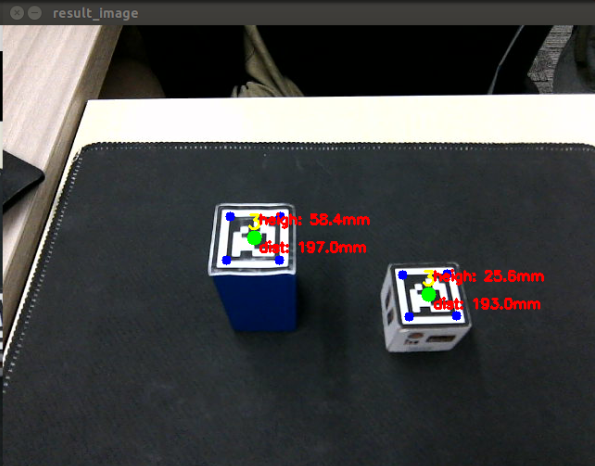
image-20240925191906089

2.2. Operation

After the program starts, the robotic arm will initially present a gesture recognition posture. The recognizable gestures range from one to five. Gesture recognition waits for about 3 seconds, waiting for the AprilTag to change posture to the AprilTag detection and recognition posture. Press the spacebar to start recognition; if a AprilTag with distance smaller than the calculated distance threshold is recognized, the robotic arm will lower the gripper to grasp that AprilTag block and place it at the set position; after placement is complete, the robotic arm returns to the AprilTag recognition posture. The next recognition requires pressing the spacebar again. If no AprilTag smaller than the set distance threshold is recognized, the robotic arm will perform a "head shaking" action group, then the robotic arm returns to the gesture recognition posture.

Distance threshold calculation: 170 + gesture recognition result * 10

3. Program Flowchart

apriltag_list_Dist.py

4. Core Code Analysis

4.1. MediapipeGesture.py

Code path:

xxxxxxxxxx
/home/jetson/dofbot_pro_ws/src/dofbot_pro_apriltag/dofbot_pro_apriltag/MediapipeGesture.py

You can refer to section 4.1 [MediapipeGesture.py] in tutorial [3D Space Sorting and Grasping\3. Mediapipe Gesture-AprilTag ID Sorting].

4.2. apriltag_list_Dist.py

Code path:

xxxxxxxxxx
/home/jetson/dofbot_pro_ws/src/dofbot_pro_apriltag/dofbot_pro_apriltag/apriltag_list_Dist.py

Import necessary libraries

​x
import cv2
import rclpy
from rclpy.node import Node
import numpy as np
from message_filters import ApproximateTimeSynchronizer, Subscriber
from sensor_msgs.msg import Image
from std_msgs.msg import Float32, Int8, Bool
from dt_apriltags import Detector
from dofbot_pro_apriltag.vutils import draw_tags
from cv_bridge import CvBridge
import cv2 as cv
from dofbot_pro_interface.srv import *  
from dofbot_pro_interface.msg import ArmJoint, AprilTagInfo
import pyzbar.pyzbar as pyzbar
import time
import queue
import math
import os
encoding = ['16UC1', '32FC1']
import threading
#Import transforms3d library for handling transformations in 3D space, performing conversions between quaternions, rotation matrices and Euler angles, supporting 3D
import transforms3d as tfs
#Import transformations for handling and calculating transformations in 3D space, including conversions between quaternions and Euler angles
import tf_transformations as tf   
from Arm_Lib import Arm_Device
​

Program parameter initialization, create publishers and subscribers

xxxxxxxxxx
def __init__(self):
    rospy.init_node('apriltag_detect')
   super().__init__('apriltag_detect') 
​
         # Initialize parameters
        self.detect_joints = [90.0, 150.0, 12.0, 20.0, 90.0, 30.0]
        self.init_joints = [90.0, 120.0, 0.0, 0.0, 90.0, 90.0]
        self.search_joints = [90.0, 120.0, 0.0, 0.0, 90.0, 30.0]
        self.Arm = Arm_Device()
        
        # ROS2 publishers
        self.pubGraspStatus = self.create_publisher(Bool, "grasp_done", 1)
        self.tag_info_pub = self.create_publisher(AprilTagInfo, "PosInfo", 1)
        self.pubPoint = self.create_publisher(ArmJoint, "TargetAngle", 1)
        
        # ROS2 subscribers (message synchronization)
        self.depth_image_sub  = Subscriber(self, Image, "/camera/color/image_raw", qos_profile=1)
        self.rgb_image_sub = Subscriber(self, Image, "/camera/depth/image_raw", qos_profile=1)
        self.TimeSynchronizer = ApproximateTimeSynchronizer([self.depth_image_sub, self.rgb_image_sub],queue_size=10,slop=0.5)
        self.TimeSynchronizer.registerCallback(self.TagDetect)
​
        # ROS2 other subscribers
        self.grasp_status_sub = self.create_subscription(Bool, 'grasp_done', self.GraspStatusCallback, 1)
        self.sub_targetID = self.create_subscription(Int8, "TargetId", self.GetTargetIDCallback, 1)
        
        # Initialize tools
        self.rgb_bridge = CvBridge()
        self.depth_bridge = CvBridge()
        self.pubPos_flag = False
        self.done_flag = True
​
        self.set_height = 40.0
        self.set_dist = 0.0 
        self.detect_flag = False
        
        # AprilTag detector (configuration remains unchanged)
        self.at_detector = Detector(
            searchpath=['apriltags'],
            families='tag36h11',
            nthreads=8,
            quad_decimate=2.0,
            quad_sigma=0.0,
            refine_edges=1,
            decode_sharpening=0.25,
            debug=0
        )
        self.target_id = 0
        self.pr_time = time.time()
        self.cnt = 0
        self.Center_x_list = []
        self.Center_y_list = []
        self.search_joints = [90.0,150.0,12.0,20.0,90.0,30.0]
​
        self.CurEndPos = [-0.006,0.116261662208,0.0911289015753,-1.04719,-0.0,0.0]
        self.camera_info_K = [477.57421875, 0.0, 319.3820495605469, 0.0, 477.55718994140625, 238.64108276367188, 0.0, 0.0, 1.0]
        self.EndToCamMat = np.array([[1.00000000e+00,0.00000000e+00,0.00000000e+00,0.00000000e+00],
                                     [0.00000000e+00,7.96326711e-04,9.99999683e-01,-9.90000000e-02],
                                     [0.00000000e+00,-9.99999683e-01,7.96326711e-04,4.90000000e-02],
                                     [0.00000000e+00,0.00000000e+00,0.00000000e+00,1.00000000e+00]])

Main image processing function TagDetect

xxxxxxxxxx
def TagDetect(self,color_frame,depth_frame):
    #rgb_image
    # Receive the color image topic message and convert the message data into image data
    rgb_image = self.rgb_bridge.imgmsg_to_cv2(color_frame,'rgb8')
    result_image = np.copy(rgb_image)
    #depth_image
    # Receive the depth image topic message and convert the message data into image data
    depth_image = self.depth_bridge.imgmsg_to_cv2(depth_frame, encoding[1])
    frame = cv.resize(depth_image, (640, 480))
    depth_image_info = frame.astype(np.float32)
    # Call the detect function, passing in parameters,
    '''
    cv2.cvtColor(rgb_image, cv2.COLOR_RGB2GRAY): Converts the RGB image to a grayscale image for tag detection.
    False: Indicates not to estimate the pose of the tag.
    None: Indicates that no camera parameters are provided, possibly only for simple detection.
    0.025: May be the set tag size (unit is usually meters) to help the detection algorithm determine the size of the tag.
    Returns a detection result, including the position, ID, and bounding box of each tag.
    '''
    tags = self.at_detector.detect(cv2.cvtColor(rgb_image, cv2.COLOR_RGB2GRAY), False, None, 0.025)
    # Sort the tags in tags, this is not a necessary step
    tags = sorted(tags, key=lambda tag: tag.tag_id) # It seems that the output is already sorted in ascending order, so manual sorting is not required
    # Call the draw_tags function to draw information related to the recognized machine code on the color image, including corner points, center point, and id value
    draw_tags(result_image, tags, corners_color=(0, 0, 255), center_color=(0, 255, 0))
    key = cv2.waitKey(10)
    # Define the length of self.Center_x_list and self.Center_y_list
    self.Center_x_list = list(range(len(tags)))
    self.Center_y_list = list(range(len(tags)))
    # Wait for keyboard input, 32 means space bar is pressed. After pressing, change the value of self.pubPos_flag to indicate that machine code related information can be published
    if key == 32:
        self.pubPos_flag = True
    # Judge the length of tags. If it is greater than 0, it means that a machine code has been detected and the flag for completing the grasping of the machine code is set
    if len(tags) > 0 and self.done_flag == True:
        # Iterate through the machine codes
        for i in range(len(tags)):
            # The center xy values of the machine code are stored in the Center_x_list and Center_y_list lists
            center_x, center_y = tags[i].center
            self.Center_x_list[i] = center_x
            self.Center_y_list[i] = center_y
            cx = center_x
            cy = center_y
            # Calculate the depth value of the center coordinate
            cz = depth_image_info[int(cy),int(cx)]/1000
            # Call the compute_heigh function to calculate the height of the machine code. The input parameters are the center coordinates of the machine code and the depth value of the center point. It returns a position list, where pose[2] represents the z value, which is the height value
            pose = self.compute_heigh(cx,cy,cz)
            # Magnify the height value and convert the unit to millimeters
            heigh_detect = round(pose[2],4)*1000 
            heigh = 'heigh: ' + str(heigh_detect) + 'mm'
            # Calculate the distance of the machine code from the base coordinate system, magnify the value, and convert the unit to millimeters
            dist_detect = math.sqrt(pose[1] ** 2 + pose[0]** 2)
            dist_detect = round(dist_detect,3)*1000
            dist = 'dist: ' + str(dist_detect) + 'mm'
            # Use opencv to draw the height and distance values on the color image
            cv.putText(result_image, heigh, (int(cx)+5, int(cy)-15), cv.FONT_HERSHEY_SIMPLEX, 0.5, (255, 0, 0), 2)
            cv.putText(result_image, dist, (int(cx)+5, int(cy)+15), cv.FONT_HERSHEY_SIMPLEX, 0.5, (255, 0, 0), 2)
            # If the detected machine code height is greater than the set height threshold, self.pubPos_flag is True, and the set height threshold is not 0
            if heigh_detect>=self.set_height and self.set_height!=0 and self.pubPos_flag == True:
                print("self.set_height: ",self.set_height)
                print("heigh_detect: ",heigh_detect)
                # Change the value of self.detect_flag. True means that a machine code higher than the set threshold has been recognized
                self.detect_flag  = True
                # Assign values to the message data. The id is the machine code id, x and y are the center values of the machine code, and z is the depth value of the center point. Here, it is scaled down by a factor of 1000, and the unit is meters
                tag = AprilTagInfo()
                tag.id = tags[i].tag_id
                tag.x = self.Center_x_list[i]
                tag.y = self.Center_y_list[i]
                tag.z = depth_image_info[int(tag.y),int(tag.x)]/1000
                # If the depth information is not 0, it means the data is valid, and then publish the machine code information message
                if tag.z!=0 :
                    self.tag_info_pub.publish(tag)
                    self.pubPos_flag = False
                    self.done_flag = False
                else:
                    print("Invalid distance.")
        # If self.detect_flag is False, it means that no machine code higher than the height threshold has been recognized, the set height threshold is not 0, and publishing of machine code messages is enabled. If these three conditions are met, it means that no machine code higher than the height threshold has been recognized.
        if self.detect_flag != True and  self.set_height!=0 and self.pubPos_flag==True:
            print("----------------------------------------")
            self.set_height!=0
            # The robotic arm performs a "head shaking" action group
            self.shake()
            #time.sleep(2)
            # Return to the gesture recognition posture to prepare for the next gesture recognition
            self.pub_arm(self.search_joints)
            # Publish the grasp completion topic so that the gesture recognition node program can publish the result of the next gesture recognition
            grasp_done = Bool()
            grasp_done.data = True
            self.pubGraspStatus.publish(grasp_done)
        self.pubPos_flag = False     
# If no machine code is recognized after pressing the space bar, the robotic arm will also perform the "head shaking" action group and then return to the gesture recognition posture
    elif self.pubPos_flag == True and len(tags) == 0:
        self.shake()
        self.pub_arm(self.search_joints)
        grasp_done = Bool()
        grasp_done.data = True
        self.pubGraspStatus.publish(grasp_done)
    result_image = cv2.cvtColor(result_image, cv2.COLOR_RGB2BGR)
    cv2.imshow("result_image", result_image)
    key = cv2.waitKey(1)

Gesture recognition result callback function GetTargetIDCallback

xxxxxxxxxx
def GetTargetIDCallback(self,msg):
    print("msg.data: ",msg.data)
    #Calculate distance threshold unit is millimeters mm, minimum is 160mm, maximum is 200mm
    self.set_dist = 150 + msg.data*10
    #Calculate height threshold unit is millimeters mm, minimum is 40mm, maximum is 80mm
    self.set_height = 30 + msg.data*10
    print("self.set_height: ",self.set_height)
    #After receiving message, change robotic arm posture to present AprilTag recognition posture
    self.pub_arm(self.init_joints)

4.3. grasp.py

You can refer to section 4.2 [grasp.py] in tutorial [3D Space Sorting and Grasping\1. AprilTag ID Sorting].

MediaPipe Gesture-AprilTag height sorting
Block color sorting

COMPANY

  • About us
  • Team Style
  • Blog

LEARNING & EXPLORATION

  • Tutorials
  • Edge AI hardware
  • Educational robots
  • Embedded intelligent hardware

WHERE TO BUY

  • Yahboom Online Store
  • Amazon
  • Alibaba
  • AliExpress
  • Mercado

TECHNOLOGY SUPPORT

  • Email: support@yahboom.com

BE A DISTRIBUTOR

  • Email: sales@yahboom.com
QR Code

Copyright © 2017-2026 Yahboom. All Rights Reserved.

EN/中文