yahboom
HomeLearn
Solution
Blog
Online Store
About Us
EN/中文
JetCobot📖
1.Introduction to the Jetcobot
  • 0.Unboxing
  • 1 Version Configuration Instructions
  • 2. Power adapter usage specifications
  • 3. Common Problems and Solutions
  • 4. First-time use instructions
  • 5. Get started
  • 6. Open and close the virtual desktop
2.Assembly and assembly tutorial
  • Installation Video
3.Linux operating system
  • 1.Introduction to Linux system
  • 2.Ubuntu file system
  • 3.Ubuntu common commands
  • 4.Ubuntu common editors
  • 5.Ubuntu software operation commands
  • 6.Virtual machine installation
  • 7.SSH remote control
  • 8.VNC remote control
  • 9.Transfer files remotely
  • 10.Driver library and communication
  • 11.Static IP and hotspot mode
  • 12.Bind device ID
  • 13.Capacity expansion and resource allocation
  • 14.Update system software sources
  • 15.Set root user password
  • 16.sudo free password
  • 17.Connect to WiFi network
  • 18.View system version
  • 19.Customized service management
  • 20.Back up system image
4.Jupyter Lab Basic Course
  • 1. Read the document before operation
  • 2. JupyterLab environment construction tutorial
  • 3. JupyterLab Basic Usage Tutorial
  • 4. JupyterWidgets Configuration Tutorial
  • 5. Getting Started Tutorial for JupyterWidgets Controls
5.Basic courses of main control board
  • 1. Introduction to the main control board
  • 2. Burn the system image
  • 3. Re-read the burned image
  • 4. System startup
  • 5. System and desktop introduction
  • 6. System expansion
  • 7. Network Configuration
  • 8. SSH remote login and file transfer
  • 9. VNC Remote Login
  • 10. System backup
  • 11. Increased swap space
  • 12. Use of Jtop
6.GPIO hardware control course
  • 1.GPIO library API usage
  • 2. Hardware library configuration
  • 3. Pin reading function
  • 4. Pin level output control
  • 5. Control LED
  • 6. External device serial communication
  • 7.I2C communication
7.Jetson-inference vision course
  • 1. Install Jetcam (optional)
  • 2. Install TensorFlow (optional)
  • 3. Jetson-inference environment construction (optional)
  • 4. Hello AI World
  • 5. Image Classification Reasoning
  • 6. Object Detection Reasoning
  • 7. Semantic Segmentation
8.Opencv basic course
  • 1. Introduction to Open Source CV
  • 2. Image reading and display
  • 3. Image writing
  • 4. Image quality
  • 5. Pixel Operation
  • 6. Image zoom
  • 7. Picture cut
  • 8. Picture pan
  • 9. Picture mirroring
  • 10. Affine transformation
  • 11. Picture rotation
  • 12. Perspective transformation
  • 13. Grayscale processing
  • 14. Binary image
  • 15. Edge green detection
  • 16. Line segment drawing
  • 17. Rectangular circle drawing
  • 18. Text and picture drawing
9.ROS Basic Course
  • 1.ROS introduction
  • 2.ROS installation
  • 3.ROS common command tools
  • 4.ROS workspace
  • 5.ROS function package
  • 6.ROS node
  • 7.ROS topic publisher
  • 8.ROS topic subscribers
  • 9.ROS service client
  • 10.ROS service server
  • 11.ROS action client
  • 12.ROS action server
  • 13.ROS custom message reception
  • 14.ROS-launch file
  • 15.ROS-TF transformation
  • 16.ROS parameter service
  • 17.ROS-rviz use
  • 18.ROS-rqt tool usage
  • 19.Topic message recording and playback
  • 20.urdf model introduction
  • 21.gazebo introduction
  • 22.ROS distributed communication
10.ROS+OpenCV course
  • 1.QR code
  • 2.Human pose estimation
  • 3.Target Detection
  • 4.AR vision
  • 5.AR QR code
  • 6.ROS+Opencv basics
  • 7.Face recognition
  • 8.harris corner detection
  • 9.Target tracking algorithm
  • 10.Contour moment
  • 11.Polygon outline
  • 12.Discrete fourier transform algorithm
  • 13.Edge detection algorithm
  • 14.Face detection algorithm
  • 15.Optical flow detection algorithm
  • 16.Contour detection
  • 17.General contour detection
  • 18.Feature point tracking
  • 19.HLS color filtering
  • 20.Hough circle detection
  • 21.Hough linear detection
  • 22.HSV color filtering
  • 23.LK optical flow algorithm
  • 24.Detection algorithm
  • 25.Phase dependent displacement detection
  • 26.Image pyramid sampling algorithm
  • 27.RGB color filtering
  • 28.Clear background detection algorithm
  • 29.Simplified optical flow algorithm
  • 30.Simple filter
  • 31.Threshold image processing
  • 32.Watershed segmentation algorithm
11.Robotic arm control course
  • 1.Send data
  • 2.Read data
  • 3.Control robotic arm joint angle
  • 4.Control coordinates of robotic arm end
  • 5.Control robotic arm posture
  • 6.Handle control robotic arm
  • 7.Calibrate robotic arm joint
  • 8.Calibrate robotic arm gripper
12.AI visual basic ourse
  • 1.Camera driver
  • 2.Block color calibration
  • 3.Color recognition
  • 4.Face detection
  • 5.Gesture recognition
  • 6.Model training
  • 7.Garbage recognition
13.Mediapipe course
  • 1.Hand detection
  • 2.Posture detection
  • 3.Overall detection
  • 4.Face detection
  • 5.Face recognition
  • 6.Face effects
  • 7.3D object recognition
  • 8.Brush
  • 9.Finger control
  • 10.Gesture recognition
14.AI visual tracking course
  • 1.PID algorithm basics
  • 2.Color block positioning
  • 3.Color block tracking
  • 4.Face positioning
  • 5.Face tracking
  • 6.Fingertip trajectory recognition
  • 7.Mediapipe gesture control robotic arm action group
  • 8.Mediapipe arm posture control robotic arm
  • 9.Mediapipe palm arm target positioning
  • 10.Mediapipe palm recognition and tracking control robotic arm
  • 11.Apriltag tag code recognition
  • 12.Apriltag tag code tracking
  • 13.KCF object tracking
15.AI visual grabbing course
  • 1.Gesture recognition stacking blocks
  • 2.Color recognition grab blocks
  • 3.Apriltag recognition grabbing blocks
  • 4.Catch game
  • 5.Color sorting
  • 6.Color stacking
  • 7.apriltag sorting
  • 8.apriltag stacking
  • 9.Garbage sorting
  • 10.Garbage stacking
  • 11.Color interaction
16.URDF Model course
  • 1.URDF model of the robotic arm
  • 2.URDF model controls the real robotic arm
17.Kinesiology advanced course
  • 1.Movelt configuration
  • 2.MoveIt control the real machine
  • 3.Moves randomly
  • 4.Movelt kinematic design
  • 5.Movelt cartesian path
  • 6.Movelt collision detection
  • 7.Movelt scene design
18.Jetson Orin SUPER -Introduction to the Jetcobotnew
  • 1. Version Configuration Instructionsnew
  • 2. Power adapter usage specificationsnew
  • 3. Common Problems and Solutionsnew
  • 4. First-time use instructionsnew
  • 5. Get startednew
  • 6. Open and close the virtual desktopnew
19.Jetson Orin SUPER -Assembly and assembly tutorial
  • Installation Videonew
20.Jetson Orin SUPER -Linux operating systemnew
  • 1.Introduction to Linux systemnew
  • 2.Ubuntu file systemnew
  • 3.Ubuntu common commandsnew
  • 4.Ubuntu common editorsnew
  • 5.Ubuntu software operation commandsnew
  • 6.Virtual machine installationnew
  • 7.SSH remote controlnew
  • 8.VNC remote controlnew
  • 9.Transfer files remotelynew
  • 10.Driver library and communicationnew
  • 11.Static IP and hotspot modenew
  • 12.Bind device IDnew
  • 13.Capacity expansion and resource allocationnew
  • 14.Update system software sourcesnew
  • 15.Set root user passwordnew
  • 16.sudo free passwordnew
  • 17.Connect to WiFi networknew
  • 18.View system versionnew
  • 19.Customized service managementnew
  • 20.Back up system imagenew
21.Jetson Orin SUPER -Jupyter Lab Basic Course
  • 1. Read the document before operationnew
  • 2. JupyterLab environment construction tutorialnew
  • 3. JupyterLab Basic Usage Tutorialnew
  • 4. JupyterWidgets Configuration Tutorialnew
  • 5. Getting Started Tutorial for JupyterWidgets Controlsnew
22.Jetson Orin SUPER -Basic motherboard usage course
  • 1. Motherboard Introductionnew
  • 2. Restore the factory image systemnew
  • 3. System startupnew
  • 4. System and desktop introductionnew
  • 5.VNC Remote Controlnew
  • 6. System expansionnew
  • 7. Network Configurationnew
  • 8.SSH remote loginnew
  • 9. Remote file transfernew
  • 10. Chinese input methodnew
  • 11. Use of Jtop toolnew
  • 12. Swap space expansionnew
  • 13.Backup SSD systemnew
  • 14.Jetpack old system upgraded to SUPER system
23.Jetson Orin SUPER -GPIO hardware control course
  • 1.GPIO library API usagenew
  • 2.Hardware library configurationnew
  • 3.Pin reading functionnew
  • 4.Pin level output controlnew
  • 5.Control LEDnew
  • 6.External device serial communicationnew
  • 7.I2C communicationnew
24.Jetson Orin SUPER -YOLO11 development
  • 01.YOLO environment constructionnew
  • 02.CLI usenew
  • 03.Object detection
  • 04.Instance segmentationnew
  • 05.Pose estimationnew
  • 06.Image classificationnew
  • 07.Oriented object detectionnew
  • 08.Model conversionnew
  • 09.Dataset annotationnew
  • 10.Model training conversionnew
  • 11.Model predictionnew
25.Jetson Orin SUPER -OpenCV course
  • 1. Introduction to Open Source CVnew
  • 2. Image reading and displaynew
  • 3. Image writingnew
  • 4. Image qualitynew
  • 5. Pixel Operationnew
  • 6. Image zoomnew
  • 7. Picture cutnew
  • 8. Picture pannew
  • 9. Picture mirroringnew
  • 10. Affine transformationnew
  • 11. Picture rotationnew
  • 12. Perspective transformationnew
  • 13. Grayscale processingnew
  • 14. Binary imagenew
  • 15. Edge green detectionnew
  • 16. Line segment drawingnew
  • 17. Rectangular circle drawingnew
  • 18. Text and picture drawingnew
26.Jetson Orin SUPER -ROS2 basic course
  • 1. Introduction to ROS2new
  • 2.ROS2 install Humblenew
  • 3.ROS2 development environmentnew
  • 4.ROS2 workspacenew
  • 5.ROS2 function packagenew
  • 6.ROS2 nodenew
  • 7.ROS2 topic communicationnew
  • 8.ROS2 service communicationnew
  • 9.ROS2 action communicationnew
  • 10.ROS2 custom interface messagenew
  • 11.ROS2 parameter service casenew
  • 12.ROS2 meta-function packagenew
  • 13.ROS2 distributed communicationnew
  • 14.ROS2 DDSnew
  • 15.ROS2 time related APInew
  • 16.ROS2 common command toolsnew
  • 17.ROS2 rviz2 usenew
  • 18.ROS2 rqt toolboxnew
  • 19.ROS2 Launch startup file configurationnew
  • 20.ROS2 recording and playback toolnew
  • 21.ROS2 URDF modelnew
  • 22.ROS2 Gazebo simulation platformnew
  • 23.ROS2 TF2 coordinate transformationnew
27.Jetson Orin SUPER -Advanced vision course
  • 1.QR codenew
  • 2.Human pose estimationnew
  • 3.Target Detectionnew
  • 4.AR visionnew
  • 5.ROS+Opencv Basicsnew
28.Jetson Orin SUPER -Robotic Arm Control Course
  • 1. Sending Datanew
  • 2. Read datanew
  • 3. Control the joint angle of the robotic armnew
  • 4. Control the coordinates of the end of the robot armnew
  • 5. Control the posture of the robotic armnew
  • 6.Handle remote control robotic armnew
  • 7. Calibrate the robot arm jointsnew
  • 8. Calibrate the robot grippernew
29.Jetson Orin SUPER -AI Vision Basic Course
  • 1. Camera drivernew
  • 2. Color threshold adjustment and color block calibrationnew
  • 3. Color recognitionnew
  • 4. Face Detectionnew
  • 5. Gesture Recognitionnew
  • 6. Garbage Identificationnew
30.Jetson Orin SUPER -Mediapipe Development Course
  • 1. Hand detectionnew
  • 2. Posture detectionnew
  • 3. Overall detectionnew
  • 4.FaceMeshnew
  • 5. Face Detectionnew
  • 6. Face effectsnew
  • 7. 3D Object Recognitionnew
  • 8. Brushnew
  • 9. Finger controlnew
  • 10. Gesture Recognitionnew
31.Jetson Orin SUPER -AI visual tracking course
  • 1.PID algorithm basicsnew
  • 2. Color block positioning experimentnew
  • 3. Color block tracking experimentnew
  • 4. Face location experimentnew
  • 5. Face tracking experimentnew
  • 6. Fingertip trajectory recognitionnew
  • 7.Mediapipe gesture control robotic arm action groupnew
  • 8.Mediapipe arm posture control robotic armnew
  • 9. Mediapipe palm arm target positioningnew
  • 10. Mediapipe identifies and tracks your palm to control the robotic armnew
  • 11. Apriltag label code recognitionnew
  • 12. Apriltag label code trackingnew
  • 13.KCF Object Trackingnew
32.Jetson Orin SUPER -AI Visual Capture Course
  • 1. Gesture recognition stacking blocksnew
  • 2. Color recognition grab blocksnew
  • 3. Apriltag recognition and grabbing building blocksnew
  • 4.Catch gamenew
  • 5. Color sortingnew
  • 6. Color stackingnew
  • 7. Apriltag sortingnew
  • 8. Apriltag stackingnew
  • 9. Garbage sortingnew
  • 10. Garbage dumpnew
  • 11.Color interactionnew
33.Jetson Orin SUPER -Robotic Arm URDF Model Course
  • 1. Robotic arm URDF modelnew
  • 2. URDF model controls the real robot armnew
34.Jetson Orin SUPER -Moveit advanced kinematics course
  • 1.Movelt Configurationnew
  • 2. Use of MoveItnew
  • 3. MoveIt drives the real machinenew
  • 4. MoveIt Random Movenew
  • 5.Movelt positive kinematics designnew
  • 6.Movelt inverse kinematics designnew
  • 7.Movelt Cartesian pathnew
  • 8.Movelt scene designnew
  • 9.Movelt Collision Detectionnew
35.FAQnew
  • 1.Using your own Jetson board, JetCobot cannot start normally
Download
  • Instruction_Manual
  • SystemFile_for_NANO4GB
  • SystemFile_For_OrinNANO
  • SystemFile_For_OrinNX
  • VM_File
  • Code
  • 3D Model File
  • Jetson_Boot_USB.tar.gz
  • ROS2_Basic_VM
Download ZIP

Welcome to JetCobot repository

1.Movelt Configuration

1. MoveIt2 configuration

Note: The factory image of this course has been configured. If you use the factory image system, you can skip the moveit configuration course.

1.1. Install MoveIt2

xxxxxxxxxx
sudo apt install ros-humble-moveit*

The Jetson Orin series motherboard can run Moveit2 related cases directly on the motherboard, and the overall fluency is acceptable!

Open another terminal.

1.2. Start the assistant

Start MoveIt Setup Assistant:

xxxxxxxxxx
ros2 launch moveit_setup_assistant setup_assistant.launch.py

For the first time, you can choose to create a new MoveIt configuration package. For later simple modifications, you can choose to compile the existing MoveIt software package:
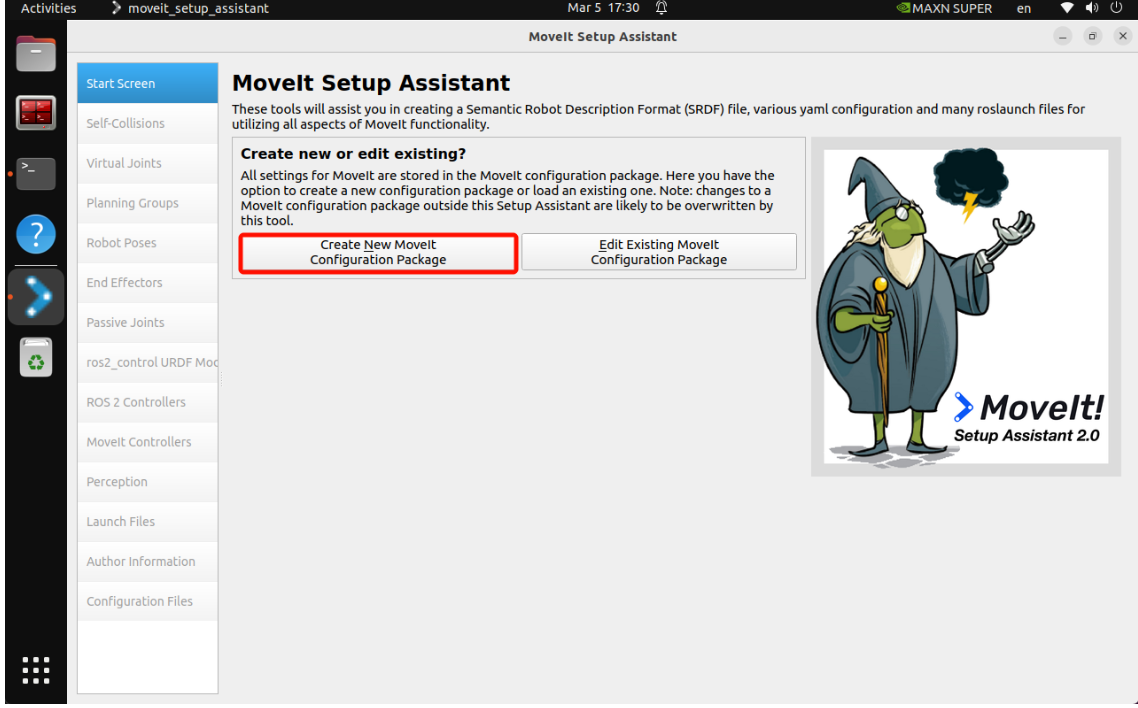
image-20250506152807162

To create a new MoveIt configuration package, you need to import the robot's URDF model: Simply importing the URDF model file into the MoveIt assistant will result in an error. You need Use the compiled software package (jetcobot_description) URDF file path
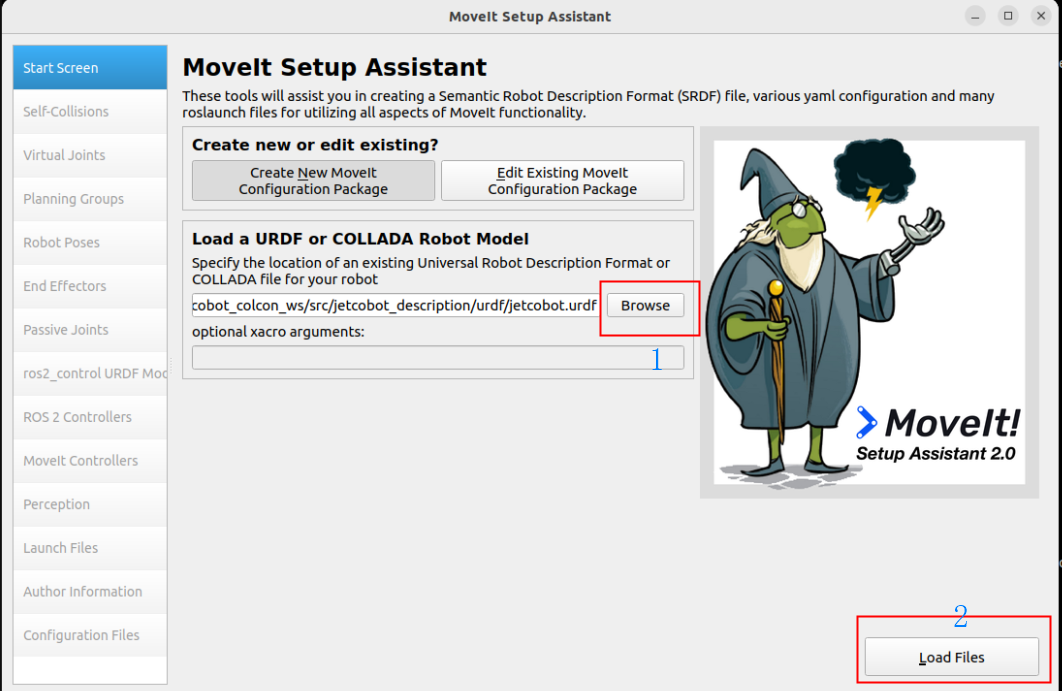
image-20250506152843350

After selecting the URDF file, click Load File, and the MoveIt assistant will display the robot model:
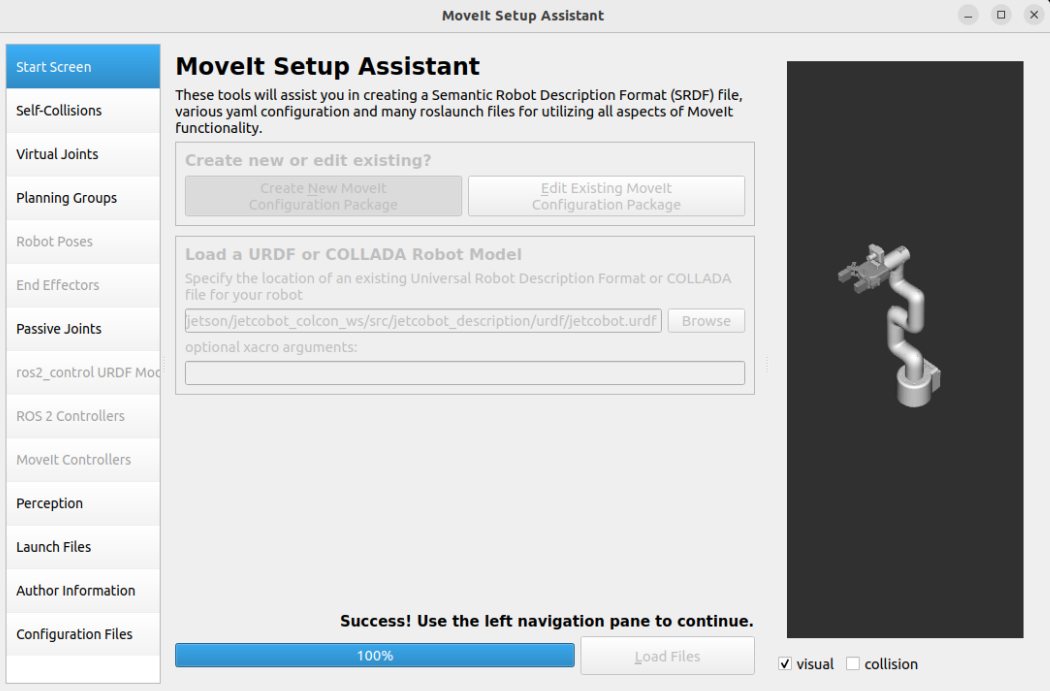
image-20250506152936827

1.3, Collision Detection

The self-collision matrix is a function used to optimize motion planning. Its main function is to generate a matrix to describe whether collisions may occur between the various links in the robot model.

This matrix can help the motion planner avoid unnecessary collision detection when planning the path, thereby improving planning efficiency.

The self-collision matrix can be automatically generated by clicking the MoveIt Setup Assistant option:
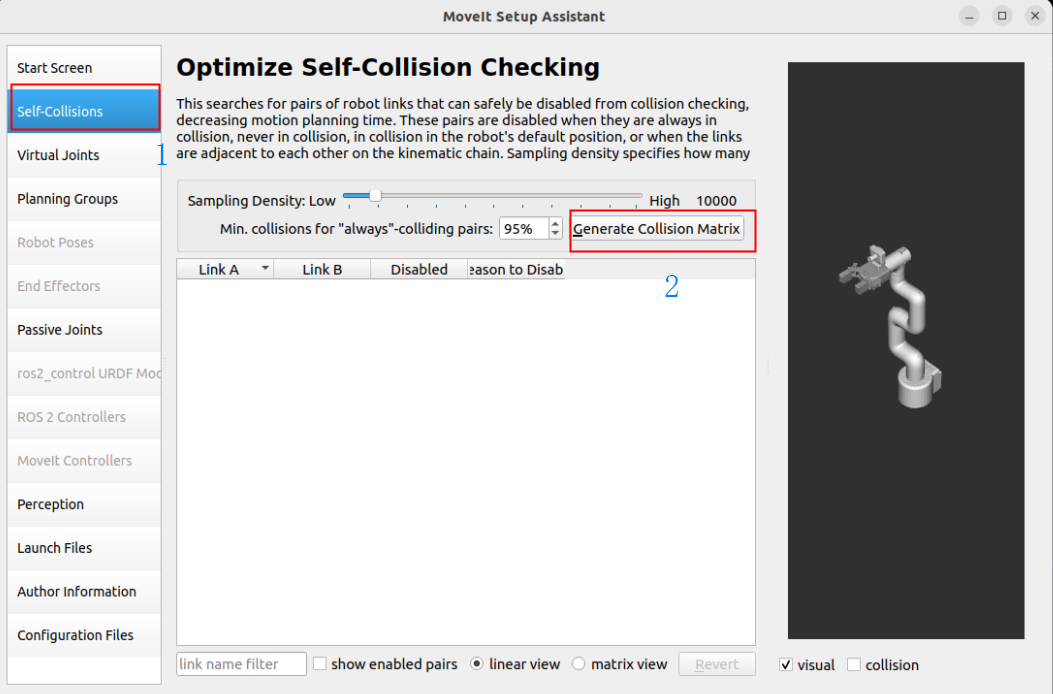
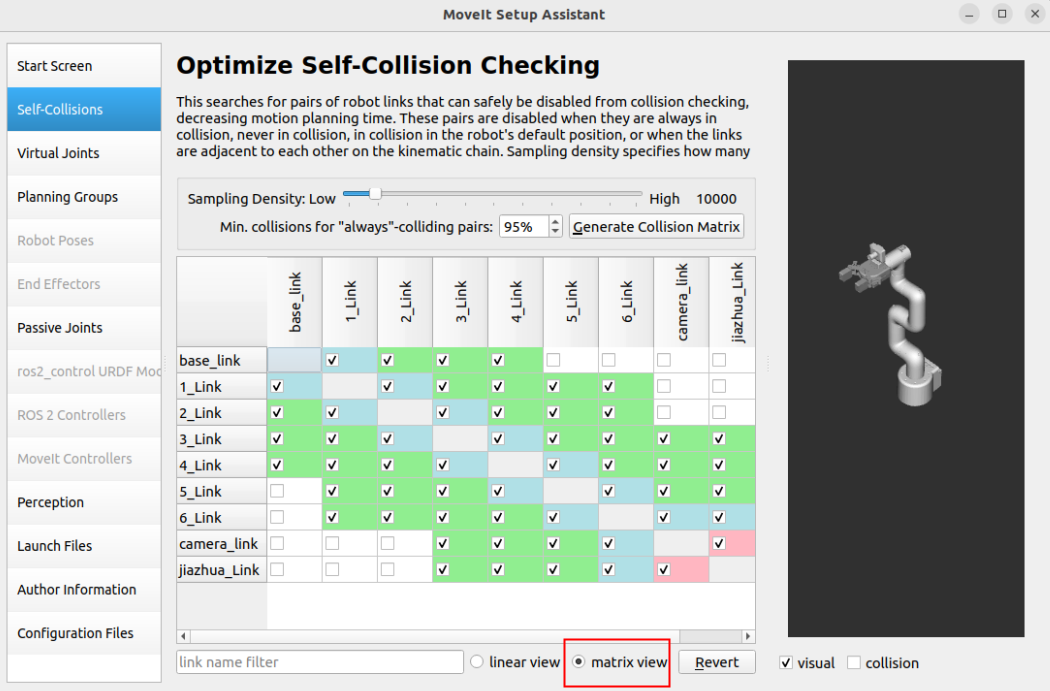
image-20250506153212500

image-20250506153230399

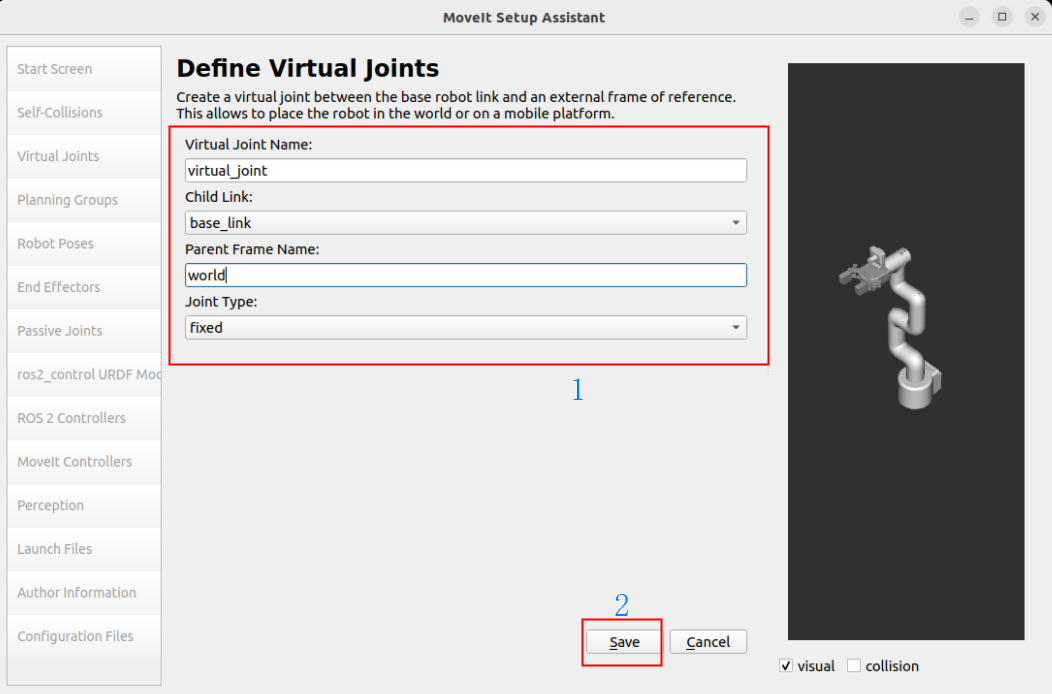
1.4. Virtual joints

A virtual joint is a tool used to define the relationship between a robot model and the outside world.

Virtual joints are usually used to describe the connection between the robot base and a fixed reference system (such as the world coordinate system).
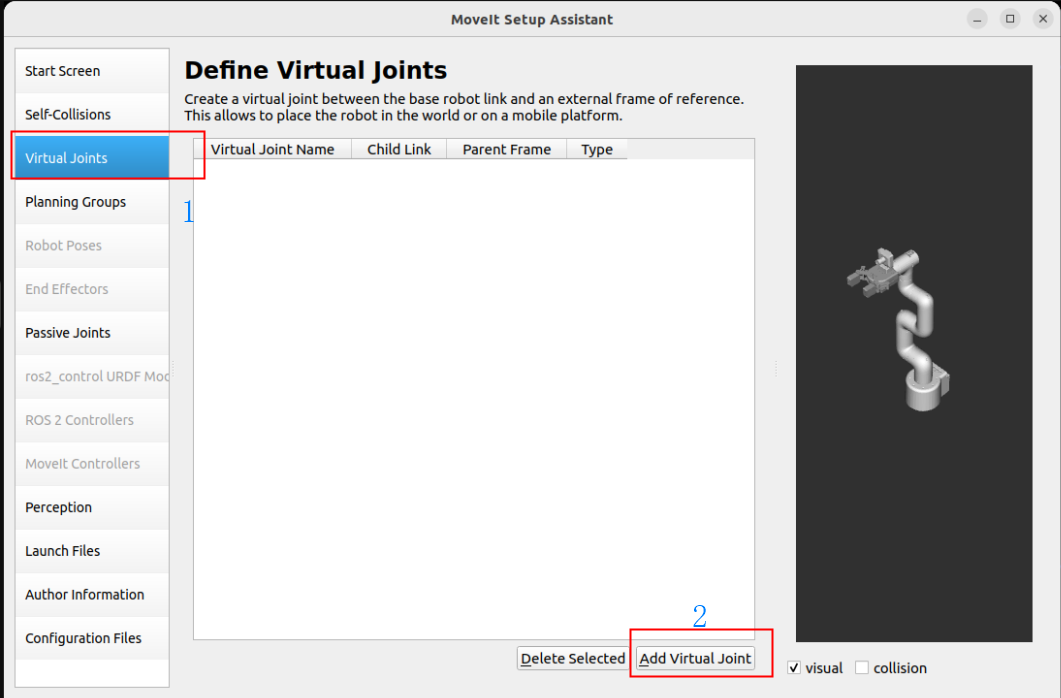
image-20250506153304082

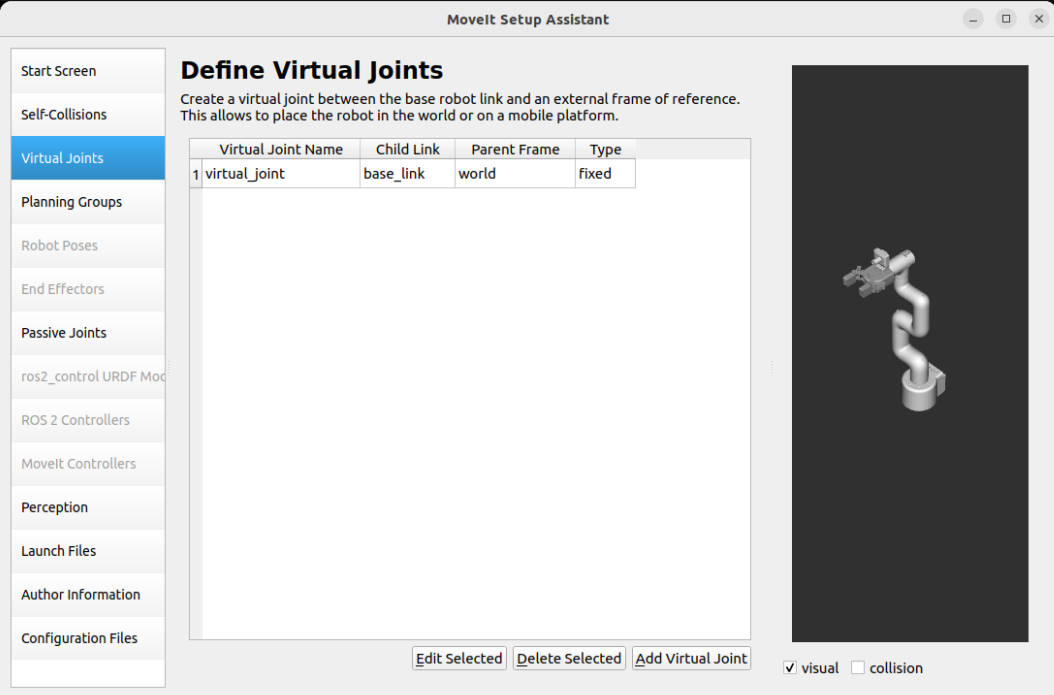
Fix the robot base link base_link and world:

  • Virtual Joint Name: virtual_joint

  • Child Link: base_link

  • Parent Frame Name: world

  • Joint Type: fixed

image-20250506153349622

image-20250506153404232

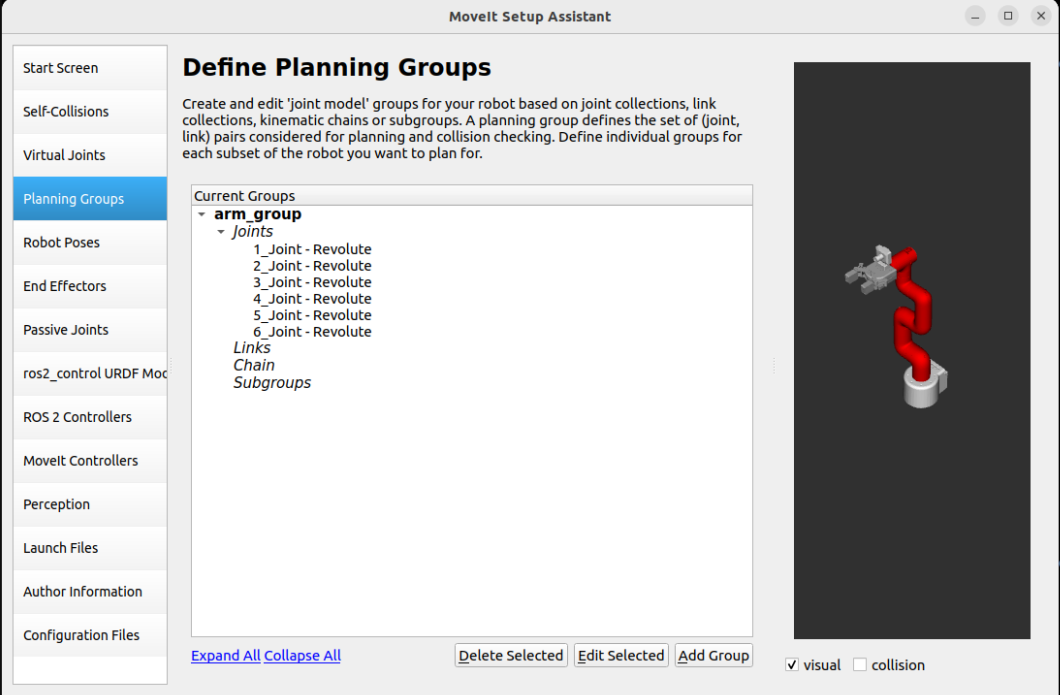
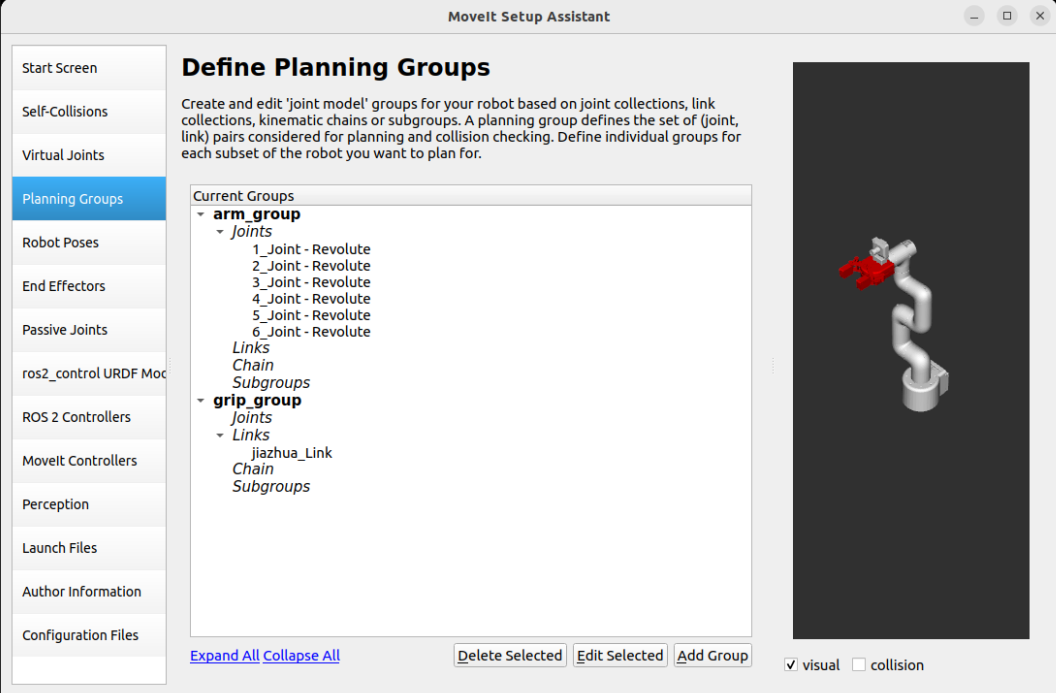
1.5, Motion Planning Group

The planning group is a key step in configuring the robot motion planning.

The planning group defines which joints and links in the robot can move together and how to plan their motion.
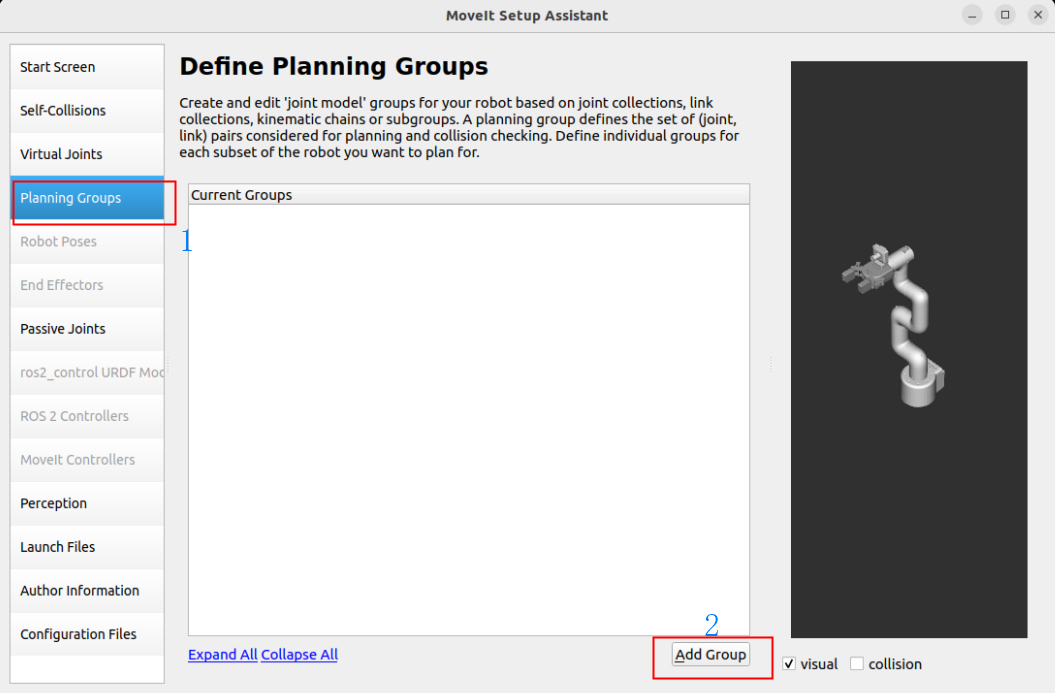
image-20250506153949946

Planning robot arm group: arm_group

  • Group Name: arm_group

  • Kinematic Solver: kdl_kinematics_plugin/KDLKinematicsPlugin

  • Kin. Search Resolution (sampling density of joint space): 0.005

  • Kin. Search Timeout (solution time): 0.005
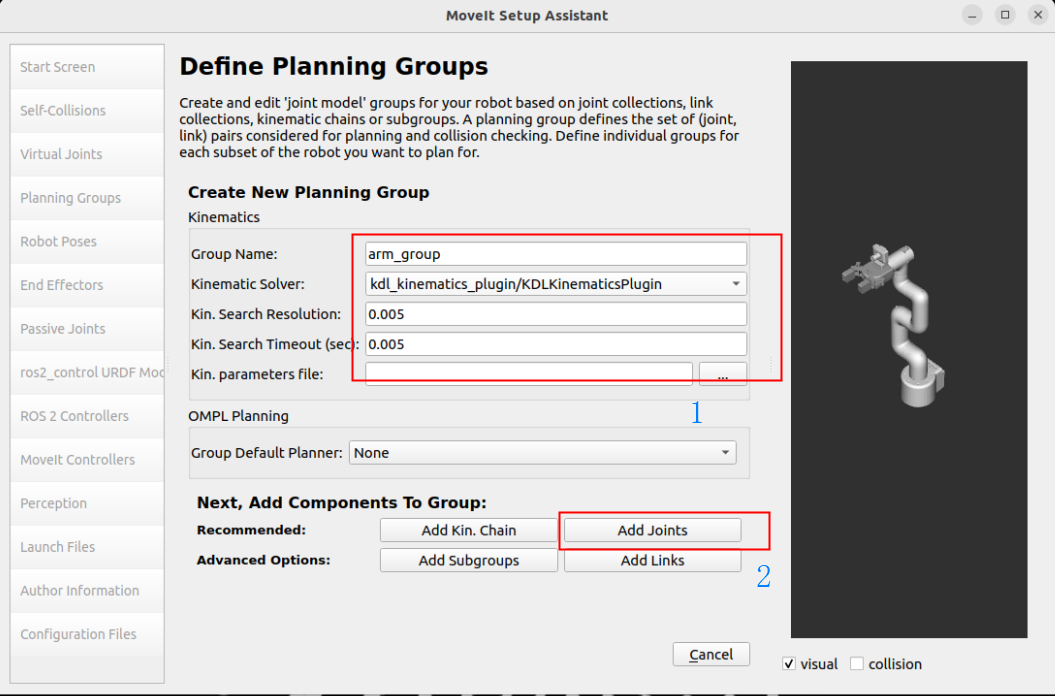
image-20250506154042292

  • Add Joints: Select the joints of the robot arm

Joints: 1_Joint, 2_Joint, 3_Joint, 4_Joint, 5_Joint, 6_Joint
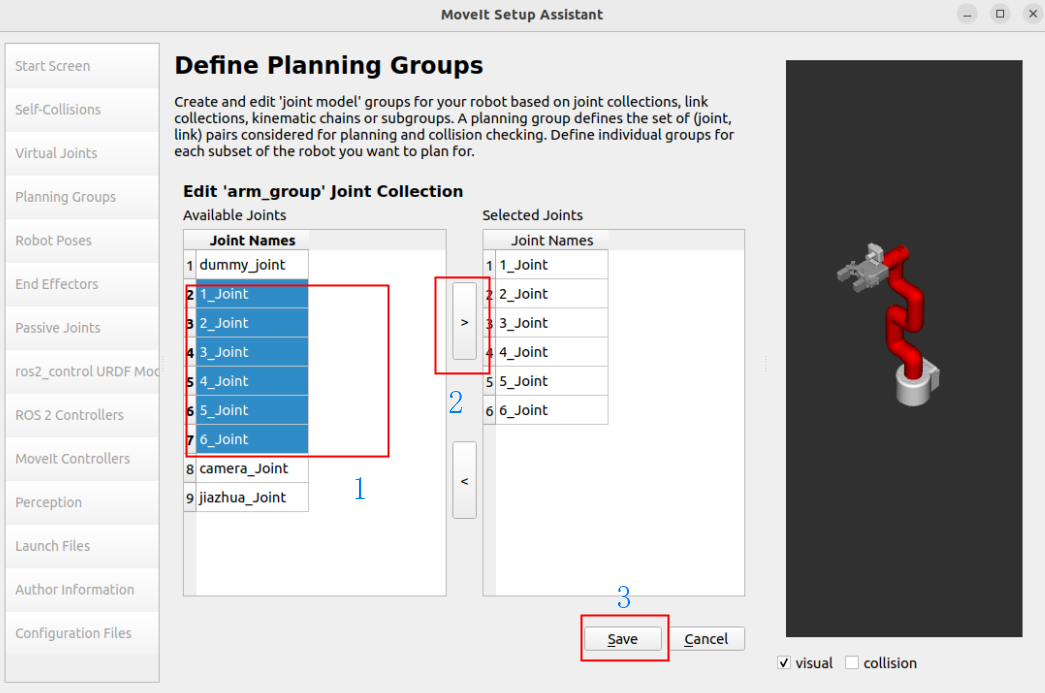
image-20250506154154740

image-20250506154620242

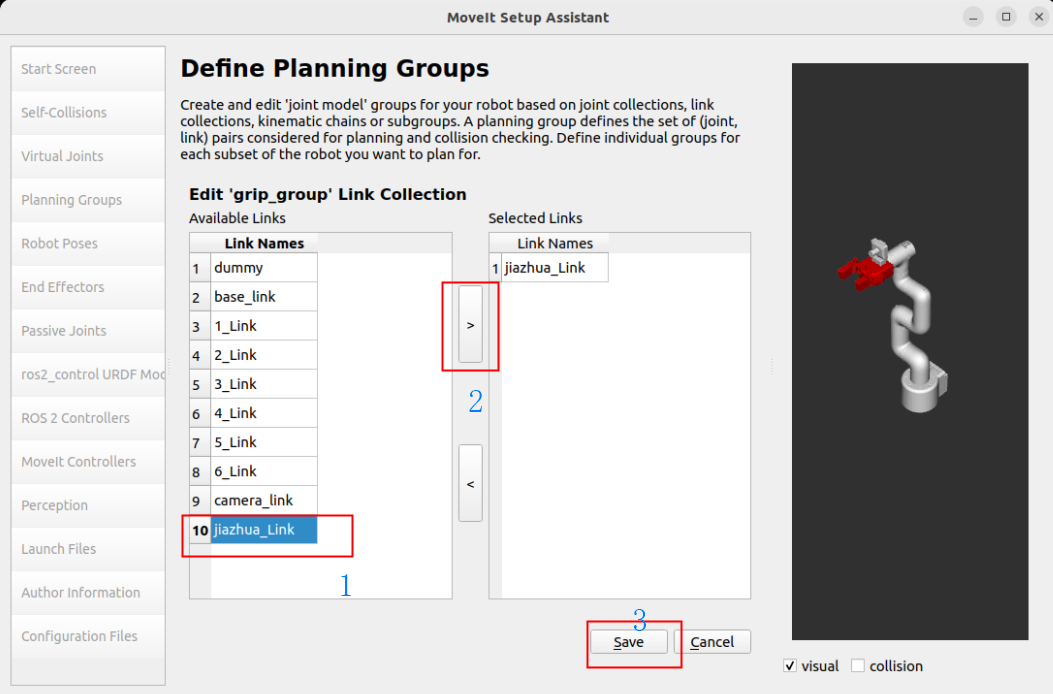
Plan gripper group: grip_group

  • Group Name: grip_group

  • Kinematic Solver: None

  • Kin. Search Resolution: 0.005

  • Kin. Search Timeout (solving time): 0.005
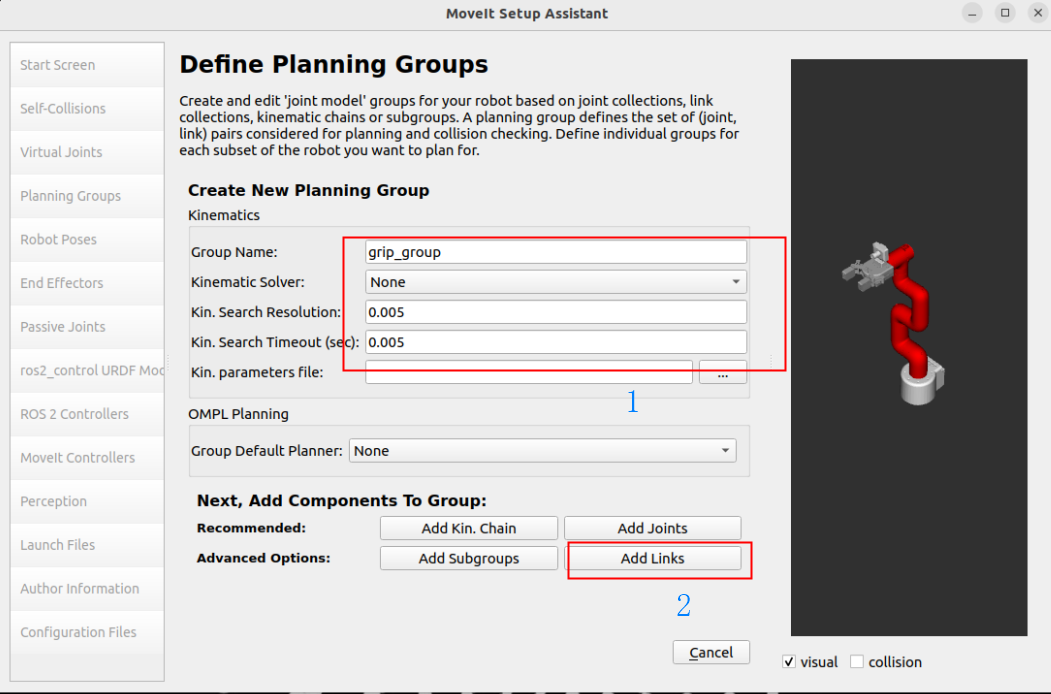
image-20250506154659995

image-20250506154729712

image-20250506154745154

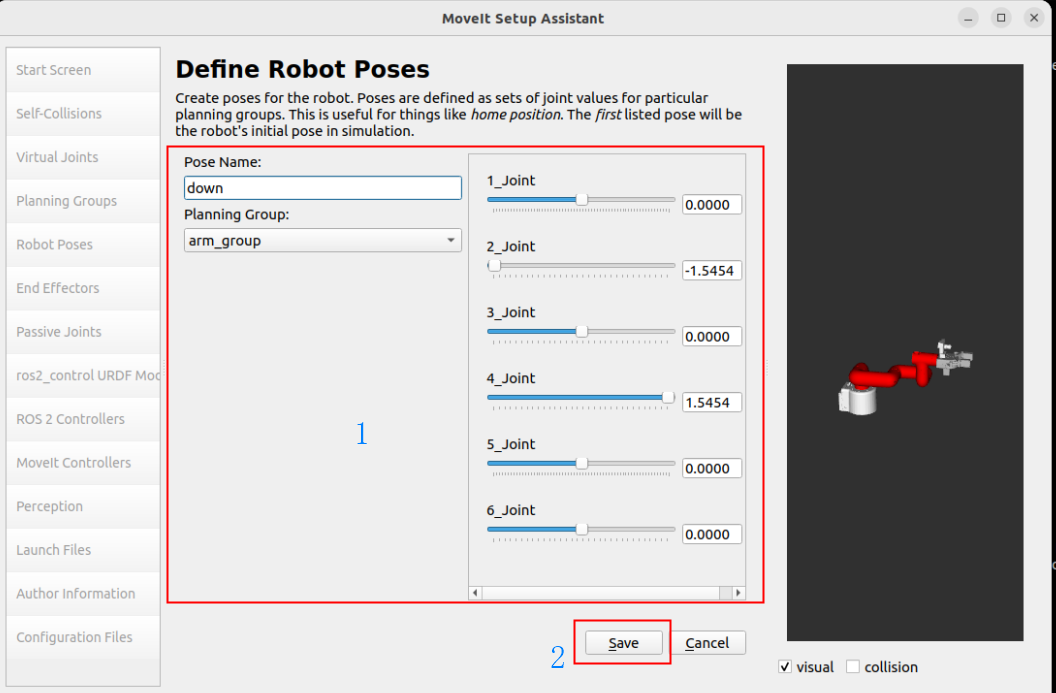
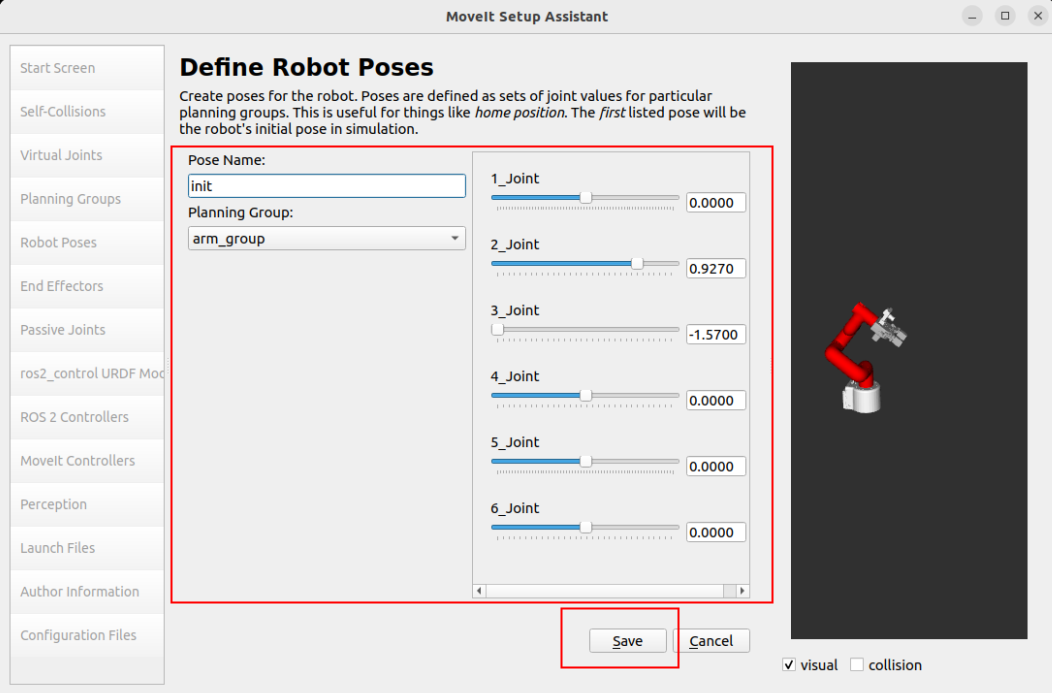
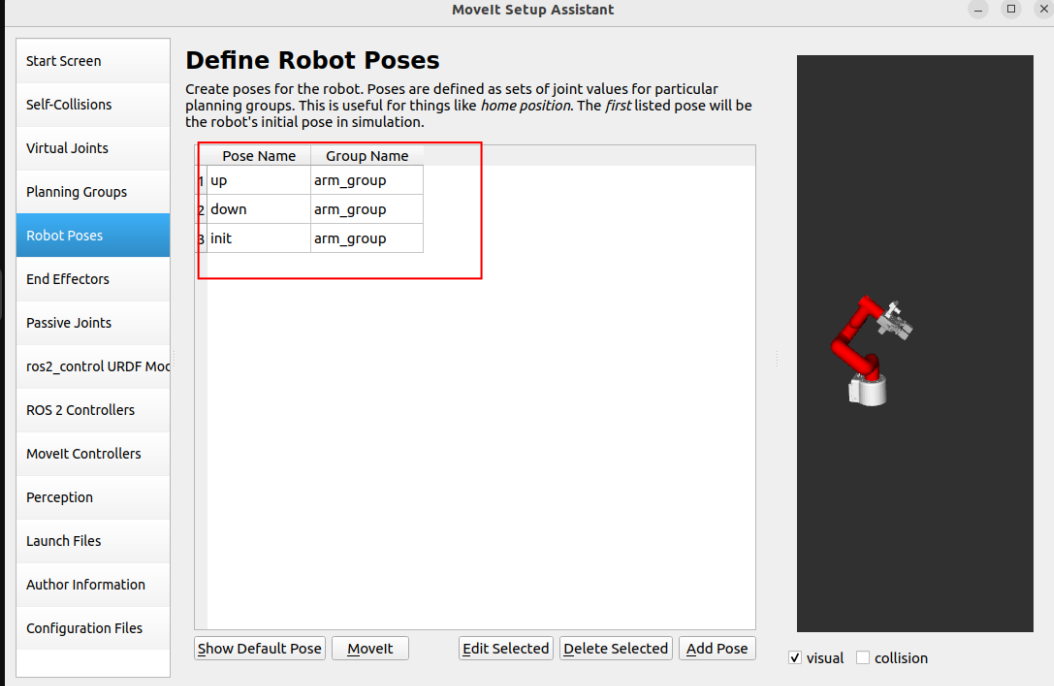
1.6. Robot position

Set three sets of predefined robot arm positions to the robot configuration:
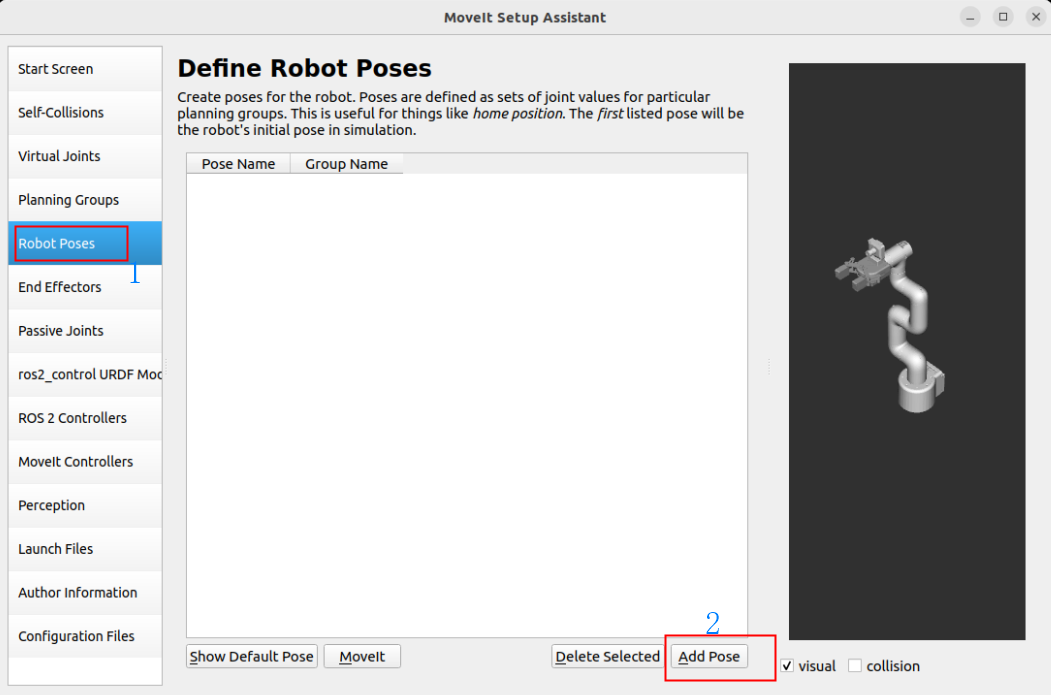
image-20250506155030761

You can manually move the slider to set the state of each joint: up, down, init
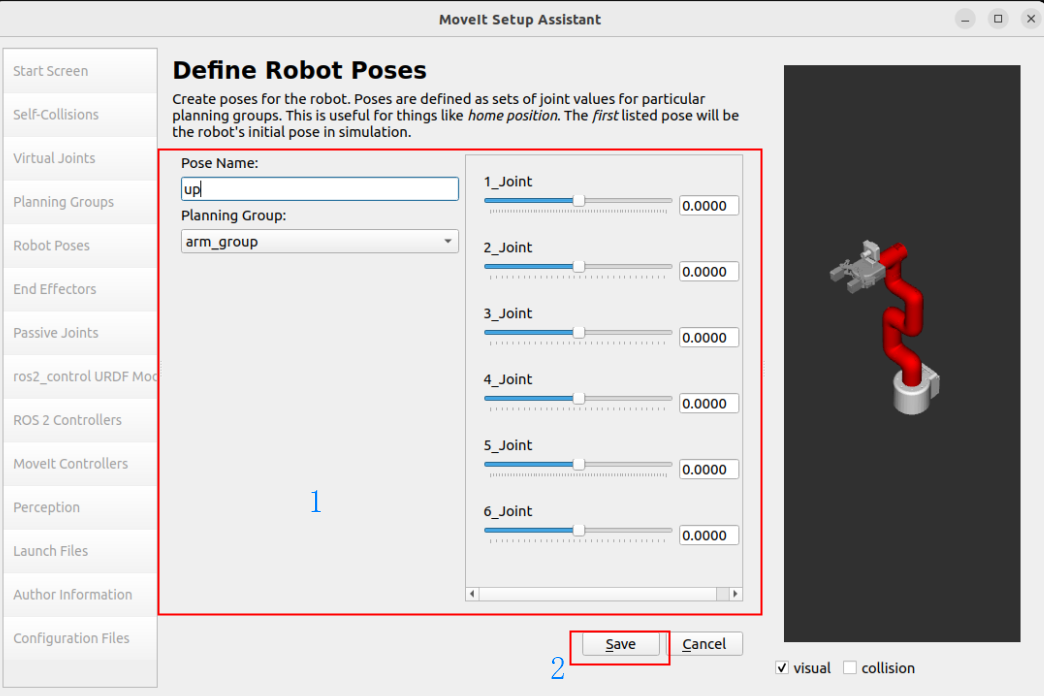
image-20250506155108084

i mage-20250506155207952

image-20250506155635532

image-20250506155654151

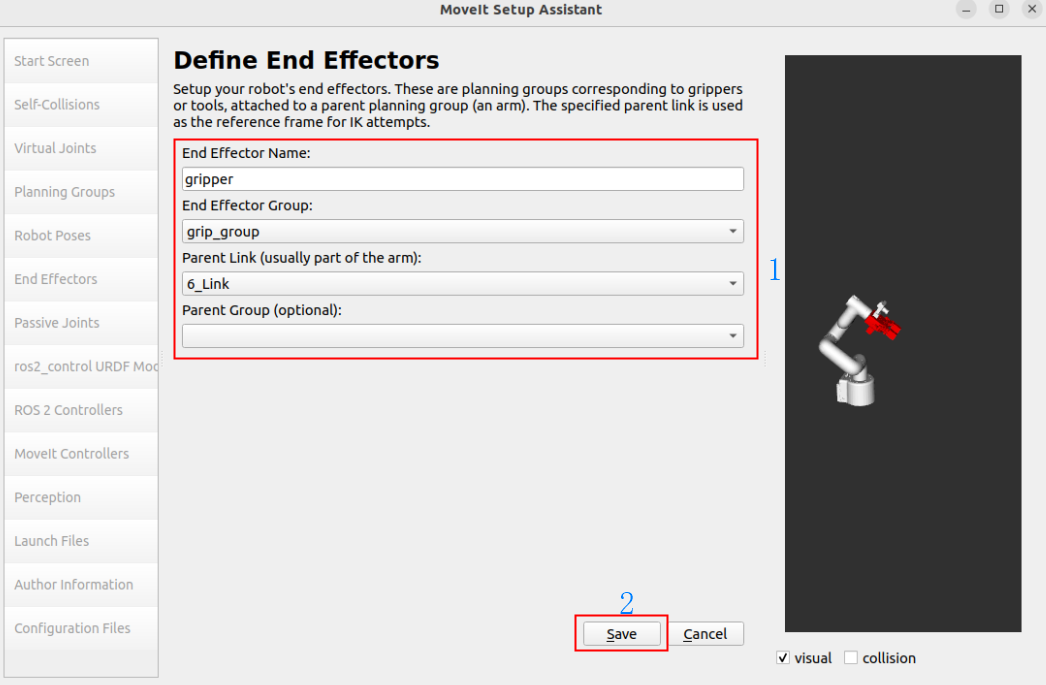
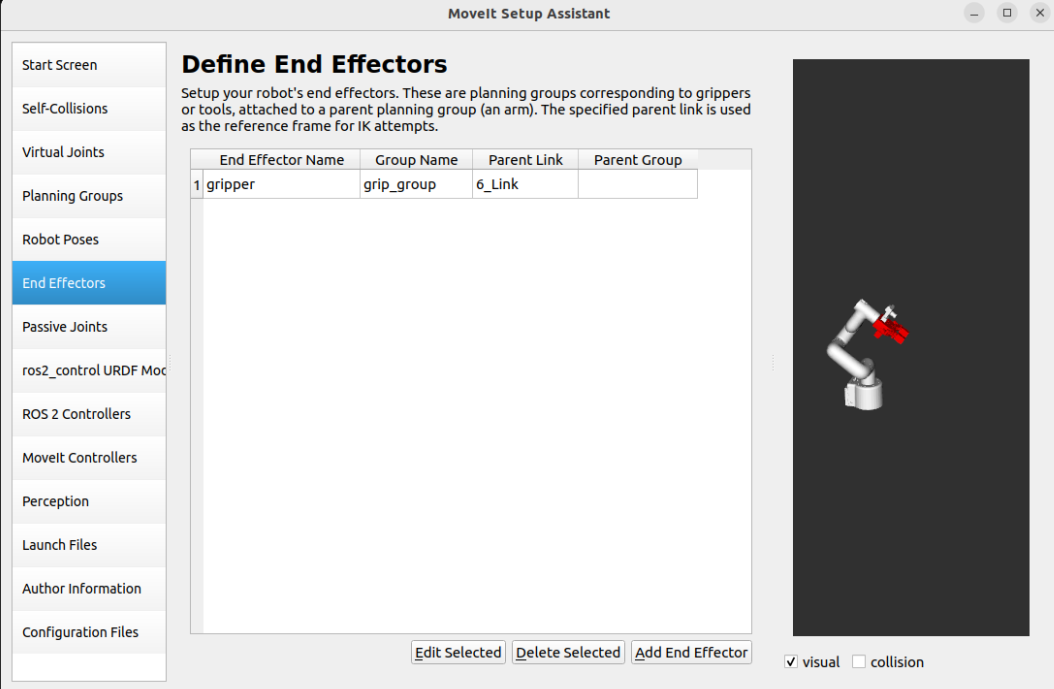
1.7. End Effector

Set the gripper group as the end effector:
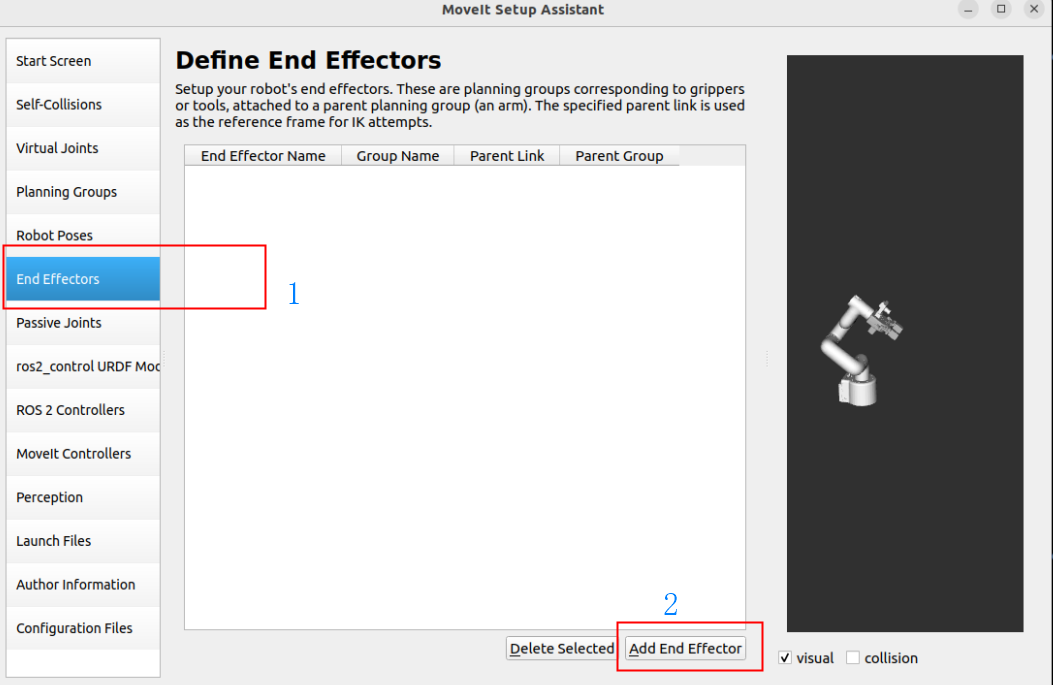
image-20250506155732017

End Effector: gripper

  • End Effector Name: gripper

  • End Effector Group: gripp_group

  • Parent Link: Arm5_Link

  • Parent Group: None

image-20250506155823615

image-20250506155833511

1.8. Passive Joints

Passive joints are non-actuated joints that cannot be directly controlled: if the robot arm does not have a passive joint, it will be skipped directly.
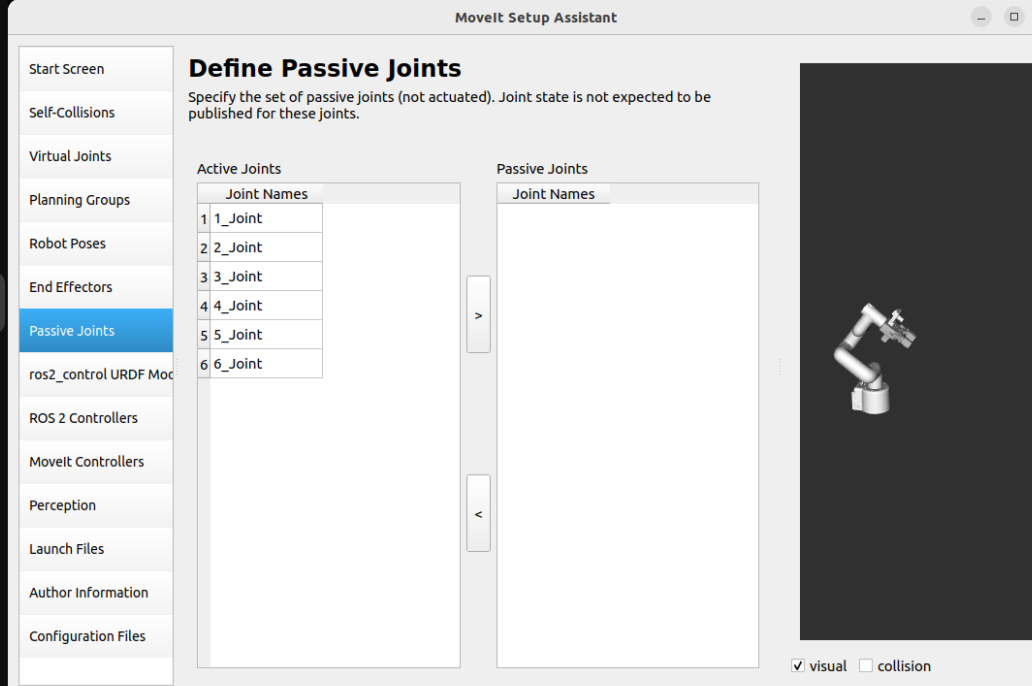
image-20250506155846139

1.9, URDF file

The MoveIt Setup Assistant automatically sets up the command interface and state interface for each joint: use the default generated information.
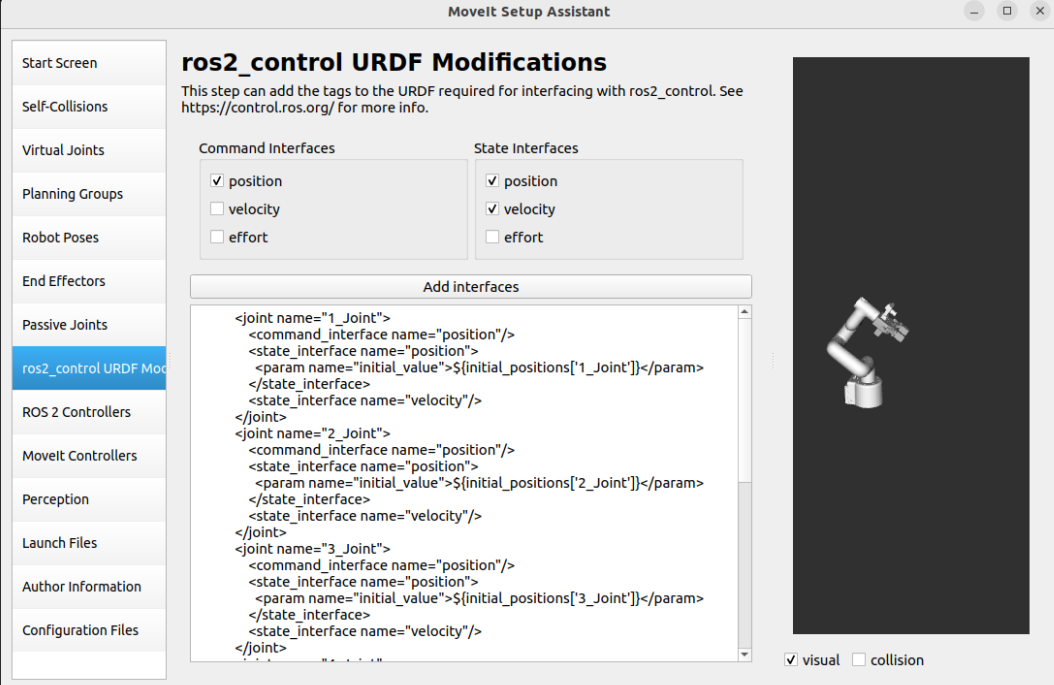
image-20250506155859915

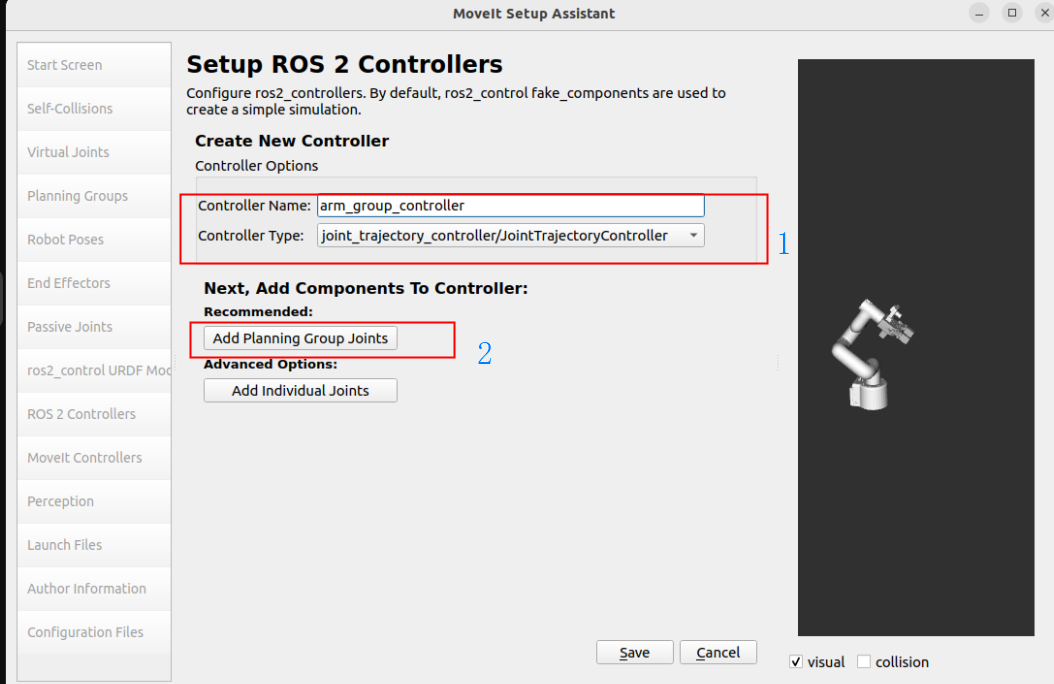
1.10, ROS2 Controllers

ROS2 Controllers is a framework for real-time robot control that can be used to automatically generate simulation controllers to drive robot joints.
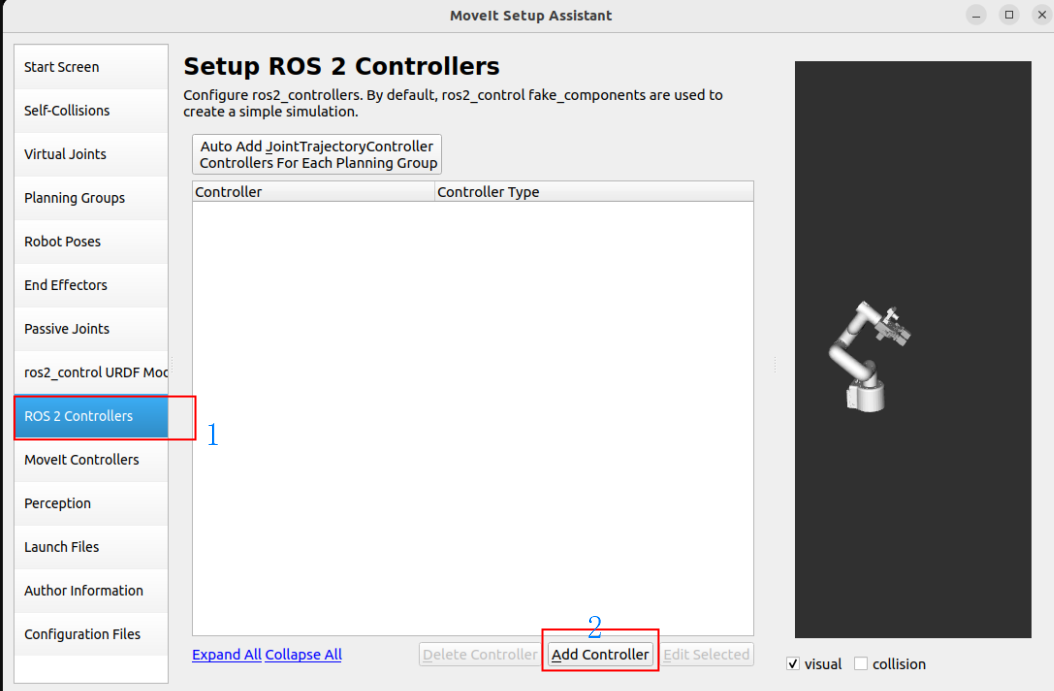
image-20250506155926663

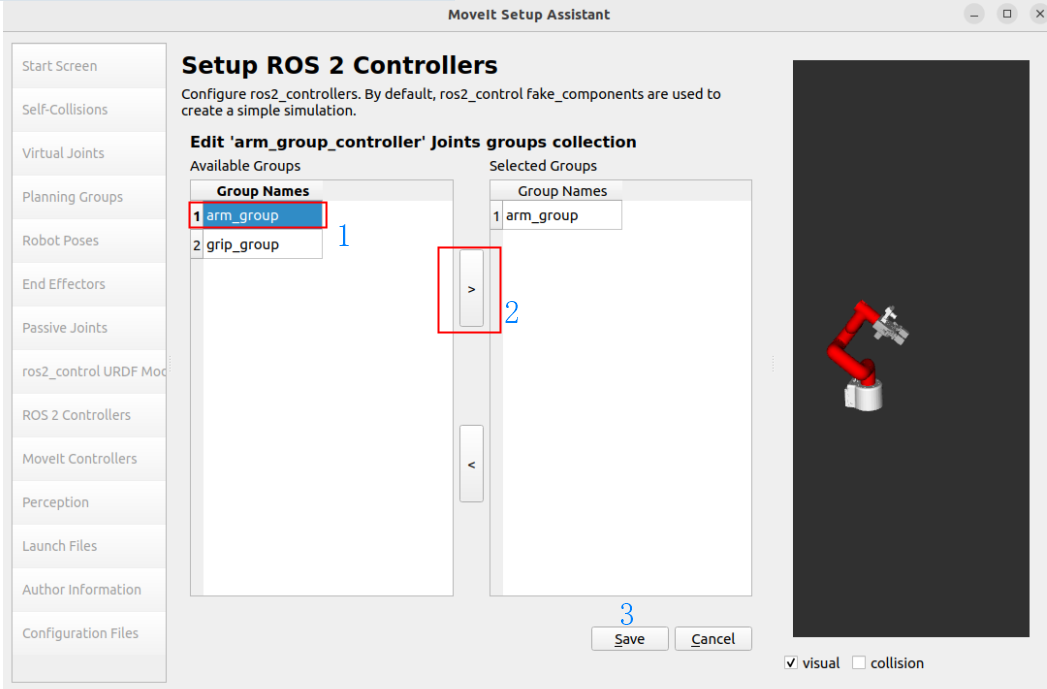
Add robot arm controller:

  • Controller Name: arm_group_controller

  • Controller Type: joint_trajectory_controller/JointTrajectoryController

  • Add Planning Group Joints: arm_group
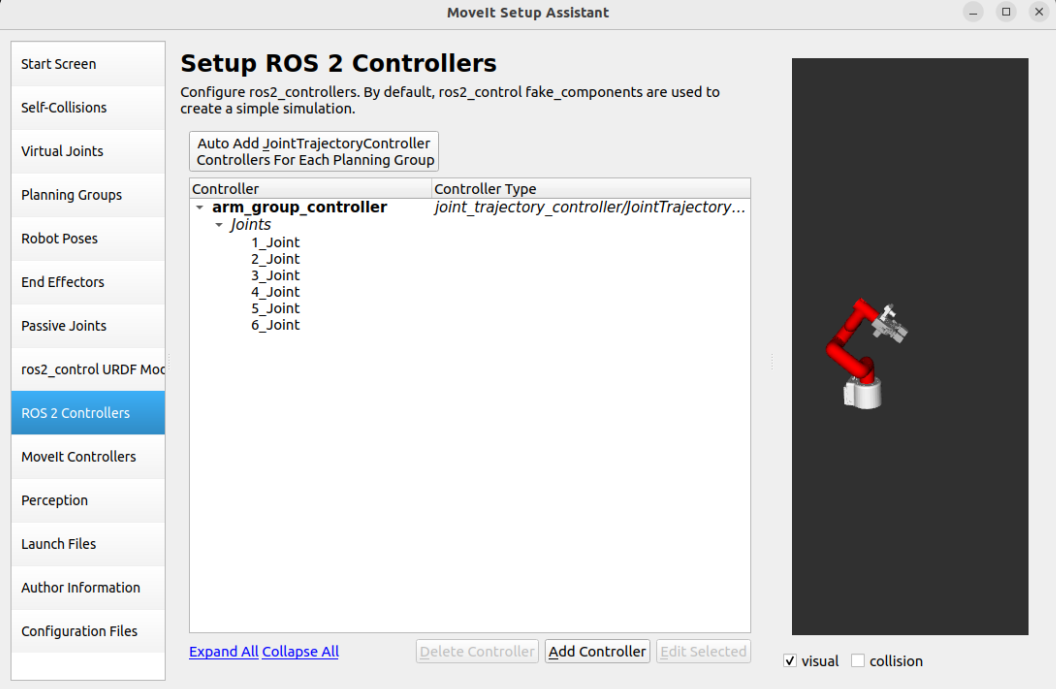
image-20250506160000275

image-20250506160119498

image-20250506160130539

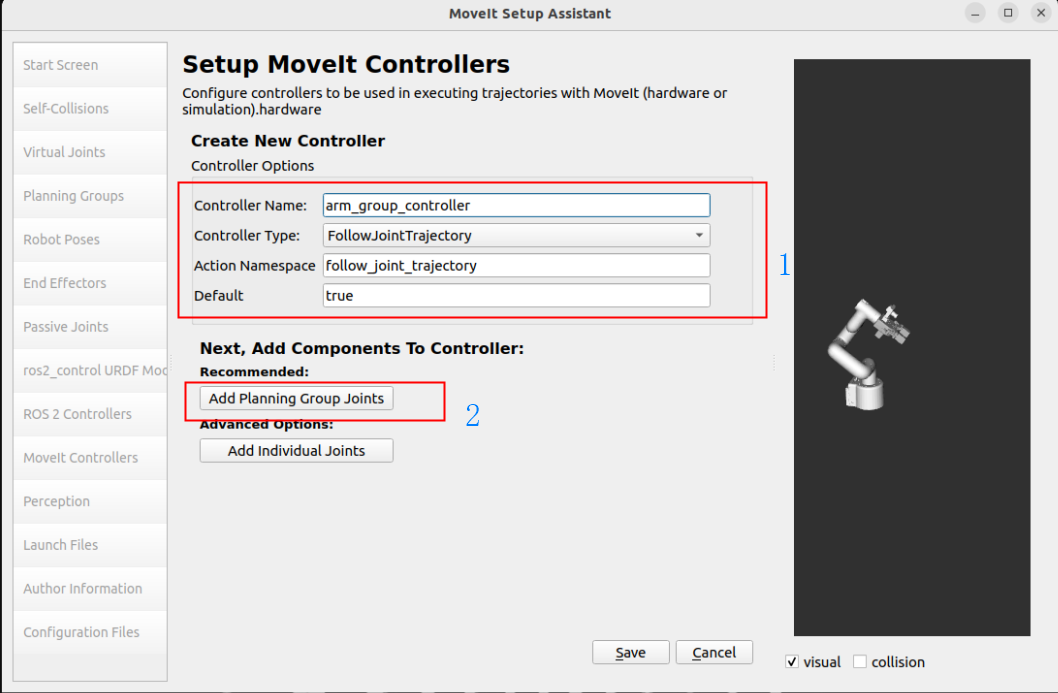
1.11, MoveIt Controllers

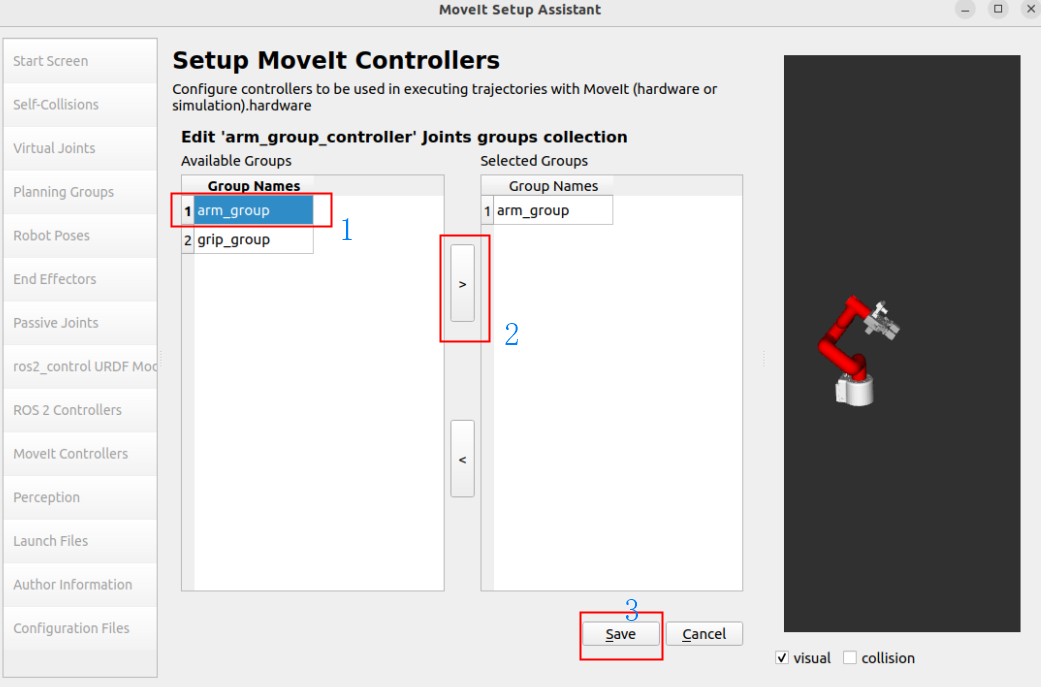
MoveIt requires a trajectory controller with the FollowJointTrajectoryAction interface to execute the planned trajectory, which sends the generated trajectory to the robot ROS2 controller.

Added MoveIt Controllers need to ensure that the controller name matches the name configured in ROS2 Controllers.
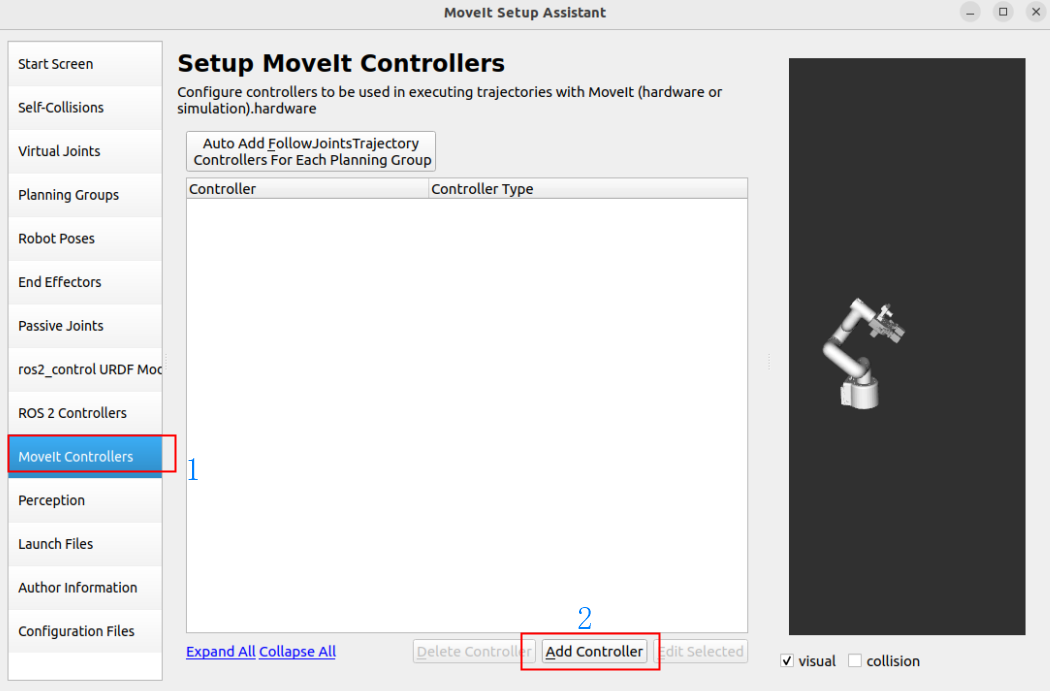
image-20250506160208795

Add robot arm controller:

  • Controller Name: arm_group_controller

  • Controller Type: FollowJointTrajectory

  • Add Planning Group Joints: arm_group
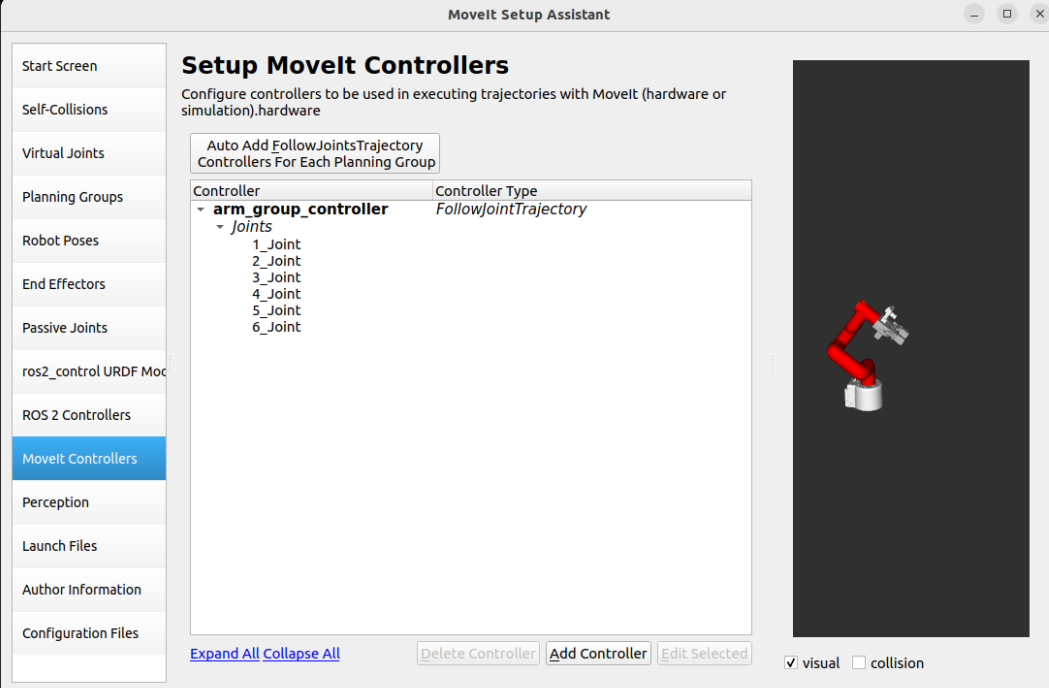
image-20250506160327248

image-20250506160350472

image-20250506160358881

1.12. Sensors

Configure the settings of the 3D sensor used by the robot: No configuration is required.
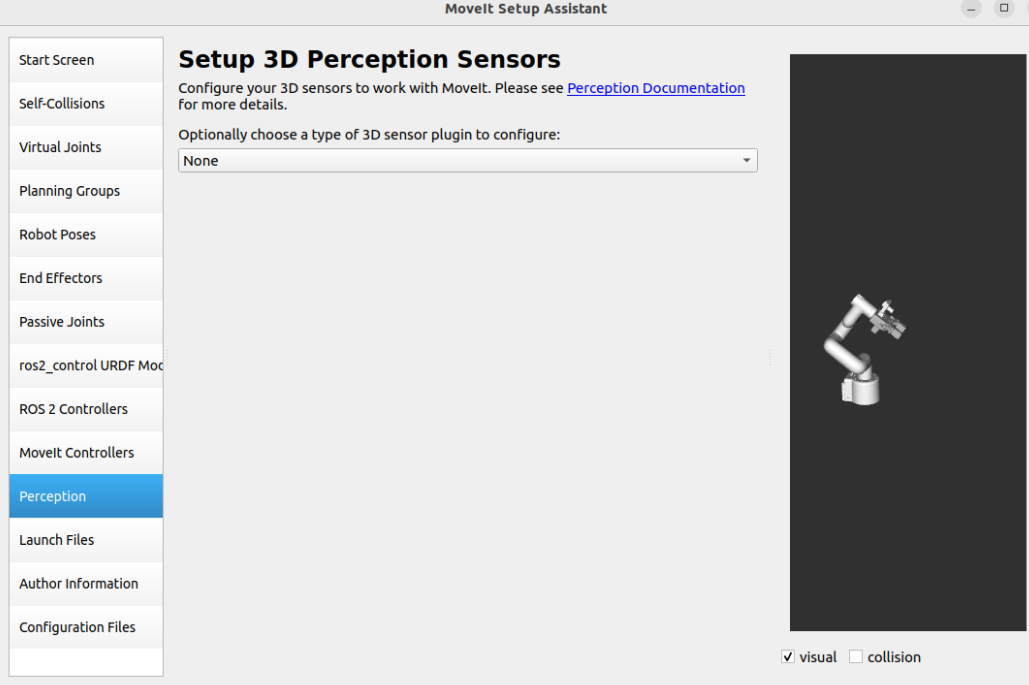
image-20250506160412107

1.13. Startup File

Configure the automatically generated startup file: Use the default options.
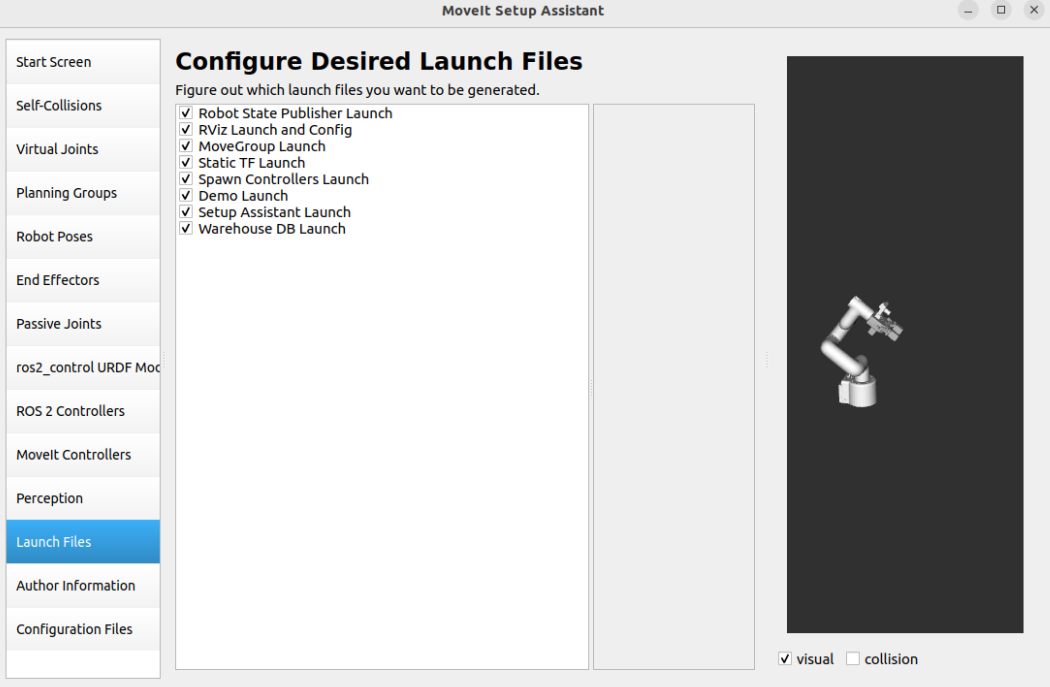
image-20250506160423765

1.14. Author Information

Add author information for package generation:
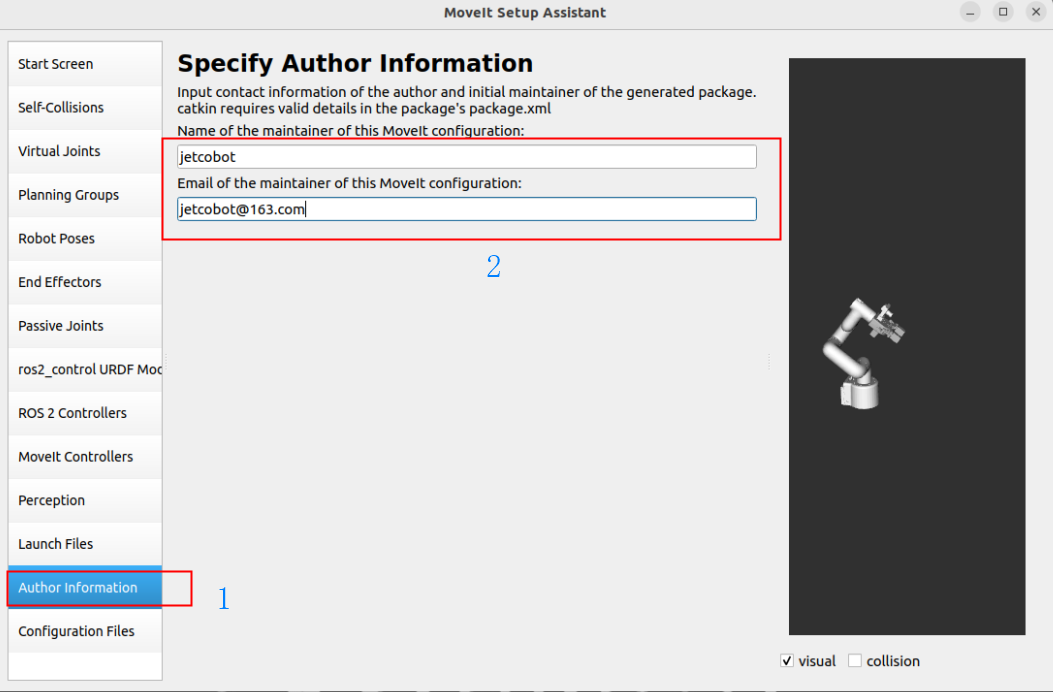
image-20250506160502328

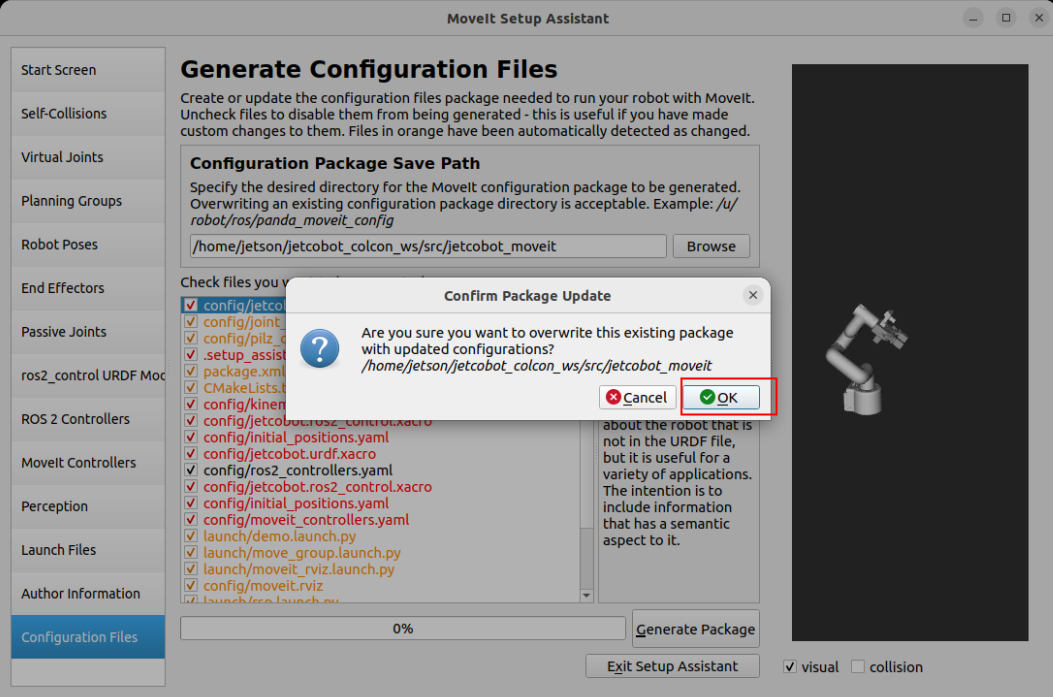
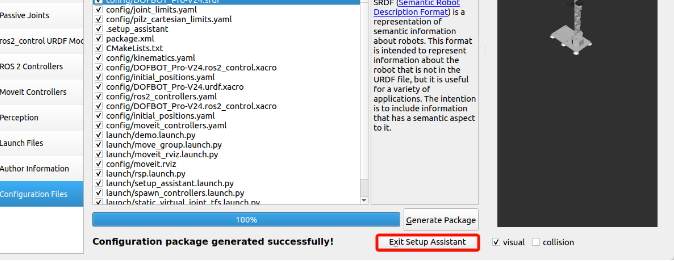
1.15. Generate configuration

Generate configuration files to the specified folder:
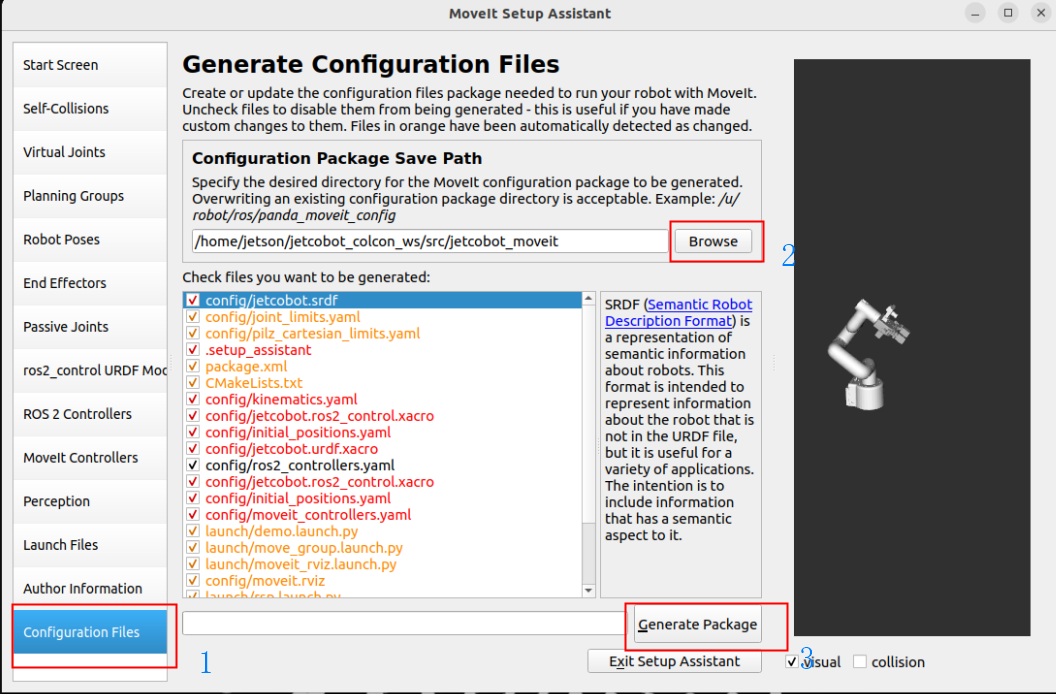
image-20250506160557302

image-20250506160625150

image-20250506160639279

2. Configuration files

Enter the dofbot_pro_moveit folder:
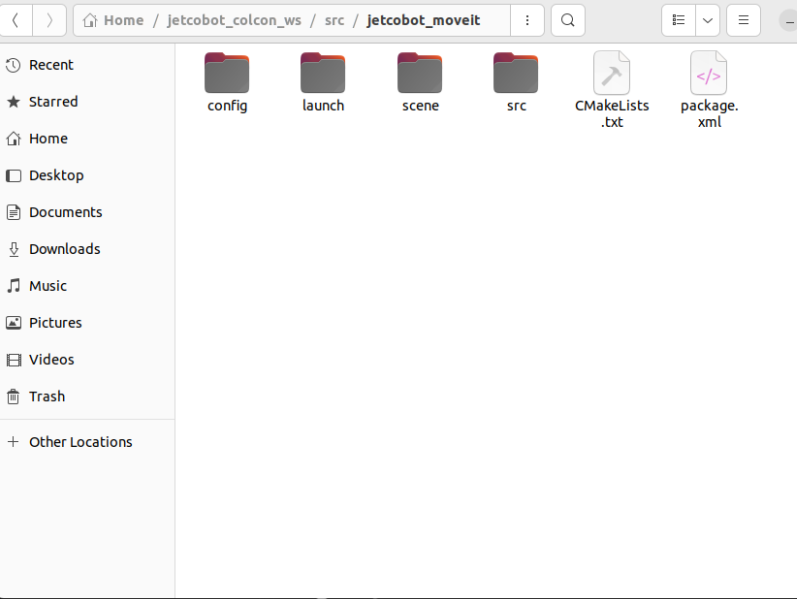
image-20250506160743408

3. Configuration verification

MoveIt Setup The configuration file generated by Assistant needs to be modified to remove the warnings at startup and the problem of model not loading.

3.1, modify the configuration file
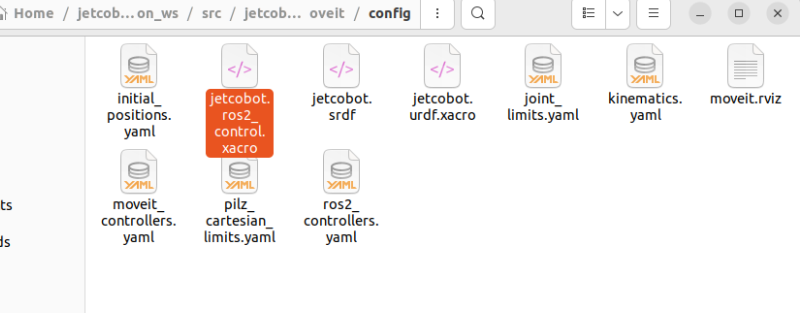
image-20250506160822358

Modify the jetcobot.ros2_control.xacro file: modify the function of loading yaml

xxxxxxxxxx
load_yaml(initial_positions_file)['initial_positions']
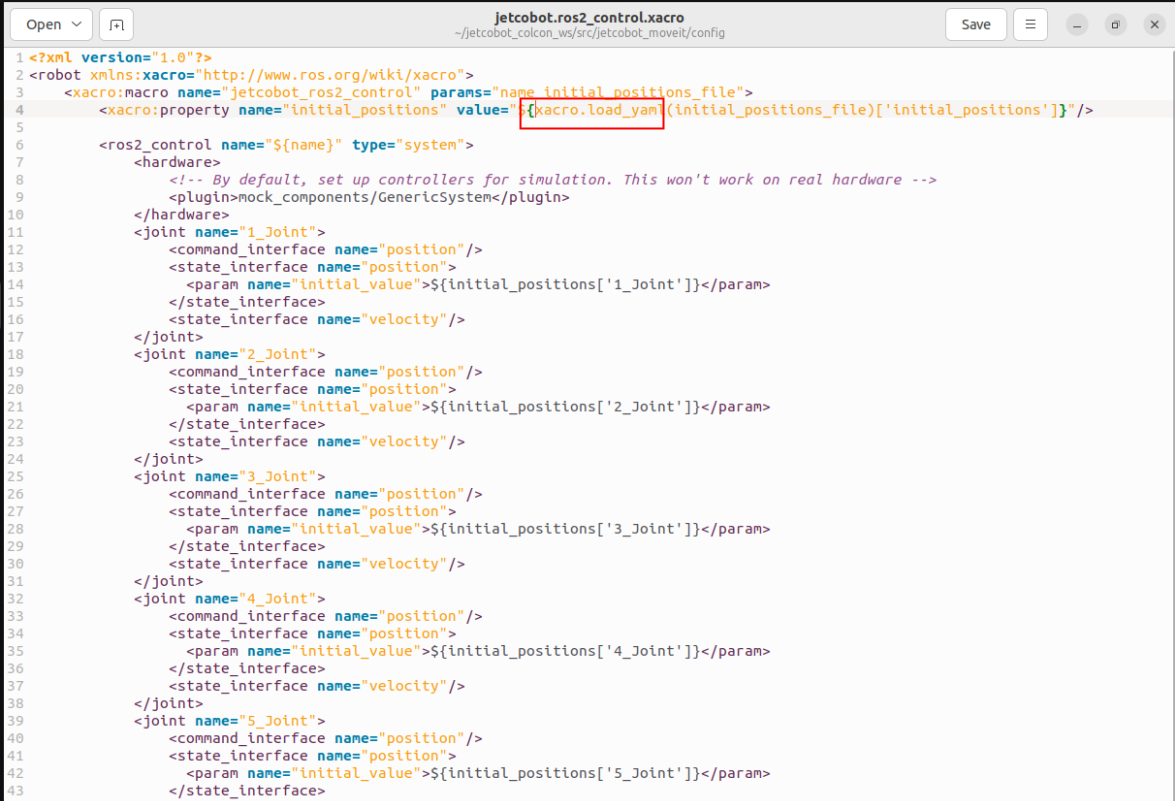
Change to
xacro.load_yaml(initial_positions_file)['initial_positions']

image-20250506160905837

3.2, compile the software package

xxxxxxxxxx
cd ~/jetcobot_colcon_ws/
colcon build
source install/setup.bash

3.3、Start MoveIt

xxxxxxxxxx
ros2 launch jetcobot_moveit demo.launch.py

Starting the simulation is slow. When the terminal displays You can start planning now! or the robot arm displays a trackball (the trackball is a newly added sphere on the robot arm), the loading is complete.
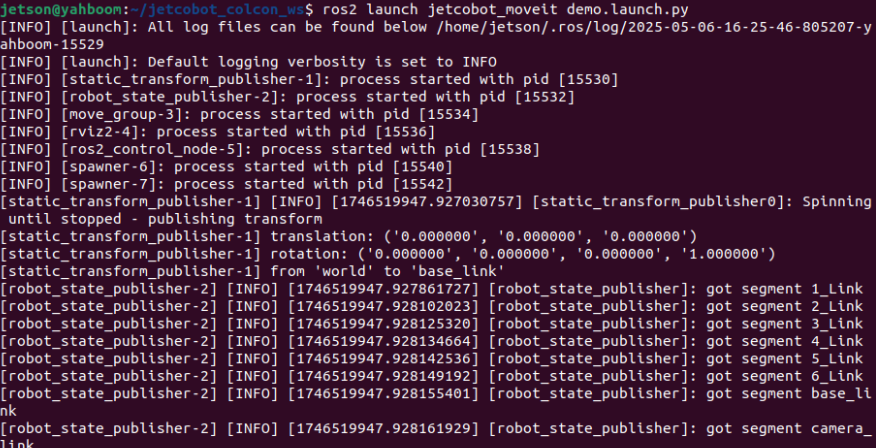
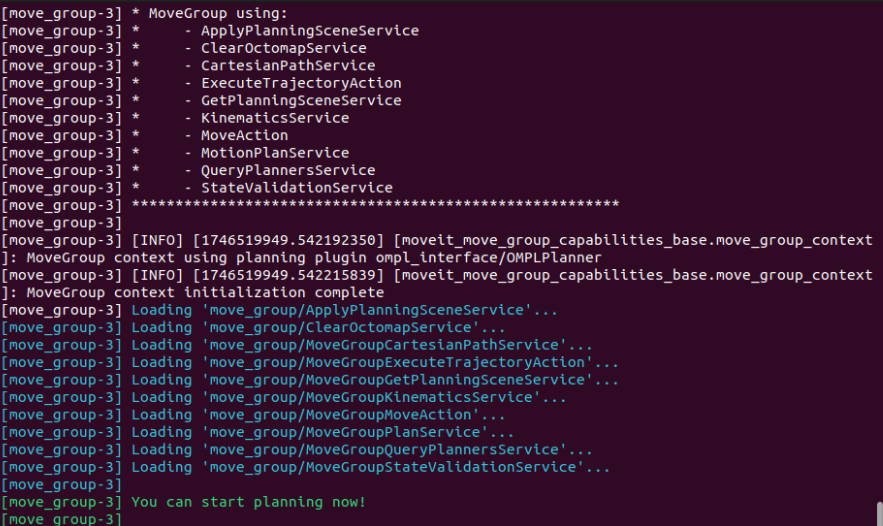
image-20250506162633041

image-20250506162651243

References

MoveIt2 Humble: https://moveit.picknik.ai/humble/index.html

MoveIt2: https://moveit.picknik.ai/main/index.html


URDF model controls the real robot arm
Use of MoveIt

COMPANY

  • About us
  • Team Style
  • Blog

LEARNING & EXPLORATION

  • Tutorials
  • Edge AI hardware
  • Educational robots
  • Embedded intelligent hardware

WHERE TO BUY

  • Yahboom Online Store
  • Amazon
  • Alibaba
  • AliExpress
  • Mercado

TECHNOLOGY SUPPORT

  • Email: support@yahboom.com

BE A DISTRIBUTOR

  • Email: sales@yahboom.com
QR Code

Copyright © 2017-2026 Yahboom. All Rights Reserved.

EN/中文