yahboom
HomeLearn
Solution
Blog
Online Store
About Us
EN/中文
MicroROS Robot Expansion Board📖
01. microROS control board development environment
  • 1. Introduction to microROS control board
  • 2. Set up ESP32-IDF development environment
  • 3. ESP32-IDF configuration tool
  • 4. Install ESP32-microros components
  • 5. Install and start microROS agent
  • 6. Flash-tool burning firmware
02. ESP32 basic course
  • 1. Turn on the LED light
  • 2. Button function
  • 3. Drive the buzzer
  • 4. Serial communication
  • 5. Battery voltage detection
  • 6. Drive PWM servo
  • 7. Drive motor
  • 8. Read motor encoder data
  • 9. PID controls car speed
  • 10. Read IMU data
  • 11. Read radar data
  • 12. Flash access data
  • 13. Partition table and memory
  • 14. Bluetooth communication
  • 15. WiFi networking
  • 16. Robot kinematics analysis
  • 17.Drive ESP32 WiFi camera
03. microros basic course
  • 1.Publish topic
  • 2. Subscribe topic
  • 3. Multi-topic subscribe and publish
  • 4. Subscribe buzzer topics
  • 5. Subscribe PWM servo topics
  • 6. Subscribe speed control topics
  • 7. Release speed topic
  • 8. Release IMU data topic
  • 9. Publish lidar data topics
  • 10. Customized transmission method
04.ROS2 basic course
  • 1. Introduction to ROS2
  • 2.ROS2 install Humble
  • 3.ROS2 development environment
  • 4.ROS2 workspace
  • 5.ROS2 function package
  • 6.ROS2 node
  • 7.ROS2 topic communication
  • 8.ROS2 service communication
  • 9.ROS2 action communication
  • 10.ROS2 custom interface message
  • 11.ROS2 parameter service case
  • 12.ROS2 meta-function package
  • 13.ROS2 distributed communication
  • 14.ROS2 DDS
  • 15.ROS2 time related API
  • 16.ROS2 common command tools
  • 17.ROS2 rviz2 use
  • 18.ROS2 rqt toolbox
  • 19.ROS2 Launch startup file configuration
  • 20.ROS2 recording and playback tool
  • 21.ROS2 URDF model
  • 22.ROS2 Gazebo simulation platform
  • 23.ROS2 TF2 coordinate transformation
05. Robot basic course
4.1 Robot information release
  • Robot information release
4.0 Preparation
  • 1. Write firmware
  • 2. How to install and use VM
  • 3. microROS control board configuration
  • 4. Connect to microROS agent
4.2 Robot keyboard control
  • Robot keyboard control
4.3 Robot handle control
  • Robot handle control
4.4 Robot state estimation
  • Robot state estimation
4.5 Line speed calibration
  • Line speed calibration
4.6 Angular velocity calibration
  • Angular velocity calibration
4.7 Robot URDF model
  • Robot URDF model
Download
  • Firmware And Code
  • VM_File
  • 3D Model File
  • ROS2_Basic_VM
Download ZIP

Welcome to MicroROS Robot Expansion Board repository

1. Introduction to ROS2

1.Introduction to ROS2

1. Overview of ROS2

ROS2 is the second-generation Robot Operating System, an upgrade to ROS1 that addresses some of its issues. The first ROS2 version, Arden, was released in 2017. With continuous updates and optimizations, it now has a stable version. As with ROS1, the choice of Linux version is also relevant to the ROS2 version. The corresponding versions are listed below.
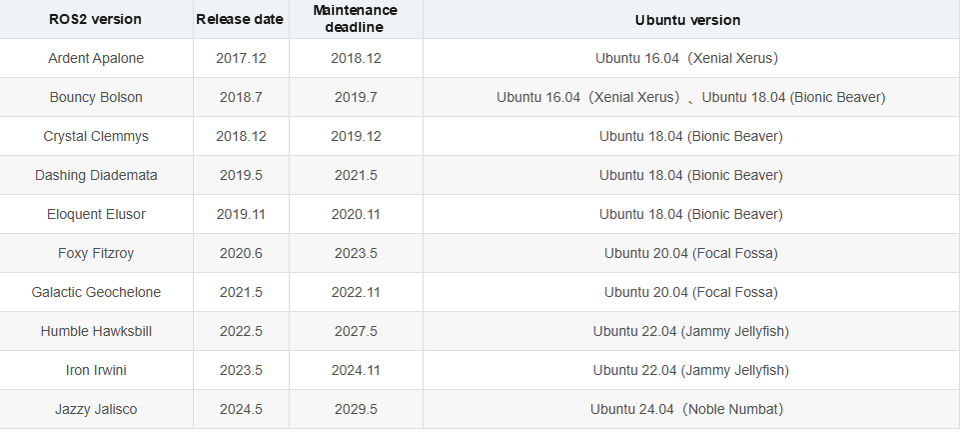
image-1

  • Note: Download the appropriate ROS2 version for your Linux distribution. This series of courses uses the Humble version as an example. The programs and examples presented in the course are applicable to all ROS2 versions.

2. Features of ROS2

2.1. ROS2 Fully Supports Three Platforms

  • Ubuntu
  • Mac OS X
  • Windows 10

2.2. Implemented a Distributed Architecture

The master node is eliminated, enabling distributed node discovery, publish/subscribe, and request/response communication.

2.3. Real-time Support

2.4. New Programming Language

  • C++11
  • Python 3.5+

2.5. Using the new build system Ament (Catkin for ROS)

2.6. ROS1 can communicate with ROS 2 via rosbridge

3. Differences between ROS2 and ROS1

3.1. Platform

ROS1 currently only supports Linux, and is commonly built and used in Ubuntu. ROS2, on the other hand, can be built and used in Ubuntu, Windows, and even on embedded development boards, making it a more widely used platform.

3.2. Language

  • C++

ROS1's core is C++03, while ROS2 makes extensive use of C++11.

  • Python

ROS1 uses Python 2, while ROS2 requires at least Python 3.5. Foxy uses Python 3.8.

3.3 Middleware

ROS 1 requires starting roscore before starting. This master controls all inter-node communication. ROS 2, however, does not have this. Instead, it uses an abstract middleware interface for data transmission. Currently, all implementations of this interface are based on the DDS standard. This enables ROS 2 to provide various high-quality QoS policies, improving communication across different networks.
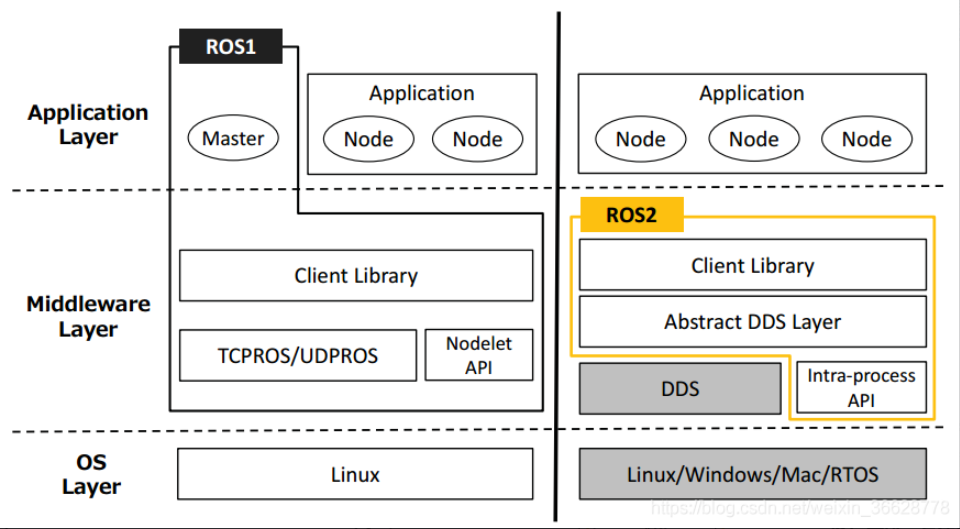
image-20230427150532854

3.4 Compilation Commands

ROS 1 compiles using the catkin_make command, while ROS 2 compiles using the colcon build command.

Customized transmission method
ROS2 install Humble

COMPANY

  • About us
  • Team Style
  • Blog

LEARNING & EXPLORATION

  • Tutorials
  • Edge AI hardware
  • Educational robots
  • Embedded intelligent hardware

WHERE TO BUY

  • Yahboom Online Store
  • Amazon
  • Alibaba
  • AliExpress
  • Mercado

TECHNOLOGY SUPPORT

  • Email: support@yahboom.com

BE A DISTRIBUTOR

  • Email: sales@yahboom.com
QR Code
QR Code

Copyright © 2017-2026 Yahboom. All Rights Reserved.

EN/中文