yahboom
HomeLearn
Solution
Blog
Online Store
About Us
EN/中文
RDK S100(P) Board📖
0. RDK S100(P) Developer Kit
  • 1. RDK S100(P) Official Tutorial
1. Introduction to RDK S100(P) Development Board
  • 1.1 Introduction to the RDK S100(P) Development Board
  • 1.2 Install Operating System
  • 1.3 Interface Descriptions
  • 1.4 Accessory installation
  • 1.5 Camera Expansion Board
  • 1.6 MCU Port Expansion Board
  • 1.7 Precautions for using 15.6-inch screens
2. Basic Settings Course
  • 2.1 Network Configuration
  • 2.2 Remote Login
  • 2.3 System Update
  • 2.4 Boot Auto-Start Configuration
  • 2.5 RDK Exclusive Command Usage
  • 2.6 Linux Command Usage
  • 2.7 Example of GPIO read and write operations
  • 2.8 Using USB Camera
  • 2.9 Using MIPI Camera
  • 2.10 SSD mounting
  • 2.11 Binocular camera depth algorithm
3. TogetheROS.Bot Vision Applications
  • 1. About TogetheROS. Bot
  • 2. System Installation
  • 3. Object Detection(YOLO)
  • 4. Image Classification(mobilenetv2)
  • 5. Image Segmentation(mobilenet_unet)
  • 6. Perception Algorithm(BEV)
  • 7. Human Detection and Tracking (Ultralytics YOLO Pose)
4.Offline AI model course
Offline large model (Text Interaction)
  • 1. AI large model environment deployment
  • 2. Install large model dialogue platform
  • 3. Meta AI Llama 3.2 model
  • 4. Alibaba Cloud Qwen3 model
  • 5. Microsoft Phi-4 mini model
  • 6. DeepSeek - DeepSeek-R1 model
  • 7. Alibaba Cloud Qwen2.5vl Visual Multimodal Large Model
  • 8. Google Gemma3 Visual Multimodal Large Model
  • 9. Lava Visual Multimodal Large Model
  • 10. MiniCPM-V Visual Multimodal Large Model
  • 11. Multimodal visual understand application
  • 12. Multimodal text to image application
  • 13. Multimodal visual localization application
  • 14. Multimodal table scanning application
  • 15. Multimodal Autonomous Agent Applications
Offline large model (Voice Interaction)
  • 0. Voice Interaction Hardware Connection (Must Read)
  • 1. Offline speech-to-text (ASR)
  • 2. Offline Text-to-Speech (TTS)
  • 3.AI large model voice interaction
  • 4. Multimodal visual understanding voice interaction
  • 5. Multimodal Text-to-Image application
  • 6. Multimodal video analytics application
  • 7. Multimodal visual localization application
  • 8. Multimodal table scanning application
  • 9. Multimodal autonomous agent application
  • 10. AI Large Model Offline Voice Assistant
5.Online AI model course
Online large model (Text Interaction)
  • 1.OpenRouter large model API aggregation platform
  • 2.Multimodal visual understand application
  • 3.Multimodal visual localization application
  • 4.Multimodal table scanning application
  • 5.Multimodal autonomous agent application
Online large model (Voice Interaction)
  • 0.Voice interaction hardware connection (ReadMe)
  • 1.Online speech to text (ASR)
  • 2.Online text to speech (TTS)
  • 3.AI large model voice interaction
  • 4.Multimodal visual understand speech interaction
  • 5.Multimodal visual localization application
  • 6.Multimodal table scanning application
  • 7.Multimodal autonomous proxy application
  • 8.AI large model online voice assistant
6.YOLO26 tutorials
  • 01.YOLO26 environment
  • 02.CLI use
  • 03.Object detection
  • 04.Instance segmentation
  • 05.Pose estimation
  • 06.Image classification
  • 07.Oriented object detection
  • 08.Model conversion
  • 09.Dataset annotation
  • 10.Model training - conversion
  • 11.Model prediction
7.OpenClaw Advanced Development
  • 1.OpenClaw Deployment
  • 2.OpenClaw WhatsApp Plugin Application
  • 3.OpenClaw WebChat Interaction
  • 4.OpenClaw TUI Interaction
  • 5.OpenClaw Tools Introduction
  • 6.OpenClawGate Gateway User Manual
  • 7.OpenClaw Features Overview
  • 8.OpenClawClawHub Introduction (Skill Installation)
  • 9.OpenClaw Application - File Management
  • 10.OpenClaw Application - Camera
  • 11.OpenClaw Application - Browser Control
  • 12.OpenClaw Application - Script Execution
  • 13.OpenClaw Application - AI Programming (Peripheral & GPIO Control)
  • 14.OpenClaw Application - Dedicated AI Assistant
  • 15.OpenClaw Web Search Capability Configuration
8.ROS2 basic course
  • 1.Introduction to ROS2
  • 2.ROS2 install Humble
  • 3.ROS2 development environment
  • 4.ROS2 workspace
  • 5.ROS2 function package
  • 6.ROS2 node
  • 7.ROS2 topic communication
  • 8.ROS2 service communication
  • 9.ROS2 action communication
  • 10.ROS2 custom interface message
  • 11.ROS2 parameter service case
  • 12.ROS2 meta-function package
  • 13.ROS2 distributed communication
  • 14.ROS2 DDS
  • 15.ROS2 time related API
  • 16.ROS2 common command tools
  • 17.ROS2 rviz2 use
  • 18.ROS2 rqt toolbox
  • 19.ROS2 Launch startup file configuration
  • 20.ROS2 recording and playback tool
  • 21.ROS2 URDF model
  • 22.ROS2 Gazebo simulation platform
  • 23.ROS2 TF2 coordinate transformation
Download
  • Annex_File
  • Code
Download ZIP

Welcome to RDK S100(P) Board repository

11.ROS2 parameter service case

11. ROS2 parameter service case

1. Introduction to parameters

Similar to global variables in C++ programming, they facilitate sharing data across multiple programs. Parameters are global dictionaries in the ROS robot system, allowing data to be shared across multiple nodes.

In the ROS system, parameters exist in the form of a global dictionary. What is a dictionary? Just like a real dictionary, they consist of a name and a value, also known as a key and a value. Alternatively, we can think of them as being like parameters in programming: there's a parameter name, followed by an equals sign, and then the parameter value. To use it, you simply access the parameter name.

Parameters have a rich set of features. For example, if a node shares a parameter, other nodes can access it. If a node modifies a parameter, other nodes can immediately be notified and obtain the latest value.

2. Parameters in the Little Turtle Example

In the Little Turtle example, the emulator provides a number of parameters. Let's use this example to familiarize ourselves with the meaning of parameters and command line usage.

Since a GUI is displayed here, the following examples are demonstrated in the virtual machine that comes with the tutorial for ease of operation.

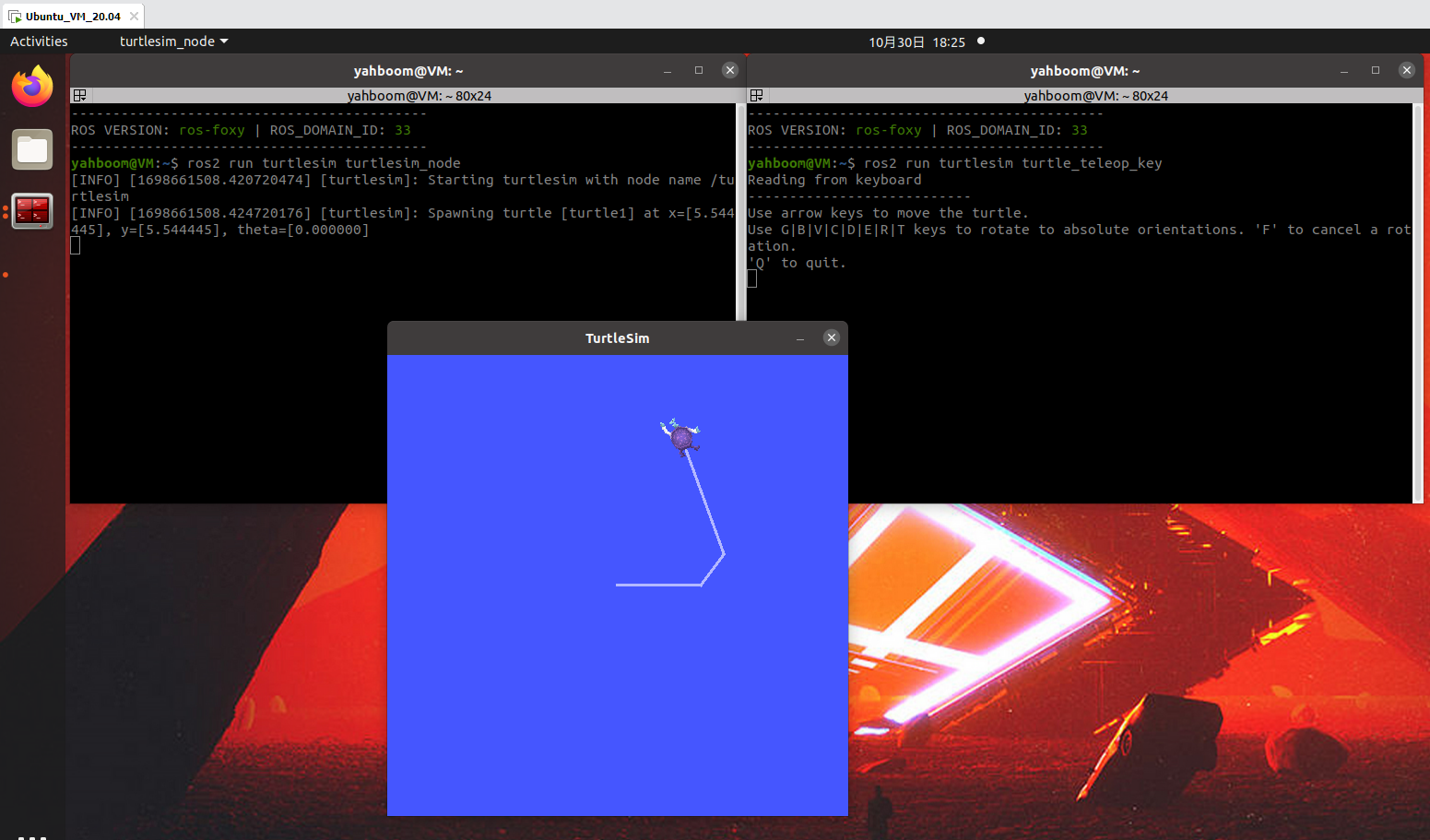
  1. Launch two terminals in the virtual machine, running the turtle simulator and the keyboard control node respectively:
xxxxxxxxxx
ros2 run turtlesim turtlesim_node
ros2 run turtlesim turtle_teleop_key

image-20231030182608893

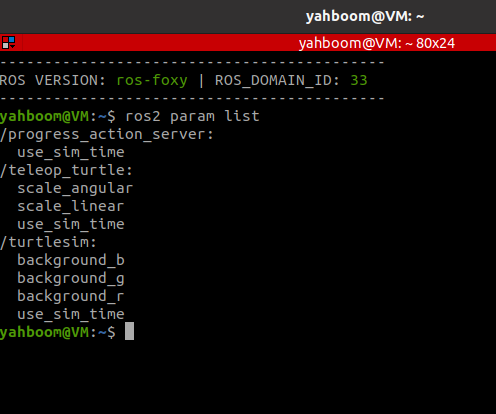
  1. Launch a terminal in the virtual machine and use the following command to view the parameter list:
xxxxxxxxxx
ros2 param list

image-20231030182640039

  1. Querying and Modifying Parameters

To query or modify the value of a parameter, follow the param command with a get or set subcommand:

xxxxxxxxxx
ros2 param describe turtlesim background_b # View the description of a parameter
ros2 param get turtlesim background_b # Query the value of a parameter
ros2 param set turtlesim background_b 10 # Modify the value of a parameter
  1. Saving and Loading Parameter Files

Querying/modifying parameters one by one is too cumbersome. Why not try using a parameter file? Parameter files in ROS use the YAML format. You can follow the param command with the dump subcommand to save all the parameters for a node to a file, or use the load command to load all the contents of a parameter file at once:

xxxxxxxxxx
ros2 param dump turtlesim >> turtlesim.yaml # Save the parameters of a node to a parameter file
ros2 param load turtlesim turtlesim.yaml # Load all parameters from a file at once

3. Parameter Examples

3.1. Creating a New Function Package

  • Create a new function package in the src directory of the workspace
xxxxxxxxxx
ros2 pkg create pkg_param --build-type ament_python --dependencies rclpy --node-name param_demo

After executing the above command, the pkg_param package will be created, a param_demo node will be created, and the relevant configuration files will be configured.
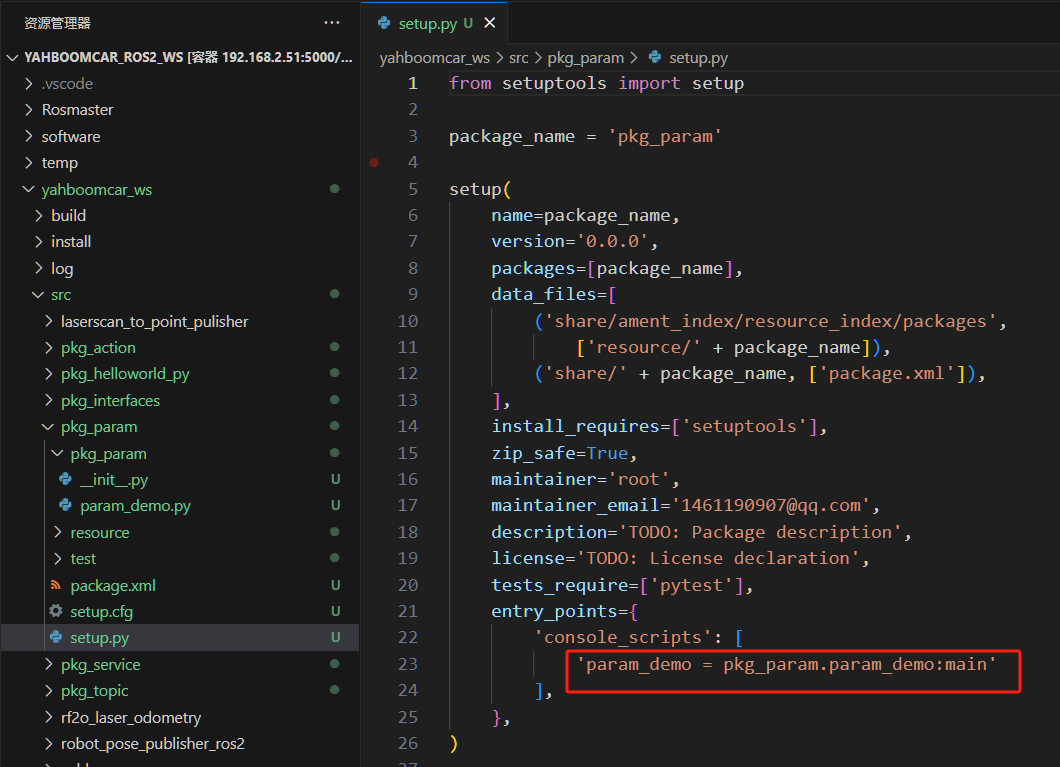
image-20231030185328553

3.2 Code Implementation

Next, edit [param_demo.py] to implement the publisher functionality and add the following code:

xxxxxxxxxx
import rclpy                                     # ROS2 Python interface library
from rclpy.node import Node                    # ROS2 Node Class
​
class ParameterNode(Node):
    def __init__(self, name):
        super().__init__(name)                                    # ROS2 node parent class initialization
        self.timer = self.create_timer(2, self.timer_callback)    # Create a timer (a period in seconds, a callback function that is executed at a fixed time)
        self.declare_parameter('robot_name', 'muto')              # Create a parameter and set its default value
​
    def timer_callback(self):                                      # Create a callback function that is executed periodically by the timer
        robot_name_param = self.get_parameter('robot_name').get_parameter_value().string_value   # Read parameter values from the ROS2 system
        self.get_logger().info('Hello %s!' % robot_name_param)     # Output log information and print the parameter values read
​
def main(args=None):                                 # ROS2 node main entry main function
    rclpy.init(args=args)                            # ROS2 Python interface initialization
    node = ParameterNode("param_declare")            # Create a ROS2 node object and initialize it
    rclpy.spin(node)                                 # Loop waiting for ROS2 to exit
    node.destroy_node()                              # Destroy node object
    rclpy.shutdown()                                 # Close the ROS2 Python interface


3.3. Compile the package

xxxxxxxxxx
colcon build --packages-select pkg_param
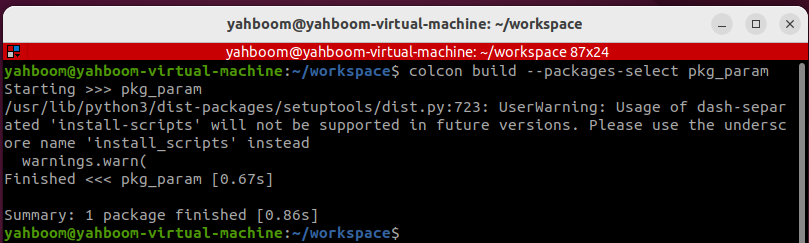
image-20250905150404041

3.4. Run the program

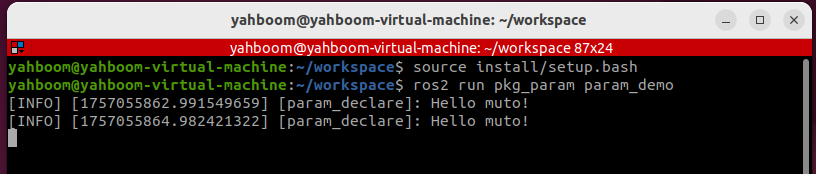
  • Refresh the environment variables first, then run the node.
xxxxxxxxxx
ros2 run pkg_param param_demo

image-20250905150438440

Open another terminal and set robot_name to robot:

xxxxxxxxxx
ros2 param set param_declare robot_name Robot

You can see the log information being printed in a loop in the terminal. "muto" represents the default parameter value for "robot_name." Changing this parameter via the command line will also change the value in the terminal.
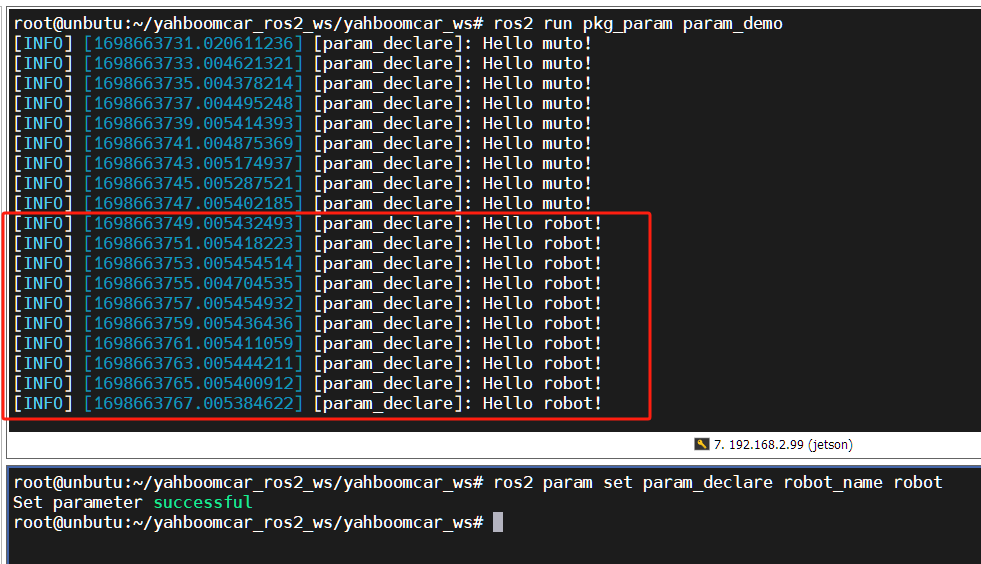
image-20231030190533095

ROS2 custom interface message
ROS2 meta-function package

COMPANY

  • About us
  • Team Style
  • Blog

LEARNING & EXPLORATION

  • Tutorials
  • Edge AI hardware
  • Educational robots
  • Embedded intelligent hardware

WHERE TO BUY

  • Yahboom Online Store
  • Amazon
  • Alibaba
  • AliExpress
  • Mercado

TECHNOLOGY SUPPORT

  • Email: support@yahboom.com

BE A DISTRIBUTOR

  • Email: sales@yahboom.com
QR Code

Copyright © 2017-2026 Yahboom. All Rights Reserved.

EN/中文