Welcome to RDK X5 MagicBox repository
1. Introduction to OpenClaw
RDK MagicBox × OpenClaw Introduction
1. OpenClaw Introduction
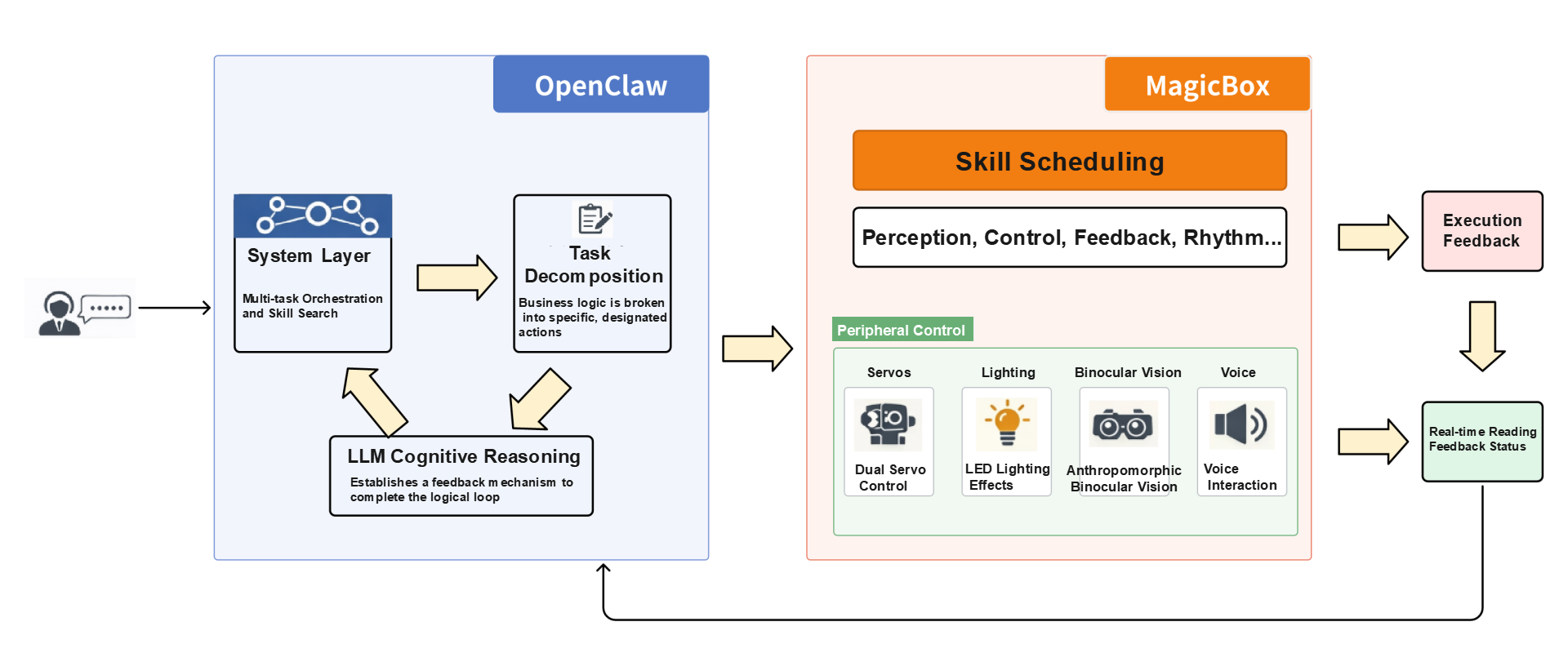
01 Embodied Intelligence · Full Loop From semantic understanding, task orchestration to feedback cognition, building the first "embodied intelligence" complete loop for RDK devices.
02 Full Series Adaptation · Zero Migration Deeply compatible with RDK X3/X5, S100, S600, enabling seamless migration of AI core capabilities across different robot form factors.
03 Dual Integration · Performance Balanced RDK Agent visual thinking logic, OpenClaw provides high-degree-of-freedom automated execution.
Related Resources:
OpenClaw Official Website: https://openclaw.ai/
OpenClaw Documentation: Getting Started - OpenClaw
OpenClaw Github Repository: GitHub - openclaw/openclaw: Your own personal AI assistant. Any OS. Any Platform. The lobster way. 🦞
MagicBox Github Repository: GitHub - frank05080/rdk_x5_openclaw_magicbox
Technical Roadmap Overview:
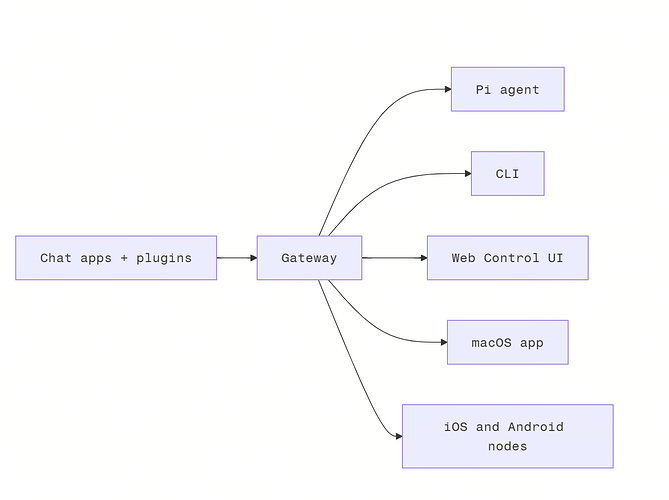
OpenClaw is an open-source, self-hostable AI execution engine that understands natural language instructions and automatically executes practical operations. By configuring communication tools like Feishu and QQ, it can become your 24/7 personal digital assistant.
Its technical architecture is as follows:
2. OpenClaw Robot Development vs Traditional Robots
Traditional Robot Paradigm
- Program-driven: Logic is hardcoded, functions are fragmented, every new capability requires re-development
New Paradigm for OpenClaw Robot Development
- Intent-driven: Perception → Planning → Orchestration → Scheduling → Execution, capabilities are composable and extensible
From the paradigm differences above, we can see some essential transformations:
- From process control system → cognitive system
- From state machine driven → LLM intent analysis system
- From simple function calls → capability composition
At this point, the robot is no longer a "device complex" but an intelligent agent system with perception, cognition, decision-making, execution, and self-feedback loop closure.
We can compare traditional robots with OpenClaw-based intelligent robots from different dimensions:
| Dimension | Traditional Robot | OpenClaw Robot |
|---|---|---|
| Control Method | Program Logic | Cognitive Driven |
| Decision Method | State Machine | Agent Planning |
| Architecture Core | Control System | Cognitive System |
| Intelligence Source | Rules | Model |
| Extension Method | Module Stacking | Capability Composition |
| Evolution Capability | None | Self-feedback |
Summary
3. RDK MagicBox × OpenClaw Connection
If we make an analogy between robots, RDK, and OpenClaw:
- Robot (MagicBox): Body
- RDK: Brain
- OpenClaw: Nervous System
If represented as a capability layering table, it can be shown as follows:
| Application Layer App | Product/Scenario |
|---|---|
| Agent Layer Agent | Cognition/Planning/Decision |
| Skills Layer Skills | Composable Capabilities |
| Tools Layer Tools | API/Interface |
| Hardware Layer Hardware | Robot Control |
4. Summary
The core of this development paradigm is not "adding AI to robots," but "making the robot itself an AI system" - using Clawdbot as the intelligent agent operating system for unified capability scheduling, using RDK as the cognitive center responsible for understanding, planning and decision-making, using MagicBox as the embodied carrier for perception and execution. Through the capability abstraction chain of Tool → Skill → Agent, hardware is transformed into composable capabilities, building an intelligent closed-loop system of perception-cognition-decision-execution-feedback, evolving robots from "program-controlled devices" to "cognitively-driven intelligent agents," upgrading from project-level systems to evolvable, scalable, and platform-ready embodied intelligence infrastructure.