yahboom
HomeLearn
Solution
Blog
Online Store
About Us
EN/中文
Rider Pi Robot📖
0.Quick Start
  • 0. Notes (Must Read)new
  • 1.APP control experience
  • 2.Web page image transmission controlnew
  • 3.Manual
1.RPi Basic course
  • 1.SSH remote login
  • 2.VNC remote login desktop
  • 3. Remote file transfer
  • 4. JupyterLab environment construction and use
  • 5. Write system image
  • 6. Connect to WiFi
  • 7. Close startup programs(MustRead)
  • 8. Raspberry Pi system expansion
2.Car basic control course
  • 1. Car screen display control
  • 2. Car recording audio
  • 3. Car plays audio
  • 4. Car recording video
  • 5. Car plays video
  • 6. RGB light control
  • 7. Car attitude angle reading
  • 8. Read the battery level of the car
3.Car motion control
  • 1. Car forward and backward
  • 2. Car rotation movement
  • 3. Adjust car height
  • 4. Adjust car posture
  • 5. Car self-stabilization mode
  • 6. Car squats and shakes
4.Open Source CV
A. Getting started with OpenCV
  • 1. Introduction to OpenCV
  • 2. OpenCV image reading and display
  • 3. OpenCV image writing
  • 4. OpenCV Image Quality
  • 5.OpenCV pixel operations
B. OpenCV geometric transformation
  • 1. Image scaling
  • 2. Image cutting
  • 3. Image translation
  • 4. Image mirroring
  • 5. Affine Transformation
  • 6. Image Rotation
  • 7. Perspective Transformation
C. OpenCV image processing and drawing text segments
  • 1. Grayscale processing
  • 2. Image Binarization
  • 3. Edge Detection
  • 4. Line drawing
  • 5. Rectangle and circle drawing
  • 6. Text and picture drawing
D. Image beautification
  • 1. Color Image Histogram
  • 2. Histogram Equalization
  • 3. Image repair
  • 4. Brightness enhancement
  • 5. Skin whitening
  • 6. Gaussian mean filtering
  • 7. Median Filter
5.AI Visual recognition course
  • 1. Camera driver tutorial
  • 2. Color recognition
  • 3. HSV value test
  • 4. Object Recognition
  • 5. QR code recognition
  • 6. Human face mask
  • 7. License Plate Recognition
  • 8. Human Pose Estimation
  • 9. Object Detection
  • 10.Yolo detection
  • 11. Face Detection
  • 12. Face effects
  • 13. 3D Object Recognition
  • 14. Paintbrush
  • 15. Finger recognition
  • 16. Gesture Recognition
  • 17.Facial Recognitionnew
  • 18.Emotion Recognitionnew
  • 19.Motion Detectionnew
6.AI Visual interaction course
  • 1. Color tracking
  • 2. Color follows
  • 3. QR code recognition action
  • 4. Face tracking
  • 5. Finger control
  • 6. Gesture following
  • 7. Gesture control car
  • 8. Human Body Followingnew
7. AI Large Model Interaction
  • 0.Principles of Large AI Models
  • 1.Large model premise use configuration
  • 2.Q&A(For cm5)
  • 3.Q&A and ChatGPT(For cm4)
  • 4.Speech recognition
  • 5.Picture to Text
  • 6.Embodied intelligence
Download
  • APP(iOS/Android)
  • System_File
  • Code
  • Hareware_Info
  • AI_Model_File
  • 3D_Model_File
  • Instruction_Manual
Download ZIP

Welcome to Rider Pi Robot repository

6. Gaussian mean filtering

6. Gaussian mean filter

6. Gaussian mean filter6.1. Gaussian mean filter6.2 Actual effect display

6.1. Gaussian mean filter

Filtering: It is a basic task in signal and image processing. Its purpose is to selectively extract certain information in the image that is considered important, depending on the application environment. Filtering can remove noise from the image, extract visual features of interest, allow image resampling, etc.

Frequency domain analysis: Divide the image into different parts from low frequency to high frequency. Low frequency corresponds to the area where the image intensity changes little, while high frequency is the area where the image intensity changes very much.

In the framework of the field of frequency analysis, a filter is an operation used to enhance a certain band or frequency in the image and block (or reduce) other frequency bands. A low-pass filter eliminates the high-frequency part of the image but retains the low-frequency part. A high-pass filter eliminates the low-frequency part.

Filtering (high-pass, low-pass, band-pass, band-stop), blurring, denoising, smoothing, etc.

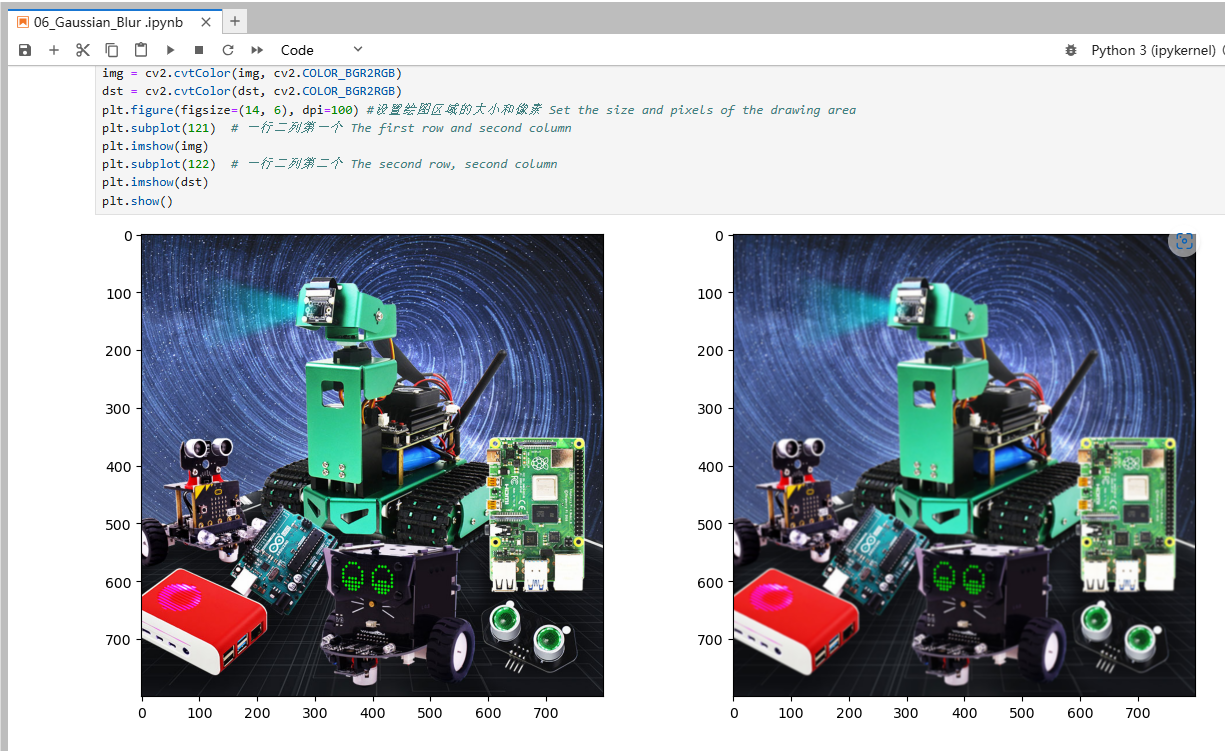
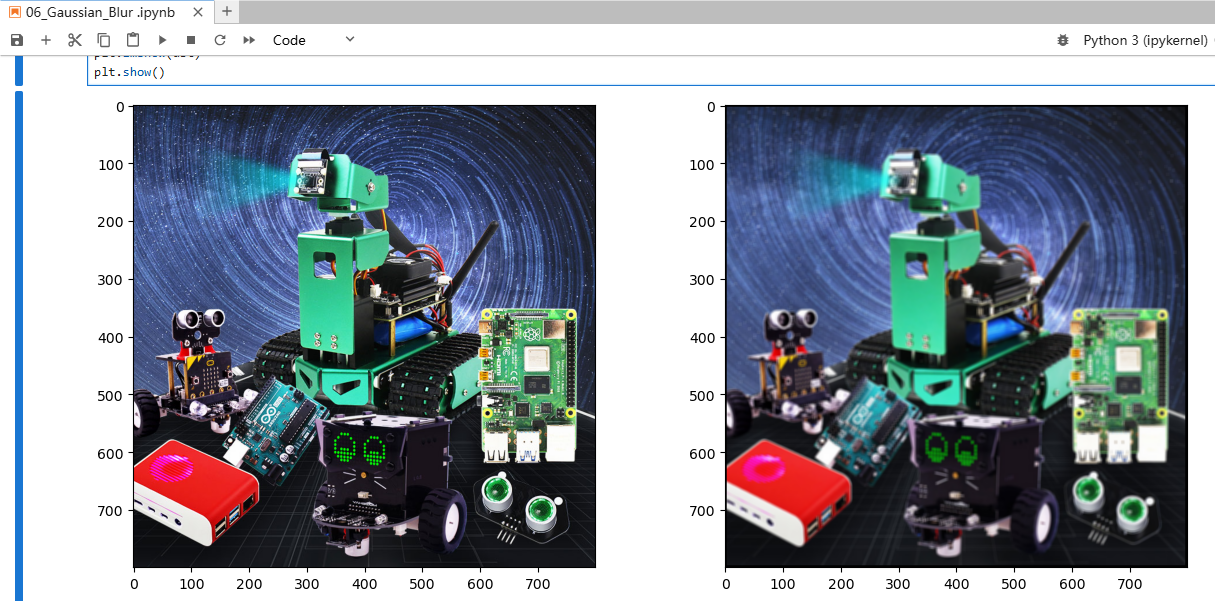
Gaussian blur is essentially a mean blur, but Gaussian blur is based on weighted average. The closer the distance, the greater the weight, and the farther the distance, the smaller the weight.

In layman's terms, Gaussian filtering is the process of weighted averaging the entire image. The value of each pixel is obtained by weighted averaging itself and other pixel values in the neighborhood.

6.2 Actual effect display

Source code path:

/home/pi/Rider-pi_class/4.Open Source CV/D.Image_Enhancement/01_Color_Image_Histogram.ipynb

​x
import cv2
import numpy as np
import matplotlib.pyplot as plt
​
img = cv2.imread('yahboom.jpg',1)
# cv2.imshow('src',img)
dst = cv2.GaussianBlur(img,(5,5),1.5)
# cv2.imshow('dst',dst)
# cv2.waitKey(0)
img = cv2.cvtColor(img, cv2.COLOR_BGR2RGB)
dst = cv2.cvtColor(dst, cv2.COLOR_BGR2RGB)
plt.figure(figsize=(14, 6), dpi=100) #设置绘图区域的大小和像素 Set the size and pixels of the drawing area
plt.subplot(121)  # 一行二列第一个 The first row and second column
plt.imshow(img)
plt.subplot(122)  # 一行二列第二个 The second row, second column
plt.imshow(dst)
plt.show()

xxxxxxxxxx
​
import cv2
import numpy as np
import matplotlib.pyplot as plt
​
img = cv2.imread('yahboom.jpg',1)
# cv2.imshow('src',img)
imgInfo = img.shape
height = imgInfo[0]
width = imgInfo[1]
dst = np.zeros((height,width,3),np.uint8)
for i in range(3,height-3):
    for j in range(3,width-3):
        sum_b = int(0)
        sum_g = int(0)
        sum_r = int(0)
        for m in range(-3,3):#-3 -2 -1 0 1 2
            for n in range(-3,3):
                (b,g,r) = img[i+m,j+n]
                sum_b = sum_b+int(b)
                sum_g = sum_g+int(g)
                sum_r = sum_r+int(r)
            
        b = np.uint8(sum_b/36)
        g = np.uint8(sum_g/36)
        r = np.uint8(sum_r/36)
        dst[i,j] = (b,g,r)
# cv2.imshow('dst',dst)
# cv2.waitKey(0)
img = cv2.cvtColor(img, cv2.COLOR_BGR2RGB)
dst = cv2.cvtColor(dst, cv2.COLOR_BGR2RGB)
plt.figure(figsize=(14, 6), dpi=100) #设置绘图区域的大小和像素 Set the size and pixels of the drawing area
plt.subplot(121)  # 一行二列第一个 The first row and second column
plt.imshow(img)
plt.subplot(122)  # 一行二列第二个 The second row, second column
plt.imshow(dst)
plt.show()

Skin whitening
Median Filter

COMPANY

  • About us
  • Team Style
  • Blog

LEARNING & EXPLORATION

  • Tutorials
  • Edge AI hardware
  • Educational robots
  • Embedded intelligent hardware

WHERE TO BUY

  • Yahboom Online Store
  • Amazon
  • Alibaba
  • AliExpress
  • Mercado

TECHNOLOGY SUPPORT

  • Email: support@yahboom.com

BE A DISTRIBUTOR

  • Email: sales@yahboom.com
QR Code
QR Code

Copyright © 2017-2026 Yahboom. All Rights Reserved.

EN/中文