yahboom
HomeLearn
Solution
Blog
Online Store
About Us
EN/中文
NUWA-HP60C Depth Camera📖
1.ROS1-Depth camera usage course
  • 1. Environment Construction
  • 2. Camera recording video
2.ROS1-ROS+OpenCV application
  • 1.ROS+Opencv Basics
  • 2.Face recognition
  • 3.Harris corner detection
  • 4. Target Tracking Algorithm
  • 5. Contour moment
  • 6. Polygonal Outlines
  • 7. Discrete Fourier Transform Algorithm
  • 8. Edge Detection Algorithm
  • 9. Face Detection Algorithm
  • 10. Optical flow detection algorithm
  • 11. Contour Detection
  • 12. General contour detection
  • 13. Feature point tracking
  • 14.HLS Color Filtering
  • 15. Hough circle detection
  • 16. Hough Line Detection
  • 17.HSV color filtering
  • 18.LK optical flow algorithm
  • 19. Human Detection Algorithm
  • 20. Phase-correlated displacement detection
  • 21. Image pyramid sampling algorithm
  • 22.RGB color filtering
  • 23. Clear background detection algorithm
  • 24. Streamlining the optical flow algorithm
  • 25. Simple Filter
  • 26. Threshold Image Processing
  • 27. Watershed segmentation algorithm
3.ROS1-Mediapipe course
  • 1.Hand detection
  • 2.Posture detection
  • 3.Overall detection
  • 4.Face Mesh
  • 5.Face recognition
  • 6.Face effects
  • 7.Face Detection
  • 8.3D Object Recognition
  • 9.Paintbrush
  • 10.Finger control
  • 11.Gesture Recognition
4.ROS1-Depth camera application course
  • 1. Camera calibration
  • 2. QR code
  • 3. Human Pose Estimation
  • 4. Target detection
  • 5. Point cloud data viewing
  • 6. AR Vision
  • 7.AR QR code tracking
  • 8. Color Tracking
  • 9. Object Tracking
5.ROS1-Linux basic course
  • 1.Introduction to Linux system
  • 2.Ubuntu file system
  • 3.Ubuntu common commands
  • 4.Ubuntu common editors
  • 5.Ubuntu software operation commands
  • 6.Virtual machine installation
  • 7.SSH remote control
  • 8.VNC remote control
  • 9.Transfer files remotely
  • 10.Driver library and communication
  • 11.Static IP and hotspot mode
  • 12.Bind device ID
  • 13.Capacity expansion and resource allocation
  • 14.Update system software sources
  • 15.Set root user password
  • 16.sudo free password
  • 17.Connect to WiFi network
  • 18.View system version
  • 19.Customized service management
  • 20.Back up system image
6.ROS1-OpenCV course
  • 1.Opencv Source CV Introduction
  • 2.Image reading and display
  • 3.Picture writing
  • 4.Picture Quality
  • 5.Pixel Operation
  • 6.Picture scaling
  • 7.Picture cutting
  • 8.Picture translation
  • 9.Picture mirroring
  • 10.Affine transformation
  • 11.Picture rotation
  • 12.Perspective transformation
  • 13.Grayscale processing
  • 14.Image binarization
  • 15.Edge detection
  • 16.Line segment drawing
  • 17.Rectangle and circle drawing
  • 18.Text and picture drawing
7.ROS1 basic course
  • 1.ROS introduction
  • 2.ROS installation
  • 3.ROS common command tools
  • 4.ROS workspace
  • 5.ROS function package
  • 6.ROS node
  • 7.ROS topic publisher
  • 8.ROS topic subscribers
  • 9.ROS service client
  • 10.ROS service server
  • 11.ROS action client
  • 12.ROS action server
  • 13.ROS custom message reception
  • 14.ROS-launch file
  • 15.ROS-TF transformation
  • 16.ROS parameter service
  • 17.ROS-rviz use
  • 18.ROS-rqt tool usage
  • 19.Topic message recording and playback
  • 20.urdf model introduction
  • 21.gazebo introduction
  • 22.ROS distributed communication
8.ROS2-Depth Camera Application Course
  • 1. Use of Depth Camera
  • 2. Camera internal parameter calibration
  • 3. Color tracking
  • 4. KCF Object Tracking
  • 5. ORBSLAM2 Basics
  • 6. ORB_SLAM2 PCL Mapping
  • 7. ORB_SLAM2 Octomap Mapping
9.ROS2-OpenCV course
  • 1. ROS+OpenCV application
  • 2. QR code creation and recognition
  • 3. AR Vision
10.ROS2-Mediapipe course
  • 1.Hand detection
  • 2.Posture detection
  • 3.Overall detection
  • 4.Face Mess
  • 5.Face recognition
11.ROS2 basic course
  • 1.Introduction to ROS2
  • 2.ROS2 install Humble
  • 3.ROS2 development environment
  • 4.ROS2 workspace
  • 5.ROS2 function package
  • 6.ROS2 node
  • 7.ROS2 topic communication
  • 8.ROS2 service communication
  • 9.ROS2 action communication
  • 10.ROS2 custom interface message
  • 11.ROS2 parameter service case
  • 12.ROS2 meta-function package
  • 13.ROS2 distributed communication
  • 14.ROS2 DDS
  • 15.ROS2 time related API
  • 16.ROS2 common command tools
  • 17.ROS2 rviz2 use
  • 18.ROS2 rqt toolbox
  • 19.ROS2 Launch startup file configuration
  • 20.ROS2 recording and playback tool
  • 21.ROS2 URDF model
  • 22.ROS2 Gazebo simulation platform
  • 23.ROS2 TF2 coordinate transformation
5.Bracket installation video
  • Bracket installation video
Download
  • ROS1_VM
  • ROS2_VM
  • ROS1_Code
  • ROS2_Code
  • DataSheet
  • 3D_Model_File
  • Windows Software
  • ROS2_Basic_VM
Download ZIP

Welcome to NUWA-HP60C Depth Camera repository

1.Hand detection

1. Hand detection

1. Hand detection

1.1. Introduction

MediaPipe is an open-source data stream processing machine learning application development framework developed by Google. It is a graph-based data processing pipeline used to build data sources in various forms, such as video, audio, sensor data, and any time series data. MediaPipe is cross-platform and can run on embedded platforms (Raspberry Pi, etc.), mobile devices (iOS and Android), workstations and servers, and supports mobile GPU acceleration. MediaPipe provides cross-platform, customizable ML solutions for real-time and streaming media. The core framework of MediaPipe is implemented in C++ and supports languages such as Java and Objective C. The main concepts of MediaPipe include packets, streams, calculators, graphs, and subgraphs.

Features of MediaPipe:

  • End-to-end acceleration: built-in fast ML inference and processing can be accelerated even on commodity hardware.
  • Build once, deploy anywhere: unified solution for Android, iOS, desktop/cloud, web and IoT.
  • Ready-to-use solution: cutting-edge ML solution that demonstrates the full capabilities of the framework.
  • Free and open source: framework and solution under Apache2.0, fully extensible and customizable.

1.2, MediaPipe Hands

MediaPipe Hands is a high-fidelity hand and finger tracking solution. It uses machine learning (ML) to infer 21 3D coordinates of the hand from a frame.

After palm detection for the entire image, the 21 3D hand joint coordinates in the detected hand area are accurately located by regression based on the hand marker model, that is, direct coordinate prediction. The model learns a consistent internal hand pose representation that is robust even to partially visible hands and self-occlusions.

To obtain ground truth data, ~30K real-world images were manually annotated with 21 3D coordinates, as shown below (Z values were taken from the image depth map, if available for each corresponding coordinate). To provide better coverage of possible hand poses and provide additional supervision on the properties of the hand geometry, high-quality synthetic hand models were also drawn against various backgrounds and mapped to the corresponding 3D coordinates.
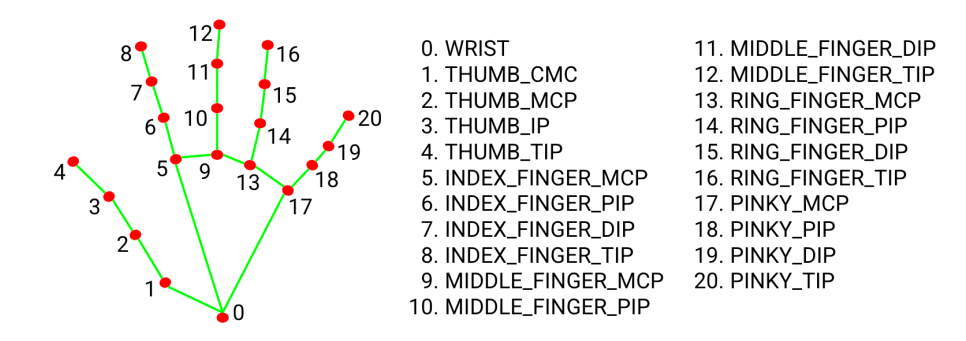
image-20231016094011872

1.3, Hand detection

1.3.1, Start

Start the camera

ros2 launch ascamera hp60c.launch.py

Open a new terminal and enter,

xxxxxxxxxx
ros2 run yahboomcar_mediapipe 01_HandDetector
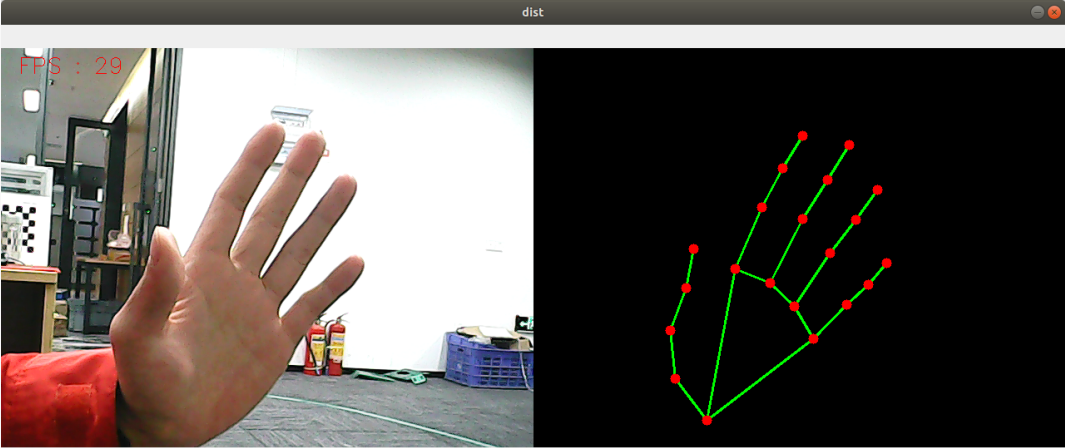
image-20231016094749653

1.3.2, Source code

Source code location: ~/ascam_ros2_ws/src/yahboomcar_mediapipe/yahboomcar_mediapipe/01_HandDetector.py

​x
#!/usr/bin/env python3
# encoding: utf-8
​
#import ros lib
import rclpy
from rclpy.node import Node
from geometry_msgs.msg import Point
from sensor_msgs.msg import Image
from cv_bridge import CvBridge
import mediapipe as mp
#import define msg
from yahboomcar_msgs.msg import PointArray
​
#import common lib
import cv2 as cv
import numpy as np
import time
import os
print("import done")
​
​
class HandDetector(Node):
    def __init__(self, name, mode=False, maxHands=2, detectorCon=0.5, trackCon=0.5):
        super().__init__(name)
        self.mpHand = mp.solutions.hands
        self.mpDraw = mp.solutions.drawing_utils
        self.hands = self.mpHand.Hands(
            static_image_mode=mode,
            max_num_hands=maxHands,
            min_detection_confidence=detectorCon,
            min_tracking_confidence=trackCon)
        self.lmDrawSpec = mp.solutions.drawing_utils.DrawingSpec(color=(0, 0, 255), thickness=-1, circle_radius=6)
        self.drawSpec = mp.solutions.drawing_utils.DrawingSpec(color=(0, 255, 0), thickness=2, circle_radius=2)
        # Create publisher to publish hand points
        self.pub_point = self.create_publisher(PointArray, '/mediapipe/points', 1000)
        
        # Initialize CvBridge to convert ROS images to OpenCV format
        self.bridge = CvBridge()
​
        # Subscribe to the image topic
        self.create_subscription(Image, '/ascamera_hp60c/camera_publisher/rgb0/image', self.image_callback, 10)
​
        self.pTime = 0  # Initialize pTime to calculate FPS
        self.exit_flag = False  # Flag to indicate exit condition
​
    def image_callback(self, msg):
        # Convert ROS image message to OpenCV format
        frame = self.bridge.imgmsg_to_cv2(msg, desired_encoding='bgr8')
        frame, img = self.pubHandsPoint(frame, draw=False)
        
        # Display FPS and combine frames
        cTime = time.time()
        fps = 1 / (cTime - self.pTime)
        self.pTime = cTime
        text = "FPS : " + str(int(fps))
        cv.putText(frame, text, (20, 30), cv.FONT_HERSHEY_SIMPLEX, 0.9, (0, 0, 255), 1)
        
        # Combine the frames (original and landmark drawn image)
        dist = self.frame_combine(frame, img)
        
        # Check if 'q' is pressed to exit the program
        if cv.waitKey(1) & 0xFF == ord('q'):
            self.exit_flag = True
        
        # Display the final image
        cv.imshow('dist', dist)
​
    def pubHandsPoint(self, frame, draw=True):
        pointArray = PointArray()
        img = np.zeros(frame.shape, np.uint8)
        img_RGB = cv.cvtColor(frame, cv.COLOR_BGR2RGB)
        self.results = self.hands.process(img_RGB)
        if self.results.multi_hand_landmarks:
            for i in range(len(self.results.multi_hand_landmarks)):
                if draw: self.mpDraw.draw_landmarks(frame, self.results.multi_hand_landmarks[i], self.mpHand.HAND_CONNECTIONS, self.lmDrawSpec, self.drawSpec)
                self.mpDraw.draw_landmarks(img, self.results.multi_hand_landmarks[
AR Vision
Posture detection

COMPANY

  • About us
  • Team Style
  • Blog

LEARNING & EXPLORATION

  • Tutorials
  • Edge AI hardware
  • Educational robots
  • Embedded intelligent hardware

WHERE TO BUY

  • Yahboom Online Store
  • Amazon
  • Alibaba
  • AliExpress
  • Mercado

TECHNOLOGY SUPPORT

  • Email: support@yahboom.com

BE A DISTRIBUTOR

  • Email: sales@yahboom.com
QR Code

Copyright © 2017-2026 Yahboom. All Rights Reserved.

EN/中文