Welcome to NUWA-HP60C Depth Camera repository
3.Overall detection
3. Overall detection
3.1. Introduction
MediaPipe is an open-source data stream processing machine learning application development framework developed by Google. It is a graph-based data processing pipeline used to build data sources in various forms, such as video, audio, sensor data, and any time series data. MediaPipe is cross-platform and can run on embedded platforms (Raspberry Pi, etc.), mobile devices (iOS and Android), workstations and servers, and supports mobile GPU acceleration. MediaPipe provides cross-platform, customizable ML solutions for real-time and streaming media.
The core framework of MediaPipe is implemented in C++ and provides support for languages such as Java and Objective C. The main concepts of MediaPipe include packets, streams, calculators, graphs, and subgraphs.
Features of MediaPipe:
- End-to-end acceleration: built-in fast ML inference and processing can be accelerated even on ordinary hardware.
- Build once, deploy anywhere: unified solution for Android, iOS, desktop/cloud, web, and IoT.
- Ready-to-use solution: cutting-edge ML solution that demonstrates the full capabilities of the framework.
- Free and open source: framework and solution under Apache2.0, fully extensible and customizable.
3.2, MediaPipe Hands
Refer to the content of hand detection [1.2] in the first section, which will not be repeated here.
3.3, MediaPipe Pose
Refer to the content of hand detection [2.2] in the first section, which will not be repeated here.
3.4, overall detection
Combining the content of the previous two sections, this section's routine implements the function of detecting both palms and human bodies.
3.4.1, Start
Start the camera
ros2 launch ascamera hp60c.launch.py
Open a new terminal and input,
xxxxxxxxxxros2 run yahboomcar_mediapipe 03_Holistic
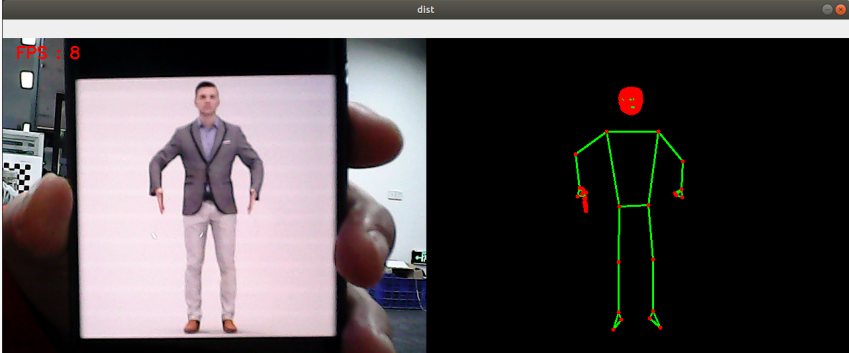
3.4.2, Source code
Source code location: ~/ascam_ros2_ws/src/yahboomcar_mediapipe/yahboomcar_mediapipe/03_Holistic.py
x#!/usr/bin/env python3# encoding: utf-8import rclpyfrom rclpy.node import Nodefrom geometry_msgs.msg import Pointfrom sensor_msgs.msg import Imageimport mediapipe as mpfrom yahboomcar_msgs.msg import PointArrayimport cv2 as cvimport numpy as npimport timefrom cv_bridge import CvBridgeprint("import done")class Holistic(Node): def __init__(self, name, staticMode=False, landmarks=True, detectionCon=0.5, trackingCon=0.5): super().__init__(name) self.mpHolistic = mp.solutions.holistic self.mpFaceMesh = mp.solutions.face_mesh self.mpHands = mp.solutions.hands self.mpPose = mp.solutions.pose self.mpDraw = mp.solutions.drawing_utils self.mpholistic = self.mpHolistic.Holistic( static_image_mode=staticMode, smooth_landmarks=landmarks, min_detection_confidence=detectionCon, min_tracking_confidence=trackingCon) # Create publisher to publish pose points self.pub_point = self.create_publisher(PointArray, '/mediapipe/points', 1000) # Initialize CvBridge to convert ROS Image messages to OpenCV format self.bridge = CvBridge() # Create subscription to the image topic self.create_subscription(Image, '/ascamera_hp60c/camera_publisher/rgb0/image', self.image_callback, 10) self.lmDrawSpec = mp.solutions.drawing_utils.DrawingSpec(color=(0, 0, 255), thickness=-1, circle_radius=3) self.drawSpec = mp.solutions.drawing_utils.DrawingSpec(color=(0, 255, 0), thickness=2, circle_radius=2) # FPS variables self.pTime = 0 self.exit_flag = False # Flag to indicate exit condition def image_callback(self, msg): # Convert ROS Image message to OpenCV format frame = self.bridge.imgmsg_to_cv2(msg, desired_encoding='bgr8') # Process the frame for holistic (pose, hands, face mesh) detection frame, img = self.findHolistic(frame, draw=False) # Calculate FPS cTime = time.time() fps = 1 / (cTime - self.pTime) self.pTime = cTime text = "FPS : " + str(int(fps)) # Display FPS on frame cv.putText(frame, text, (20, 30), cv.FONT_HERSHEY_SIMPLEX, 0.9, (0, 0, 255), 1) # Combine the frames (original and holistic detection result) dist = self.frame_combine(frame, img) # Show the combined image cv.imshow('Holistic Detection', dist) # Exit the program if 'q' is pressed if cv.waitKey(1) & 0xFF == ord('q'): self.exit_flag = True def findHolistic(self, frame, draw=True): pointArray = PointArray() img = np.zeros(frame.shape, np.uint8) img_RGB = cv.cvtColor(frame, cv.COLOR_BGR2RGB) self.results = self.mpholistic.process(img_RGB) if self.results.face_landmarks: if draw: self.mpDraw.draw_landmarks(frame, self.results.face_landmarks, self.mpFaceMesh.FACEMESH_CONTOURS, self.lmDrawSpec, self.drawSpec) self.mpDraw.draw_landmarks(img, self.results.face_landmarks, self.mpFaceMesh.FACEMESH_CONTOURS, self.lmDrawSpec, self.drawSpec) for id, lm in enumerate(self.results.face_landmarks.landmark): point = Point() point.x, point.y, point.z = lm.x, lm.y, lm.z pointArray.points.append(point) if self.results.pose_landmarks: if draw: self.mpDraw.draw_landmarks(frame, self.results.pose_landmarks, self.mpPose.POSE_CONNECTIONS, self.lmDrawSpec, self.drawSpec) self.mpDraw.draw_landmarks(img, self.results.pose_landmarks, self.mpPose.POSE_CONNECTIONS, self.lmDrawSpec, self.drawSpec) for id, lm in enumerate(self.results.pose_landmarks.landmark): point = Point() point.x, point.y, point.z = lm.x, lm.y, lm.z pointArray.points.append(point) if self.results.left_hand_landmarks: if draw: self.mpDraw.draw_landmarks(frame, self.results.left_hand_landmarks, self.mpHands.HAND_CONNECTIONS, self.lmDrawSpec, self.drawSpec) self.mpDraw.draw_landmarks(img, self.results.left_hand_landmarks, self.mpHands.HAND_CONNECTIONS, self.lmDrawSpec, self.drawSpec) for id, lm in enumerate(self.results.left_hand_landmarks.landmark): point = Point() point.x, point.y, point.z = lm.x, lm.y, lm.z pointArray.points.append(point) if self.results.right_hand_landmarks: if draw: self.mpDraw.draw_landmarks(frame, self.results.right_hand_landmarks, self.mpHands.HAND_CONNECTIONS, self.lmDrawSpec, self.drawSpec) self.mpDraw.draw_landmarks(img, self.results.right_hand_landmarks, self.mpHands.HAND_CONNECTIONS, self.lmDrawSpec, self.drawSpec) for id, lm in enumerate(self.results.right_hand_landmarks.landmark): point = Point() point.x, point.y, point.z = lm.x, lm.y, lm.z pointArray.points.append(point) # Publish the detected points self.pub_point.publish(pointArray) return frame, img def frame_combine(self, frame, src): if len(frame.shape) == 3: frameH, frameW = frame.shape[:2] srcH, srcW = src.shape[:2] dst = np.zeros((max(frameH, srcH), frameW + srcW, 3), np.uint8) dst[:, :frameW] = frame[:, :] dst[:, frameW:] = src[:, :] else: src = cv.cvtColor(src, cv.COLOR_BGR2GRAY) frameH, frameW = frame.shape[:2] imgH, imgW = src.shape[:2] dst = np.zeros((frameH, frameW + imgW), np.uint8) dst[:, :frameW] = frame[:, :] dst[:, frameW:] = src[:, :] return dst def run(self): # Custom loop for handling ROS 2 callback and OpenCV events while rclpy.ok() and not self.exit_flag: rclpy.spin_once(self) # Process one callback if self.exit_flag: break cv.destroyAllWindows()def main(): print("start it") rclpy.init() holistic = Holistic('holistic') try: holistic.run() except KeyboardInterrupt: pass finally: holistic.destroy_node() rclpy.shutdown()if __name__ == '__main__': main()