Welcome to ROSMASTER A1 repository
7.3D object recognition
3D object recognition
1. Content Description
This course implements the functions of acquiring color images and using the MediaPipe framework to recognize 3D objects (the examples only show four: a mug, a shoe, a chair, and a camera). This section requires entering commands in the terminal. The terminal to open depends on the motherboard type. This section uses a Raspberry Pi 5 as an example.
For Raspberry Pi and Jetson Nano boards, you need to open a terminal on the host computer and enter the command to enter the Docker container. Once inside the Docker container, enter the commands mentioned in this section in the terminal. For instructions on entering the Docker container from the host computer, refer to [01. Robot Configuration and Operation Guide] --[5.Enter Docker (For JETSON Nano and RPi 5)].
For Orin and RDK motherboards, simply open the terminal and enter the commands mentioned in this section.
2. Program Startup
For the Raspberry Pi 5 and jetson nano controller, you must first enter the Docker container. For the Orin and RDK controller, this is not necessary.
Entering the Docker container (see the Docker course for steps: 4. Docker Startup Script).
All commands below must be executed within the same Docker container (See the Docker course for steps: 3. Docker Commit and Multi-Terminal Entry).
First, in the terminal, enter the following command to start the camera.
#usb cameraros2 launch usb_cam camera.launch.py#nuwa cameraros2 launch ascamera hp60c.launch.pyAfter successfully starting the camera, open another terminal and enter the following command to start the 3D object detection program.
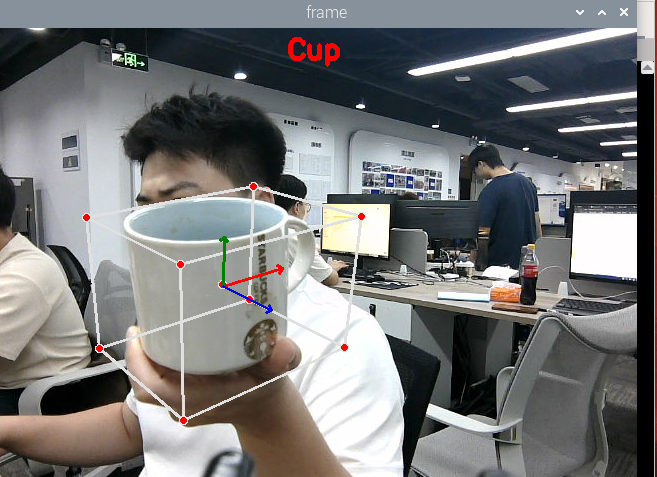
xxxxxxxxxxros2 run yahboomcar_mediapipe 07_ObjectronAfter running the program, the default object to be recognized is shoes. You can press the F key to switch the object to be recognized. As shown in the image below, a mug is recognized.
3. Core Code Analysis
Program Code Path:
- Raspberry Pi 5 and Jetson Nano motherboard
The program code is running in Docker. The path in Docker is /root/yahboomcar_ros2_ws/yahboomcar_ws/src/yahboomcar_mediapipe/yahboomcar_mediapipe/07_Objectron.py
- Orin motherboard
The program code path is /home/jetson/yahboomcar_ros2_ws/yahboomcar_ws/src/yahboomcar_mediapipe/yahboomcar_mediapipe/07_Objectron.py
- RDK motherboard
The program code path is /home/sunrise/yahboomcar_ros2_ws/yahboomcar_ws/src/yahboomcar_mediapipe/yahboomcar_mediapipe/07_Objectron.py
Import the necessary library files.
xxxxxxxxxximport mediapipe as mpimport cv2 as cvimport timeimport rclpyfrom rclpy.node import Nodefrom sensor_msgs.msg import Imagefrom cv_bridge import CvBridgeimport osimport numpy as npInitialize data and define publishers and subscribers,
xxxxxxxxxxdef __init__(self, staticMode=False, maxObjects=5, minDetectionCon=0.5, minTrackingCon=0.99): super().__init__('objectron') self.staticMode = staticMode self.maxObjects = maxObjects self.minDetectionCon = minDetectionCon self.minTrackingCon = minTrackingCon self.index = 0 self.modelNames = ['Shoe', 'Chair', 'Cup', 'Camera'] #Use the class in the mediapipe library to define a 3D detection object self.mpObjectron = mp.solutions.objectron self.mpDraw = mp.solutions.drawing_utils self.mpobjectron = self.mpObjectron.Objectron( self.staticMode, self.maxObjects, self.minDetectionCon, self.minTrackingCon, self.modelNames[self.index]) self.bridge = CvBridge() #Define subscribers for the color image topic camera_type = os.getenv('CAMERA_TYPE', 'usb') topic_name = '/ascamera_hp60c/camera_publisher/rgb0/image' if camera_type == 'nuwa' else '/usb_cam/image_raw' self.subscription = self.create_subscription( Image, topic_name, self.image_callback, 10)Color image callback function,
xxxxxxxxxxdef image_callback(self, msg): frame = self.bridge.imgmsg_to_cv2(msg, desired_encoding='bgr8') action = cv2.waitKey(1) #Press the F key to switch the recognized objects if action == ord('f') or action == ord('F') : self.configUP() frame = self.findObjectron(frame) cv.imshow('Objectron', frame)configUP switches the object recognition function and selects self.modelNames by modifying the value of self.index. The options for self.modelNames are ['Shoe', 'Chair', 'Cup', 'Camera']
xxxxxxxxxxdef configUP(self): self.index += 1 if self.index>=4:self.index=0 self.mpobjectron = self.mpObjectron.Objectron( self.staticMode, self.maxObjects, self.minDetectionCon, self.minTrackingCon, self.modelNames[self.index])findObjectron object recognition function,
xxxxxxxxxxdef findObjectron(self, frame): cv.putText(frame, self.modelNames[self.index], (int(frame.shape[1] / 2) - 30, 30), cv.FONT_HERSHEY_SIMPLEX, 0.9, (0, 0, 255), 3) #Convert the color space of the incoming image from BGR to RGB to facilitate subsequent image processing img_RGB = cv.cvtColor(frame, cv.COLOR_BGR2RGB) #Call the process function in the mediapipe library to process the image. During init, the self.pose object is created and initialized. results = self.mpobjectron.process(img_RGB) #Determine whether the target object is recognized if results.detected_objects: for id, detection in enumerate(results.detected_objects): #On the image, draw the coordinate system for the identified target object self.mpDraw.draw_landmarks(frame, detection.landmarks_2d, self.mpObjectron.BOX_CONNECTIONS) self.mpDraw.draw_axis(frame, detection.rotation, detection.translation) return frame