yahboom
HomeLearn
Solution
Blog
Online Store
About Us
EN/中文
RDK X5 Robot📖
01. RDK-X5-Robot Introduction
  • 1.Introduction
  • 2.Common Problem Analysis
  • 3.Battery and charger usage precautions
  • 4.TF card expand capacity
02. Assembly Tutorial
  • Assembly Tutorial
  • Assembly Video-1
  • Assembly Video-2
  • Assembly Video-3
  • Assembly Video-4
03. Remote Control Course
  • 1.Mobile APP remote control
  • 2.USB Wireless Controller Remote Control
04. ROS Driver Board Course
  • 1. Introduction of extension board
  • 2. Set up STM32 development environment
  • 3. Key control buzzer sound
  • 4. FreeRTOS application
  • 5. Serial communication
  • 6. SBUS model remote control
  • 7. CAN bus communication
  • 8. RGB color light strip
  • 9. Timer interrupt control PWM servo
  • 10. Control serial steering gear
  • 11. Nine-axis attitude sensor to obtain data
  • 12. Control motor forward and reverse
  • 13. The timer captures encoder data
  • 14. Theory of robot kinematics analysis
  • 15. PID control robot motion
05. Basic Control Course
  • 1.Update expansion board firmware
  • 2.Install Python driver library
  • 3.Set the car type
  • 4.Open and close APP program control
  • 5.Turn hotspot mode on and off
  • 6.Buzzer sound
  • 7.Control the motor to rotate forward and reverse
  • 8.Controlling robot movement
  • 9.OLED display
  • 10.Control fans and lighting effects
06. Development Environment
  • 1. Virtual machine installation and use
  • 2. Linux Basics
  • 3. Remote connection
  • 4. Multi-machine communication configuration
  • 5. Bind device ID
  • 6. Image installation and backup
07. ROS2 Basic Course
  • 1. Introduction to ROS2
  • 2. ROS2 install Humble
  • 3. ROS2 development environment
  • 4. ROS2 workspace
  • 5. ROS2 function package
  • 6. ROS2 node
  • 7. ROS2 topic communication
  • 8. ROS2 service communication
  • 9. ROS2 action communication
  • 10. ROS2 custom interface message
  • 11. ROS2 parameter service case
  • 12. ROS2 meta-function package
  • 13. ROS2 distributed communication
  • 14. ROS2 DDS
  • 15. ROS2 time related API
  • 16. ROS2 common command tools
  • 17. ROS2 rviz2 use
  • 18. ROS2 rqt toolbox
  • 19. ROS2 Launch startup file configuration
  • 20. ROS2 recording and playback tool
  • 21. ROS2 URDF model
  • 22. ROS2 Gazebo simulation platform
  • 23. ROS2 TF2 coordinate transformation
08. Robot Chassis Control Course
  • 1. PID algorithm theory
  • 2. Robot information release
  • 3. Robot control
  • 4. Robot state estimation
  • 5. Robot calibration
  • 6. Robot trajectory tracking
  • 7. URDF Model
09. LiDAR Course
  • 1. Introduction and use of lidar
  • 2. Lidar obstacle avoidance
  • 3. Lidar tracking
  • 4. Lidar guard
  • 5. Lidar patrol
  • 6. gmapping mapping algorithm
  • 7. Cartographer mapping algorithm
  • 8. Navigation and obstacle avoidance
  • 9. App Mapping and Navigation
10. OpenCV Course
  • 1. Getting started with OpenCV
  • 2. OpenCV geometric transformation
  • 3. OpenCV Image Processing
  • 4. OpenCV image beautification
  • 5. QR code creation and recognition
11. Mipi Camera Course
  • 1. Camera driver
  • 2. Adjust the color HSV value
  • 3. Color recognition
  • 4. Color Tracking
  • 5. Color Follow
  • 6. QR code instructions
  • 7. Face Detection
  • 8. Object Detection
  • 9. Visual line patrol-OpenCV
  • 10. Visual line patrol-deep learning
  • 11. Human body tracking
  • 12. Gesture control
12. Depth Camera Course
  • 1. Use of Depth Camera
  • 2. Camera intrinsic calibration
  • 3. ROS+OpenCV Basics
  • 4. AR Vision
  • 5. Color Tracking
  • 6. Object Tracking
  • 7. RTAB-Map 3D Mapping Navigation
13. Multi-robot Synchronous Control
  • Multi-vehicle synchronous control
Remote login control
  • 1. VNC and SSH remote login
  • 2. Jupyter lab login and case code running
Download
  • System_File
  • Code
  • VM_File
  • Software_Tools
  • Hardware_Info
  • Firmware
  • Instruction_Manual
  • ROS2_Basic_VM
Download ZIP

Welcome to RDK X5 Robot repository

2. Lidar obstacle avoidance

2. Lidar obstacle avoidance

2. Lidar obstacle avoidance2.1. Program function description2.2, Program code reference path2.3, Program startup2.3.1, Car startup command2.3.2, Virtual machine end parameter modification2.3.3, view the topic communication node graph2.4, core source code analysis

2.1. Program function description

After the program is started, the car will move forward. When an obstacle appears within the detection range, it will adjust its posture, avoid the obstacle, and then continue to move forward.

Click [Switch] after starting the dynamic parameter regulator on the virtual machine to turn on/pause this function.

In addition, the [L1] button of the handle can lock/open the motion control of the car. When the motion control is turned on, the function will be locked; when the motion control is locked, the function can be turned on.

2.2, Program code reference path

After SSH connects to the car, the location of the function source code is,

xxxxxxxxxx
#python file
/home/sunrise/yahboomcar_ws/src/yahboomcar_laser/yahboomcar_laser/laser_avoidance.py
#launch file
/home/sunrise/yahboomcar_ws/src/yahboomcar_laser/launch/laser_avoidance_launch.py

2.3, Program startup

2.3.1, Car startup command

After SSH connects to the car, enter in the terminal,

xxxxxxxxxx
ros2 launch yahboomcar_laser laser_avoidance_launch.py

2.3.2, Virtual machine end parameter modification

Open the dynamic parameter adjuster on the virtual machine end, open the terminal and enter,

xxxxxxxxxx
ros2 run rqt_reconfigure rqt_reconfigure
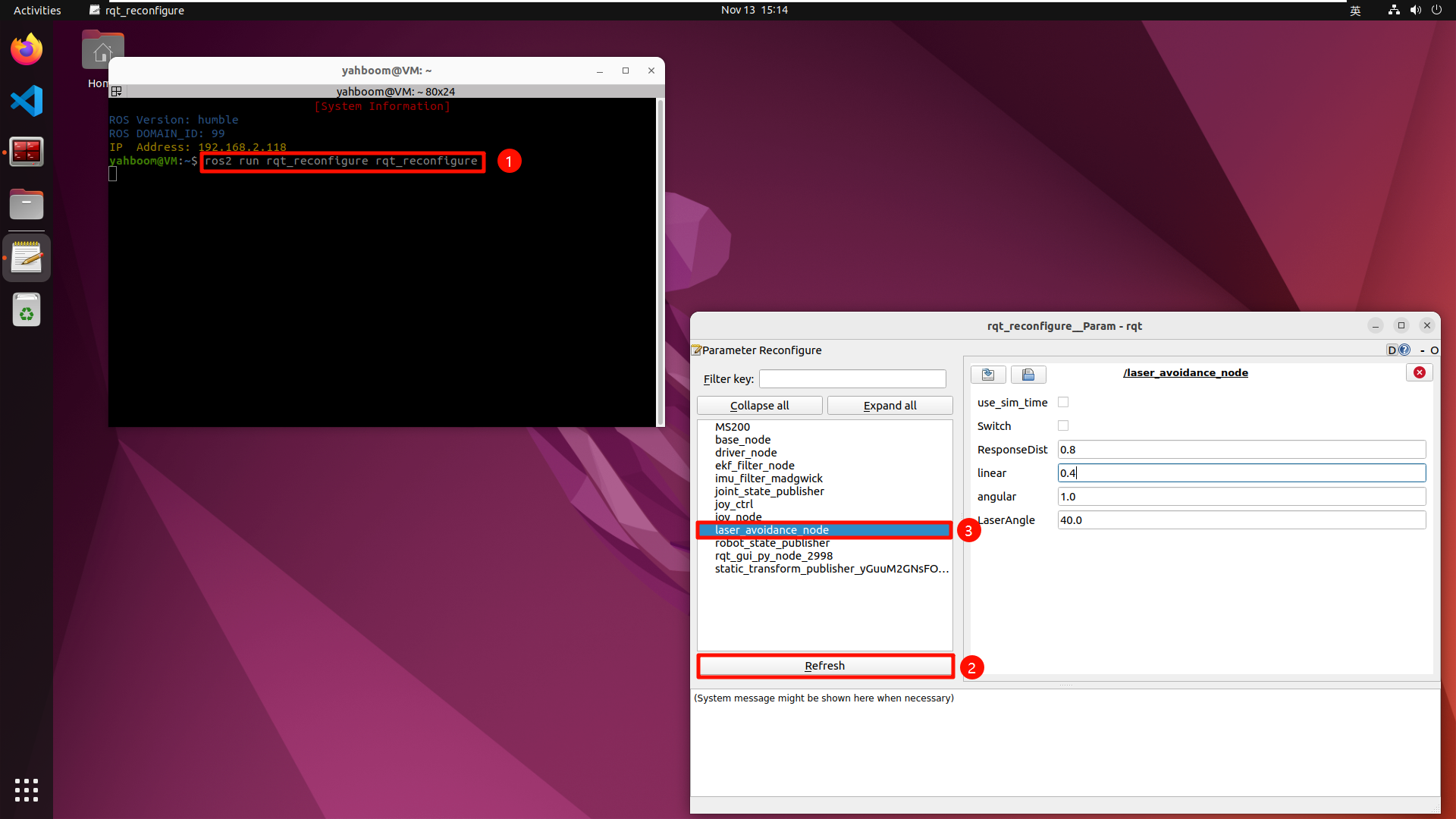
image-20241113151455101

The meaning of each parameter is as follows,

Parameter nameParameter meaning
SwitchGameplay switch
ResponseDistObstacle detection distance
linearLinear speed
angularAngular speed
LaserAngleRadar detection angle

The above parameters can be adjusted. Check or uncheck [Switch] to turn on or pause the radar obstacle avoidance function.

The other four need to be set in decimals. After modification, press the Enter key or click on the blank space to write.

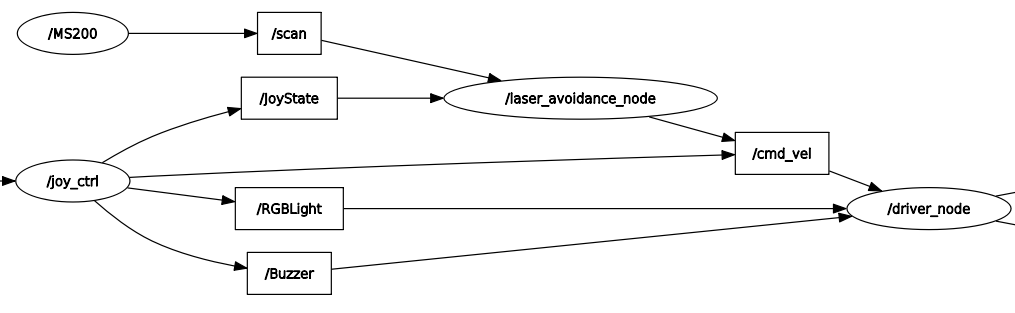
2.3.3, view the topic communication node graph

Virtual machine terminal input,

xxxxxxxxxx
ros2 run rqt_graph rqt_graph

1684746599055

2.4, core source code analysis

Mainly look at the callback function of the radar, which explains how to obtain the obstacle distance information at each angle,

def registerScan(self, scan_data):
if not isinstance(scan_data, LaserScan): return
self.right_warning = 0
self.left_warning = 0
self.front_warning = 0

ranges = np.array(scan_data.ranges)
for i in range(len(ranges)):
if ranges[i] < self.ResponseDist: #range[i] is the result of the radar scan, which refers to the distance information
angle = (scan_data.angle_min + scan_data.angle_increment * i) * 180 / pi #The angle of the radar information is in radians, so it needs to be converted to angles for calculation here.
if angle > 180: angle = angle - 360 #angle is used to set the judgment range based on the structure of the radar.
if -self.LaserAngle < angle < -20:
self.right_warning += 1
elif abs(angle) <= 20:
self.front_warning += 1
elif 20 < angle < self.LaserAngle:
self.left_warning += 1
if self.Joy_active == True or self.Switch == False:
if self.Moving == True:
self.pub_vel.publish(Twist())
self.Moving = not self.Moving
return
self.Moving = True
Introduction and use of lidar
Lidar tracking

COMPANY

  • About us
  • Team Style
  • Blog

LEARNING & EXPLORATION

  • Tutorials
  • Edge AI hardware
  • Educational robots
  • Embedded intelligent hardware

WHERE TO BUY

  • Yahboom Online Store
  • Amazon
  • Alibaba
  • AliExpress
  • Mercado

TECHNOLOGY SUPPORT

  • Email: support@yahboom.com

BE A DISTRIBUTOR

  • Email: sales@yahboom.com
QR Code

Copyright © 2017-2026 Yahboom. All Rights Reserved.

EN/中文