yahboom
HomeLearn
Solution
Blog
Online Store
About Us
EN/中文
RDK X3 Robot📖
01. About RDK-X3-Robot
1. Instructions
  • 1. Introduction
  • 2. FAQ
  • 3. Battery and charger use precautions
  • 4.TF card expand capacity
2. Common problem analysis
02. Assembly video
  • Part1-Install Motor
  • Part2-Install Battert Fixing Column
  • Part3-Install Motor Coupling
  • Part4-Install Mecanum wheel
  • Part5-Install Expansion Board
  • Part6-Wiring Show
  • Part7-Install Main Control Board
  • Part8-Install Car Top Plate and Antenna
  • Part9-Install OLED Screen
  • Part10-Install Depth Camera(Optional)
  • Part11-Install OLED Screen
  • Part12-Install HD Camera
  • Part13-Install Top Plate
  • Part14-Install Right Side Plate
  • Part15-Motor Wiring Show
  • Part16-lnstall Car Body
  • Part17-Install Battery
  • Part18-Install Lidar
03. Remote control tutorial
  • 1. The phone APP remote tutorial
  • 2. USB wireless controller remote tutorial
04. ROS functional tutorial
  • 1. Introduction of extension board
  • 2. Set up STM32 development environment
  • 3. Key control buzzer sound
  • 4. FreeRTOS application
  • 5. Serial communication
  • 6. SBUS model remote control
  • 7. CAN bus communication
  • 8. RGB color light strip
  • 9. Timer interrupt control PWM servo
  • 10. Control serial steering gear
  • 11. Nine-axis attitude sensor to obtain data
  • 12. Control motor forward and reverse
  • 13. The timer captures encoder data
  • 14. Theory of robot kinematics analysis
  • 15. PID control robot motion
05. Basic control tutorial
  • 1. Update the firmware of the expansion module
  • 2. Install the Python driver library
  • 3. Set the type of bottom car
  • 4. Open and close the APP program control
  • 5. Turn hotspot mode on and off
  • 6. The buzzer blows
  • 7. Control the motor forward and reverse
  • 8. Control robot movement
  • 9. OLED display
  • 10. Control fan and lamp effect
06. Development environment setup
  • 1. Virtual Machine
  • 2. Linux Basics
  • 3. Remote connection
  • 4. Multi-computer communication configuration
  • 5. Bind the device ID
  • 6. Image installation and backup
07. ROS2 Basic Course
  • 1. Introduction to ROS2
  • 2. ROS2 install Humble
  • 3. ROS2 development environment
  • 4. ROS2 workspace
  • 5. ROS2 function package
  • 6. ROS2 node
  • 7. ROS2 topic communication
  • 8. ROS2 service communication
  • 9. ROS2 action communication
  • 10. ROS2 custom interface message
  • 11. ROS2 parameter service case
  • 12. ROS2 meta-function package
  • 13. ROS2 distributed communication
  • 14. ROS2 DDS
  • 15. ROS2 time related API
  • 16. ROS2 common command tools
  • 17. ROS2 rviz2 use
  • 18. ROS2 rqt toolbox
  • 19. ROS2 Launch startup file configuration
  • 20. ROS2 recording and playback tool
  • 21. ROS2 URDF model
  • 22. ROS2 Gazebo simulation platform
  • 23. ROS2 TF2 coordinate transformation
08. Robot chassis control
  • 1. PID algorithm theory
  • 2. Robot information release
  • 3. Robot control
  • 4. Robot state estimation
  • 5. Robot calibration
  • 6. Robot trajectory tracking
  • 7. URDF model
09. Lidar courses
  • 1. Introduction and use of lidar
  • 2. Lidar obstacle avoidance
  • 3. Lidar following
  • 4. Lidar guard
  • 5. Patrol
  • 6. gmapping algorithm
  • 7. cartographer algorithm
  • 8. Navigation and obstacle avoidance
  • 9. App mapping and navigation
10. OpenCV courses
  • 1. Introduction to OpenCV
  • 2. OpenCV geometric transformation
  • 3. OpenCV image processing
  • 4. OpenCV image beautification
  • 5. Qr code creation and identification
11. MIPI camera course
  • 1. Camera driver
  • 2. Adjust the color HSV value
  • 3. Color recognition
  • 4. Color tracking
  • 5. Color follow
  • 6. Qr code command
  • 7. Face detection
  • 8. Object detection
  • 9. Visual Inspection -OpenCV
  • 10. Visual inspection - Deep learning
  • 11. Human tracking
  • 12. Gesture control
12. Depth Camera courses
  • 1. Use depth camera
  • 2. Calibration of camera internal reference
  • 3. ROS+OpenCV Foundation
  • 4. AR vision
  • 5. Color tracking
  • 6. Object tracking
13. Multi vehicle control
  • 1. Multi-vehicle synchronous control
  • 2. Multi-vehicle navigation
Remote login control
  • 1. VNC and SSH remote login
  • 2. Jupyter lab login and case code running
Download
  • RemoteCtrl_APP(iOS/Android))
  • Mapping_APP(iOS_Android)
  • Code
  • System File
  • VM_File
  • Manual
  • Software_File
  • Hardware_File
  • ROS2_Basic_VM
Download ZIP

Welcome to RDK X3 Robot repository

16. ROS2 common command tools

16. ROS2 Common Command Tools

1. Package Management Tool ros2 pkg

1.1. ros2 pkg create

Function: Creates a package. When creating a package, you must specify the package name, compilation method, dependencies, etc.

Format:

xxxxxxxxxx
ros2 pkg create <package_name> --build-type <build-type> --dependencies <dependencies>

In the ros2 command:

  • pkg: Indicates the functions associated with the package;
  • create: Indicates the creation of a package;
  • package_name: Required: The name of the new package;
  • build-type: Required: Indicates whether the newly created package is C++ or Python. If using C++ or C, follow ament_cmake; if using Python, follow ament_python;
  • dependencies: Optional: Indicates the package's dependencies. C++ packages must include rclcpp; Python packages must include rclpy, as well as other required dependencies.

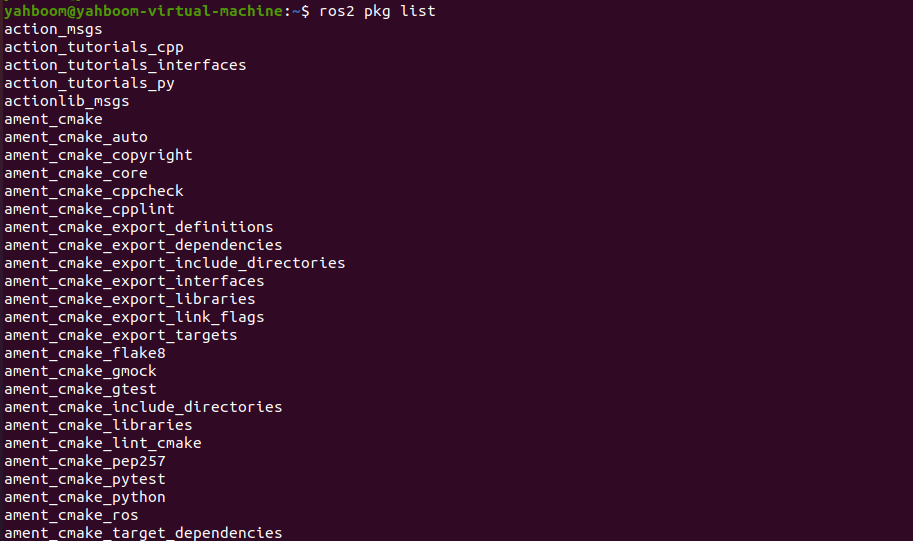
1.2, ros2 pkg list

Function: View the list of packages in the system

Format:

xxxxxxxxxx
ros2 pkg list

image-20230427154146879

1.3. ros2 pkg executables

Function: View all executable files in a package

Format:

xxxxxxxxxx
ros2 pkg executables pkg_name

image-20230427154419005

2. Node Run ros2 run

Function: Run the node program in the package

Format:

xxxxxxxxxx
ros2 run pkg_name node_name
  • pkg_name: Package name
  • node_name: The name of the executable program
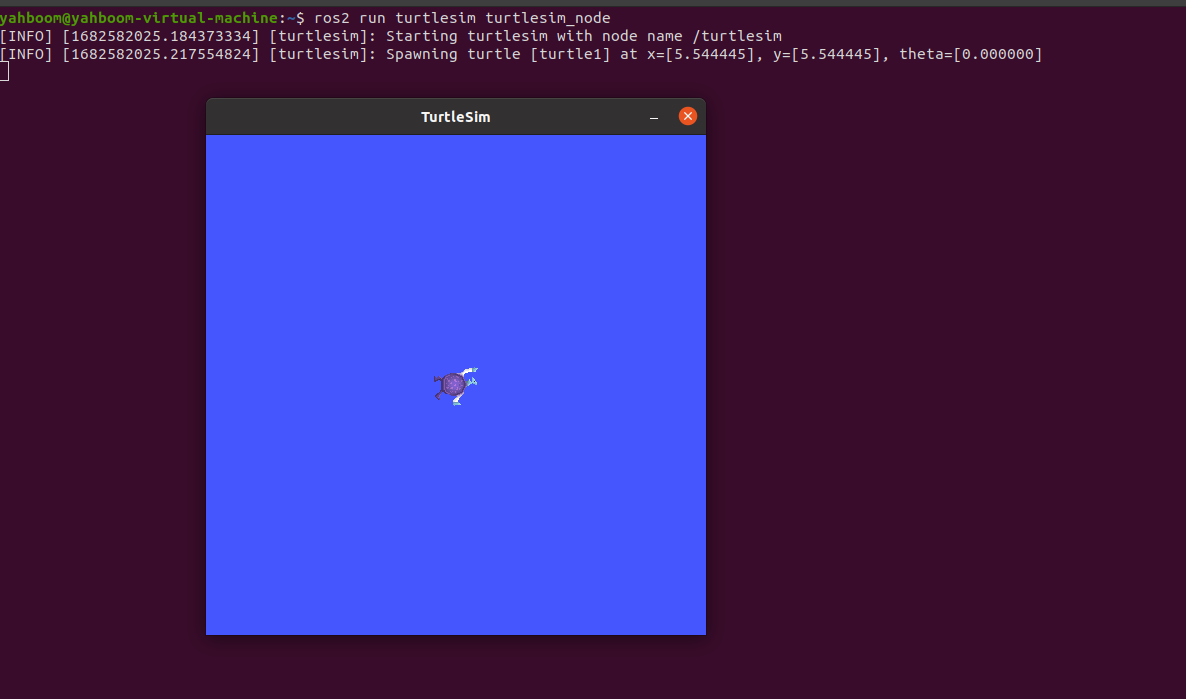
image-20230427155359745

3. Node-Related Tools: ros2 node

3.1. ros2 node list

Function: Lists all node names in the current domain

Format:

xxxxxxxxxx
ros2 node list

image-20230427155655753

3.2. ros2 node info

Function: View detailed node information, including subscriptions, published messages, enabled services, and actions.

Format:

xxxxxxxxxx
ros2 node info node_name
  • node_name: The name of the node to be viewed.
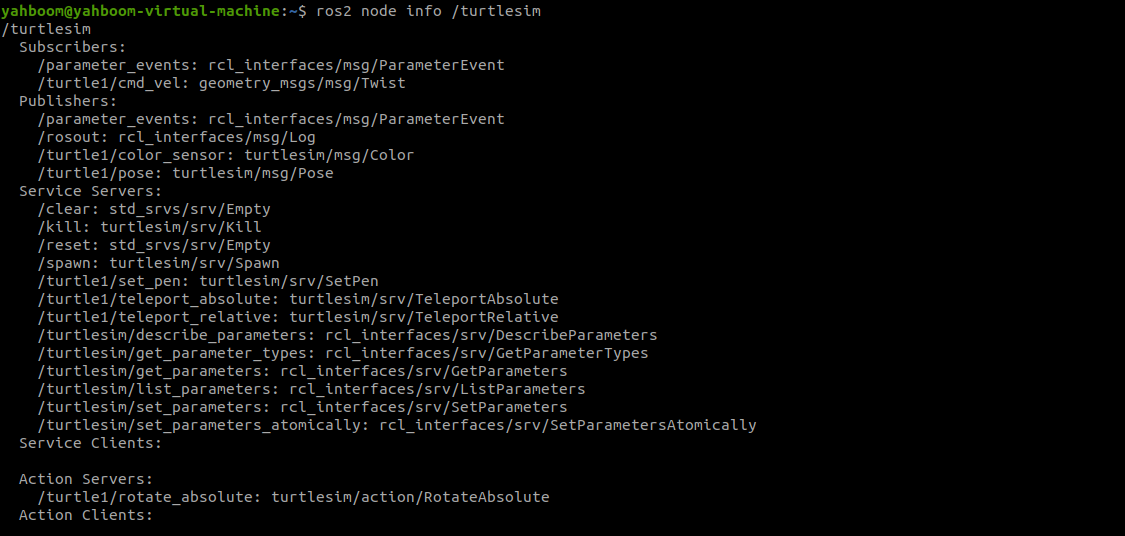
image-20230427160001101

4. Topic-Related Tools: ros2 topic

4.1. ros2 topic list

Function: List all topics in the current domain

Format:

xxxxxxxxxx
ros2 topic list

image-20230427160351051

4.2. ros2 topic info

Function: Display topic message type and number of subscribers/publishers

Format:

xxxxxxxxxx
ros2 topic info topic_name
  • topic_name: The name of the topic to be queried.

image-20230427160625594

4.3, ros2 topic type

Function: View the message type of a topic

Format:

xxxxxxxxxx
ros2 topic type topic_name
  • topic_name: The name of the topic type to be queried.

image-20230427161056536

4.4, ros2 topic hz

Function: Display the average publishing frequency of a topic.

Format:

xxxxxxxxxx
ros2 topic hz topic_name
  • topic_name: The name of the topic whose frequency you want to query.
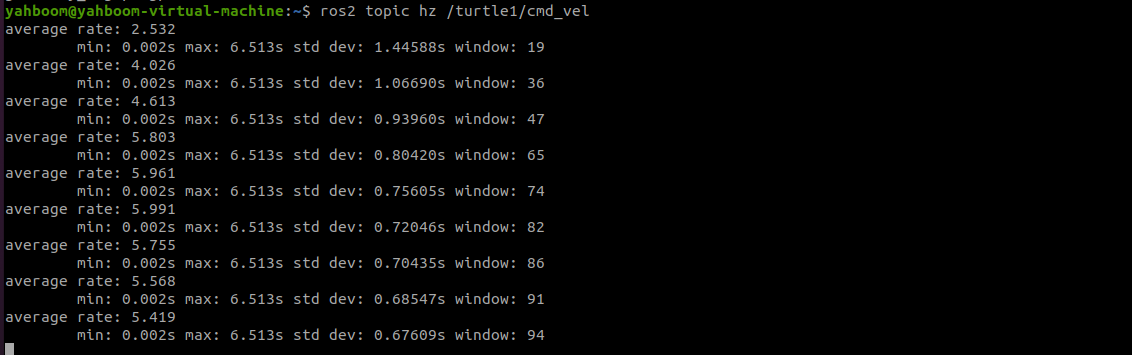
image-20230427161721650

4.5, ros2 topic echo

Function: Print topic messages on the terminal, similar to a subscriber.

Format: ros2 topic echo topic_name

  • topic_name: The name of the topic whose messages you want to print.
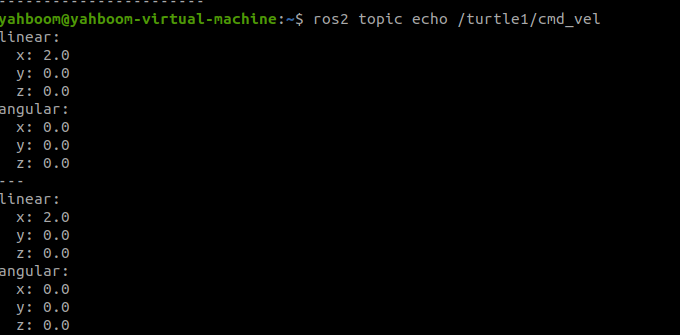
image-20230427162312888

4.5, ros2 topic pub

Function: Publish a message on a specified topic on the terminal.

Format:

xxxxxxxxxx
ros2 topic pub topic_name message_type message_content
  • topic_name: The name of the topic whose messages you want to publish.
  • message_type: The data type of the topic.
  • message_content: Message content

The default is to publish at a 1Hz frequency. The following parameters can be set:

  • Parameter -1 to publish only once, ros2 topic pub -1 topic_name message_type message_content
  • Parameter -t count to publish count times, ros2 topic pub -t count topic_name message_type message_content
  • Parameter -r count to publish at a count Hz frequency, ros2 topic pub -r count topic_name message_type message_content

Example:

  • Publish velocity commands via the command line
  • Note that there is a space after each colon; otherwise, a format error will be displayed.
xxxxxxxxxx
ros2 topic pub turtle1/cmd_vel geometry_msgs/msg/Twist "{linear: {x: 0.5, y: 0.0, z: 0.0}, angular: {x: 0.0, y: 0.0, z: 0.2}}"
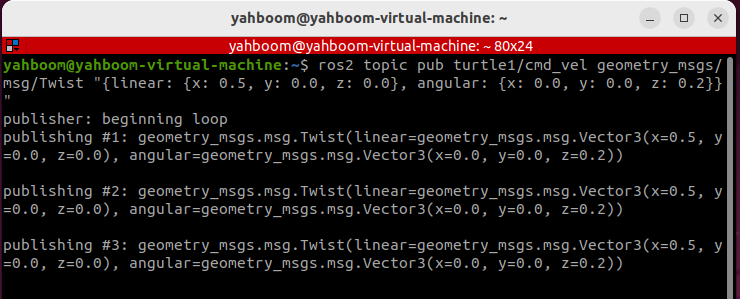
image-20250905163149992

5. Interface-Related Tools: ros2 interface

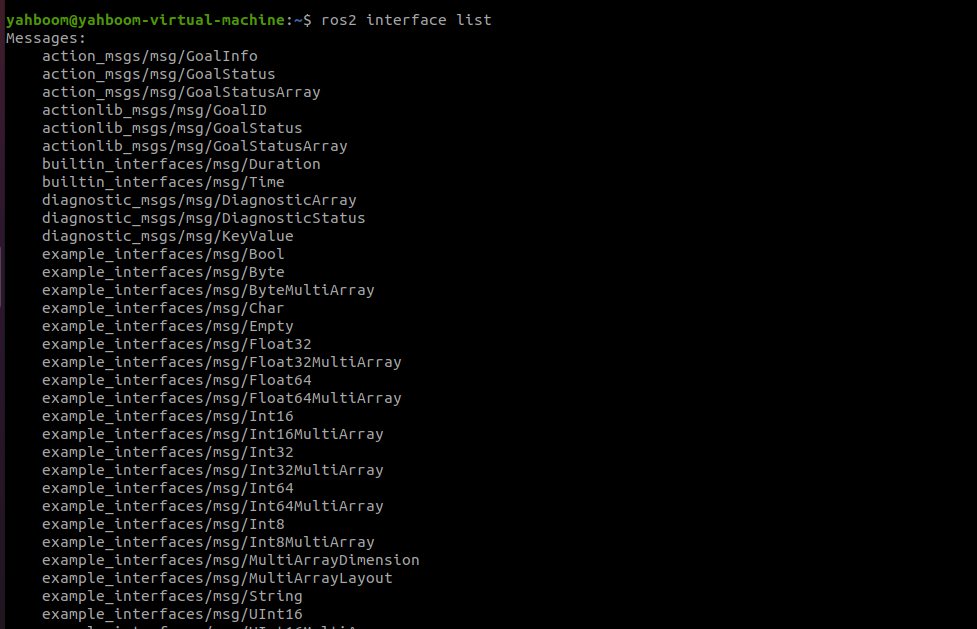
5.1. ros2 interface list

Function: Lists all interfaces in the current system, including topics, services, and actions.

Format:

xxxxxxxxxx
ros2 interface list

image-20230427164755075

5.2. ros2 interface show

Function: Displays the detailed information of a specified interface

Format:

xxxxxxxxxx
ros2 interface show interface_name
  • interface_name: The name of the interface to be displayed
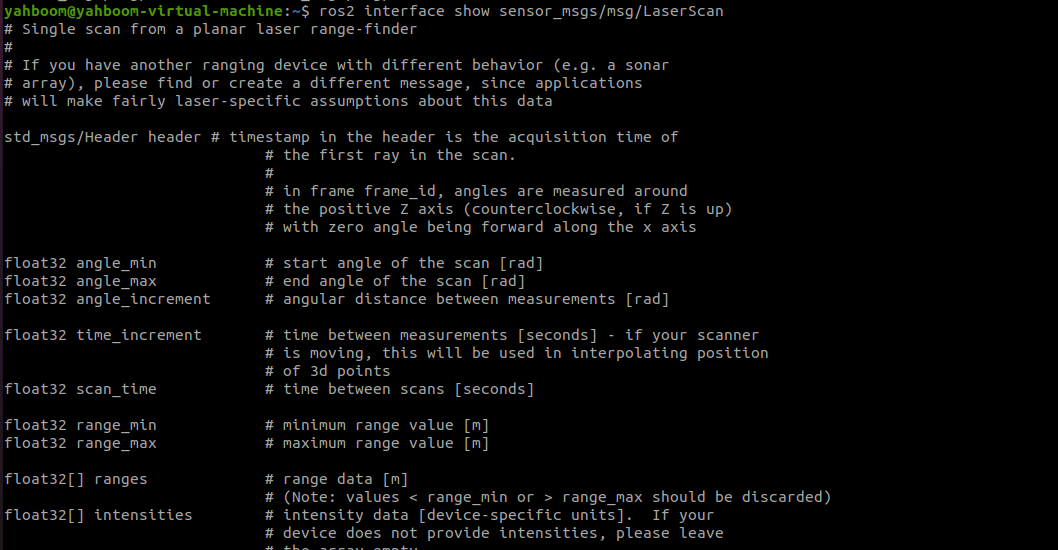
image-20230427165057647

6. Service-Related Tools ros2 service

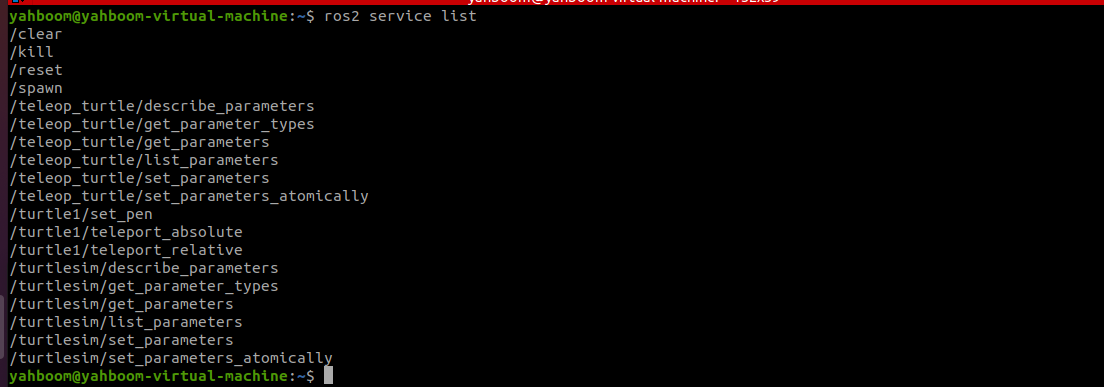
6.1. ros2 service list

Function: Lists all services in the current domain

Format:

xxxxxxxxxx
ros2 interface show interface_name

image-20230427172236875

6.2, ros2 service call

Function: Call a specified service

Format:

xxxxxxxxxx
ros2 interface call service_name service_Type arguments
  • service_name: The service to be called
  • service_type: The service data type
  • arguments: The parameters required to provide the service

For example, to call the turtle spawn service

xxxxxxxxxx
ros2 service call /spawn turtlesim/srv/Spawn "{x: 2, y: 2, theta: 0.2, name: 'turtle10'}"
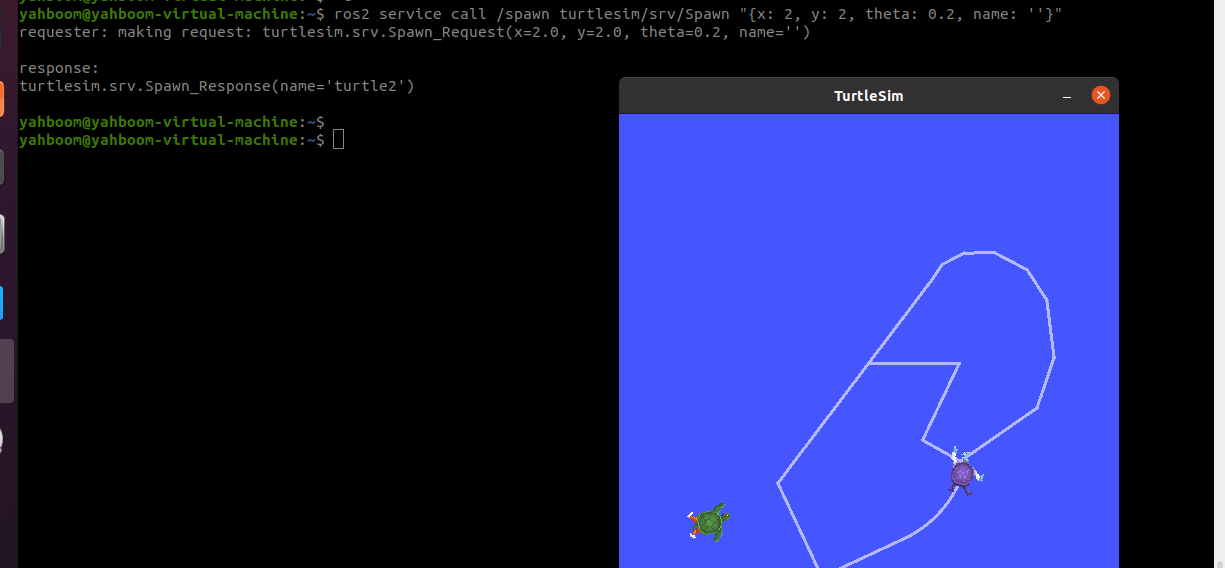
image-20230427173625631

ROS2 time related API
ROS2 rviz2 use

COMPANY

  • About us
  • Team Style
  • Blog

LEARNING & EXPLORATION

  • Tutorials
  • Edge AI hardware
  • Educational robots
  • Embedded intelligent hardware

WHERE TO BUY

  • Yahboom Online Store
  • Amazon
  • Alibaba
  • AliExpress
  • Mercado

TECHNOLOGY SUPPORT

  • Email: support@yahboom.com

BE A DISTRIBUTOR

  • Email: sales@yahboom.com
QR Code

Copyright © 2017-2026 Yahboom. All Rights Reserved.

EN/中文