yahboom
HomeLearn
Solution
Blog
Online Store
About Us
EN/中文
ROSMASTER R2📖
1.Preparation and First Trial
  • 1.1 Accessories introduction
  • 1.2 Precautions for battery
  • 1.3 First Trial
2.Assembly steps
  • Installaction Video
3.ROS1-Remote control course
  • 3.1 APP remote control
  • 3.2 Model aircraft remote control
  • 3.3 Handle remote control
4.ROS1-Hardware course
  • 4.1 About expansion board_V3.0
  • 4.1 About expansion board_V1.0
  • 4.2 STM32 Development environment
  • 4.3 Button to control the buzzer to whistle
  • 4.4 FreeRTOS application
  • 4.5 Serial communication
  • 4.6 SBUS model aircraft remote control
  • 4.7 CAN bus communication
  • 4.8 RGB colorful light bar
  • 4.9 Timer interrupt to control PWM servo
  • 4.10 Control serial port servos
  • 4.11 Nine-axis attitude sensor to obtain data
  • 4.12 Control motor
  • 4.13 Timer captures the encoder data
  • 4.14.1 Kinematic Analysis of Mecanum Wheel
  • 4.14.2 Kinematics Analysis of Ackermann Car
  • 4.15 PID control robot movement
5.ROS1-Basic course
  • 5.1 Update the firmware
  • 5.2 Turn off the self-starting process at startup
  • 5.3 Install the Rosmaster driver library
  • 5.4 Buzzer whistle
  • 5.5 Control PWM servo
  • 5.6 RGB colorful light bar special effects display
  • 5.7 Control motor
  • 5.8 Control robot movement
  • 5.9 Control Serial Servo
6.ROS1-Linux operating system
  • 6.1 Virtual machine installation and use
  • 6.2 Linux basics
  • 6.3 Remote control
  • 6.4 Multi-machine communication configuration
  • 6.5 Static IP and hotspot mode
  • 6.6 Bind the device ID
  • 6.7 Web page real-time monitoring
  • 6.8 Expansion tutorial
  • 6.9.1 Jetson Nano write sytem
  • 6.9.2 Jetson Xavier NX write system
  • 6.9.3 Jetson TX2 NX write system
  • 6.9.4 Raspberry Pi write system
7.ROS1-Docker-pi5
  • 1、Docker overview and docker installation
  • 2、Common commands for docker image containers
  • 3、Docker images deeply understand and publish images
  • 4、Docker hardware interaction and data processing
  • 5、Enter the bot's docker container
  • 6、Robot development environment construction in Docker
  • 7、How customers can update docker images in the future
8.ROS1-ROS basic course
  • 1.ROS introduction
  • 2.ROS installation
  • 3.ROS common command tools
  • 4.ROS workspace
  • 5.ROS function package
  • 6.ROS node
  • 7.ROS topic publisher
  • 8.ROS topic subscribers
  • 9.ROS service client
  • 10.ROS service server
  • 11.ROS action client
  • 12.ROS action server
  • 13.ROS custom message reception
  • 14.ROS-launch file
  • 15.ROS-TF transformation
  • 16.ROS parameter service
  • 17.ROS-rviz use
  • 18.ROS-rqt tool usage
  • 19.Topic message recording and playback
  • 20.urdf model introduction
  • 21.gazebo introduction
  • 22.ROS distributed communication
9.ROS1-OpenCV courses
  • 9.1 Getting started with Open Source CV
  • 9.2 Geometric transformation
  • 9.3 Image processing and drawing text line segments
  • 9.4 Image beautification
  • 9.5 Opencv application
  • 9.6 AR vision
  • 9.7 AR QR code
  • 9.8 ROS+Opencv foundation
  • 9.9 ROS+Opencv application
  • 9.10 Data transformation and point cloud
  • 9.11 MediaPipe development
10.ROS1-Robot control course
  • 10.1 PID algorithm theory
  • 10.2 Robot PID debugging
  • 10.3 Robot information release
  • 10.4 Robot keyboard control
  • 10.5 Robot handle control
  • 10.6 Robot state estimation
  • 10.7 Robot calibration
  • 10.8 Robot URDF model
11.ROS1-Depth camera course
  • 11.1 How to use the Astra camera
  • 11.2 Astra camera calibration
  • 11.3 Astra Color Tracking
  • 11.4 Astra Object Tracking
  • 11.5 Visual tracking autopilot
  • 11.6 Pure visual 2D mapping and navigation
  • 11.7 RTAB-Map 3D mapping navigation
  • 11.8 ORB_SLAM2 basics
  • 11.9 ORB_SLAM2_Octomap
12.ROS1-Lidar course
  • 11.1 Lidar basic-SLAM
  • 11.1 Lidar basic-EAI
  • 11.2 Lidar avoiding
  • 11.3 Lidar guard
  • 11.4 Lidar follow
  • 11.5 Patrol game
  • 11.6 gmapping mapping
  • 11.7 hector mapping
  • 11.8 karto mapping
  • 11.9 cartographer mapping
  • 11.10 rrt_exploration mappin
  • 11.11 AMCL
  • 11.12 Navigation and avoiding
  • 11.13 APP mapping and navigation
  • 11.14 TEB path planning algorithm
13.ROS1-Multi-robot control course
  • 13.1 Multi-machine handle control
  • 13.2 Multi-machine navigation
  • 13.3 Multi-machine formation
  • 13.4 Multi-machine surround
14.ROS1-Deep learning courses
  • 14.1 KNN recognizes handwritten digits
  • 14.2 Basic use of TensorFlow
  • 14.3 Basic use of PyTorch(jetson)
  • 14.4 yolov5 model training(jetson)
  • 14.5 yolov5+tensorrt acceleration(jetson)
  • 14.6 yolov4-tiny
15.ROS1-Voice control courses
  • 15.0 How to use old voice module in new image
  • 15.1 Introduction of voice control module-NEW
  • 15.2 Voice control module port binding-NEW
  • 15.1 Introduction of voice control module-Old
  • 15.2 Voice control module port binding-Old
  • 15.3 Voice control car movement
  • 15.4 Voice control Autopilot
  • 14.5 Voice control color recognition
  • 15.6 Voice control color tracking
  • 15.7 Voice control multi-point navigation
16.ROS1-Model training Autopilot
  • 16.0 ReadMe
  • 16.1 yolov5 to train traffic signs
  • 16.2 TensorRt acceleration identification mark
  • 16.3 Road sign indication function description
  • 16.4 Collect data
  • 16.5 Training model
  • 16.6 Model transformation and application
  • 16.7 AI Autopilot
17. ROS2-Remote control course
  • 1. APP remote control
  • 2. Model aircraft remote control
  • 3. Handle remote control
18.ROS2-Hardware course
  • 1. Expansion board introduction_V3.0
  • 1. Expansion board introduction_V1.0
  • 2. STM32 development environment build
  • 3. Key control buzzer sounding
  • 4. FreeRTOS applications
  • 5. Serial communication
  • 6. SBUS model airplane remote control
  • 7. CAN bus communication
  • 8. RGB colorful light bar
  • 9. Timer interrupt control PWM servos
  • 10. Control serial servos
  • 11. Nine-axis attitude sensor acquires data
  • 12. Control motor forward and reverse
  • 13. Timer Capture Encoder Data
  • 14. Theory of Robot Kinematics Analysis
  • 14.1.Mecanum wheel
  • 14.2.Ackerman
  • 14.3.4WD
  • 15. PID control of robot motion
19. ROS2-Basic course
  • 1. Update the firmware of the expansion board
  • 2.Close the large self-starting program at boot
  • 3. Install Rosmaster driver library
  • 4. Buzzer sounding
  • 5. Control PWM servo
  • 6. RGB colorful light bar special effects show
  • 7. Control motor forward and reverse
  • 8. Controlling robot motion
  • 9. Control serial servos
20. ROS2-Linux operating systemnew
  • 01. Virtual Machines
  • 02. Linux Basics
  • 03. Remote control
  • 04. Multi-computer communication configuration
  • 05. Static ip and hotspot mode
  • 06. Bind device ID
  • 07.Webpage real-time monitoring
  • 08. Expansion Tutorial
  • 09-1.Jetson Nano write system file
  • 09-2. Raspberry Pi write system file
  • 09-3.Orin write system
  • 10.Jetpack old system upgraded to SUPER systemnew
21.ROS2 -Docker(Nano Pi)
  • 1. docker overview and docker installation
  • 2. docker image container common command
  • 3. docker image in-depth understanding and publishing images
  • 4. docker hardware interaction and data processing
  • 5. Enter the docker container of the robot
  • 6. docker in the robot development environment build
  • 7. Customer's method of updating docker images in the future
22.ROS2- ROS2 Basic Tutorial
  • 1.Introduction to ROS2
  • 2.ROS2 install Humble
  • 3.ROS2 development environment
  • 4.ROS2 workspace
  • 5.ROS2 function package
  • 6.ROS2 node
  • 7.ROS2 topic communication
  • 8.ROS2 service communication
  • 9.ROS2 action communication
  • 10.ROS2 custom interface message
  • 11.ROS2 parameter service case
  • 12.ROS2 meta-function package
  • 13.ROS2 distributed communication
  • 14.ROS2 DDS
  • 15.ROS2 time related API
  • 16.ROS2 common command tools
  • 17.ROS2 rviz2 use
  • 18.ROS2 Rqt Toolbox
  • 19.ROS2 Launch startup file configuration
  • 20.ROS2 recording and playback tool
  • 21.ROS2 URDF model
  • 22.ROS2 Gazebo simulation platform
  • 23.ROS2 TF2 coordinate transformation
23. ROS2-Robot control course
  • 1. PID algorithm theory
  • 2. Robot information release
  • 3. Robot control
  • 4. Robot state estimation
  • 5. Robot calibration
  • 6. URDF model
24. ROS2-Lidar course
  • 1-1. Introduction and use of SLAM lidar
  • 1-2. Introduction and use of 4ROS lidar
  • 2. Lidar obstacle avoidance fun gameplay
  • 3. Lidar tracking fun gameplay
  • 4. Patrol function play
  • 5. gmapping map building algorithm
  • 6. cartographer building algorithm
  • 7. Navigation and obstacle avoidance
  • 8. Rosmaster_R2 using the app to build maps
  • 9. Rosmaster_R2 navigating with the app
25. ROS2-OpenCV courses
  • 1. opencv basic course
  • 2. ROS+opencv application
  • 3. QR code creation and recognition
  • 4. AR Vision
  • 5. mediapipe fun gameplay
  • 6. Patrol line autopilot
26. ROS2-Depth camera courses
  • 1. Depth camera use
  • 2. Camera calibration
  • 3. Color tracking
  • 4. KCF object tracking
  • 5. ORB_SLAM2 Basics
  • 6. ORB_SLAM2 PCL mapping
  • 7. ORB_SLAM2 Octomap mapping
  • 8. RTAB-Map 3D mapping navigation
27.ROS2- Voice control courses
  • 0. How to use old voice module in new image
  • 1.1 Introduction to the module-New
  • 1.2 Voice Control Module Port Binding-New
  • 1.3 Introduction to the module-Old
  • 2. Voice control car movement
  • 3. Voice control autopilot
  • 4. Voice control color recognition
  • 5. Voice control color tracking
  • 6. Voice control multi-point navigation
28.Deep learning courses(SUPER)
  • 1.KNN recognizes handwritten digitsnew
  • 2.Basic use of TensorFlownew
  • 3.Basic use of PyTorch(jetson)new
  • 4.YOLOv11Model conversion(SUPER)new
  • 5.YOLOv11Dataset annotation(SUPER)new
  • 6.YOLOv11Model conversion + tensorrt acceleration(SUPER)new
  • 7.YOLOv11Object recognition(SUPER)new
29. ROS2-Multi-robot control
  • 1. Multi-robot control
  • 2. Multi-robot navigation
LLM tutorial
1.Development environment
  • 0. Model usage instructions
  • 1.Environments deployment
  • 2.Dialogue platform installation
2.Jetson Nano B01
  • 1.Qwen2 model
  • 2.TinyLlama model
  • 3.Phi-3 model
  • 4.Gemma model
  • 5.Orca Mini model
  • 6.StarCoder2 model
  • 7.DeepSeek-R1 model
  • 8.Expand LLaVA-Phi3
3.Jetson Orin NXNANO
  • 1.Llama3 model
  • 2.Qwen2 model
  • 3.Phi-3 model
  • 4.Gemma model
  • 5.WizardLM2 model
  • 6.Codellama model
  • 7.DeepSeek-R1 model
  • 8.Orca Mini model
  • 9.StarCoder2 model
  • 10.TinyLlama model
  • 11.Expand LLaVA
  • 12.Expand LLaVA-Phi3
4.Raspberry Pi 5B
  • 1.Meta AI Llama3 model
  • 2.Qwen2 model
  • 3.Phi-3 model
  • 4.Gemma model
  • 5.WizardLM2 model
  • 6.Meta AI Codellama model
  • 7.DeepSeek-R1 model
  • 8.Expand LLaVA
FAQ
  • 1.Using your own Jetson board, car cannot start normally
Download
  • RemoteCtrl_APP(iOS/Android)
  • Mapping_APP(iOS_Android)
  • Instruction Manual
  • SystemFile_ROS1
  • SystemFile_ROS2
  • SystemFile_ROS2_OrinNANOSUPER
  • SystemFile_ROS2_OrinNXSUPER
  • VM software
  • Code
  • Jetson_Boot_USB.tar.gz
  • Autopilot Annex
  • Other_Annex_File
  • LLM_SystemFile
  • ROS2_Basic_VM
Download ZIP

Welcome to ROSMASTER R2 repository

3、Docker images deeply understand and publish images

3. In-depth understanding of docker images and publishing images


3. In-depth understanding of docker images and publishing images3.1. Understanding of mirroring3.2, UnionFS (Union File System)3.3. Mirror layering3.3.1. Hierarchical understanding3.3.2. The benefits of layering docker images3.4. Making and publishing images3.4.1. Make an image3.4.2. Release image

The operating environment and software and hardware reference configuration are as follows:

  • Reference model: ROSMASTER X3

  • Robot hardware configuration: Arm series main control, Silan A1 lidar, AstraPro Plus depth camera

  • Robot system: Ubuntu (no version required) + docker (version 20.10.21 and above)

  • PC virtual machine: Ubuntu (18.04) + ROS (Melodic)

  • Usage scenario: Use on a relatively clean 2D plane


3.1. Understanding of mirroring

  1. An image is a lightweight, executable independent software package that contains everything needed to run a certain software. We package the application and configuration into a formed, deliverable, and deployable operating environment, including code, libraries required for runtime, environment variables, and configuration files, etc. This large packaged operating environment is an image image file.

  2. Docker container instances can only be generated through image files.


3.2, UnionFS (Union File System)

  1. Union File System (UnionFS) is a layered, lightweight, high-performance file system. It is the basis of docker images and supports modifications to the file system to be superimposed layer by layer as a single submission. At the same time, different directories can be mounted under the same virtual file system.

  2. Images can be inherited through layering. Based on the basic image, various specific application images can be produced.

Features of the Union file system: multiple file systems are loaded at the same time, but from the outside, only one file system can be seen; Union loading will superimpose the file systems of each layer, so that the final file system will contain all layers. Files and directories.


3.3. Mirror layering

When downloading an image, pay attention to the download log output. You can see that it is downloading layer by layer:
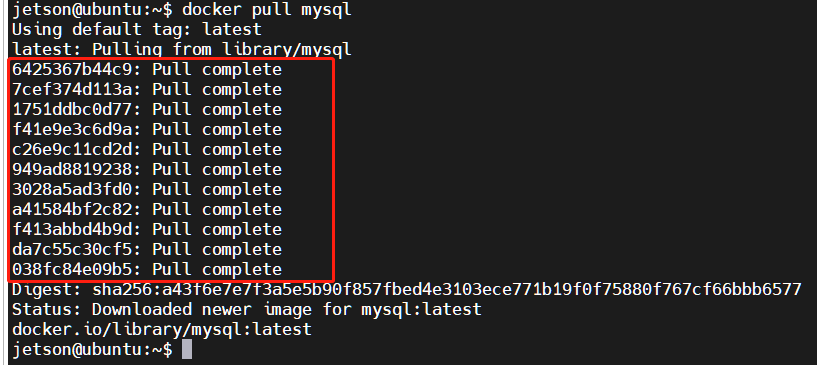
image-20230424154810939

xxxxxxxxxx
# To view the image layering method, you can use the command: docker image inspect image name
jetson@ubuntu:~$ docker image inspect mysql:latest
[
     {
         "Id": "sha256:5371f8c3b63eec64a33b35530be5212d6148e0940111b57b689b5ba1ffe808c8",
         .........
         "RootFS": {
             "Type": "layers",
             "Layers": [
                 "sha256:d6d4fc6aef875958d6186f85f03d88e6bb6484ab2dd56b30a79163baceff2f6d",
                 "sha256:05c3b0b311a02bc56ca23105a76d16bc9b8c1d3e6eac808f4efb1a2e8350224b",
                 "sha256:7b80f7f05642477ebc7d93de9539af27caab7c41a768db250fe3fe2b5506ca2c",
                 "sha256:50e037faefab22cb1c75e60abb388b823e96a845650f3abd6d0a27e07a5a1d5e",
                 "sha256:66040abb3f7201d2cc64531349a8225412db1029447a9431d59d999c941d56f6",
                 "sha256:857162425652837a362aa5f1c3d4974cc83702728793de52ba48176d5367a89b",
                 "sha256:7eebed3016f6b6ab68aa8e6be35f0689a3c18d331b7b542984a0050b859eaf26",
                 "sha256:2fc4c142633d57d795edc0f3fd457f99a35fa611eab8b8c5d75c66e6eb729bc2",
                 "sha256:7fde2d12d484f0c14dabd9ca845da0bcdaf60bd773a58ca2d73687473950e7fe",
                 "sha256:9319848a00d38e15b754fa9dcd3b6e77ac8506850d32d8af493283131b9745a3",
                 "sha256:5ff94d41f068ea5b52244393771471edb6a9a10f7a4ebafda9ef6629874a899b"
             ]
         },
         "Metadata": {
             "LastTagTime": "0001-01-01T00:00:00Z"
         }
     }
]


3.3.1. Hierarchical understanding

  • All docker images start from a basic image layer. When modifications are made or new content is added, a new image layer will be created on top of the current image layer.

  • To give a simple example, if a new image is created based on Ubuntu 20.04, this is the first layer of the new image; if a python package is added to the image, a second image layer will be created on top of the basic image layer; If you continue to add a security patch, a third image layer will be created.

  • Docker images are read-only, when the container starts, a new writable layer is loaded on top of the image! This layer is what we usually call the container layer, and everything below the container is called the mirror layer!


3.3.2. The benefits of layering docker images

Resource sharing, for example, if multiple images are built from the same Base image, then the host only needs to keep one base image on the disk, and only one base image needs to be loaded in the memory, so that all Containers serve, and each layer of the image can be shared.


3.4. Making and publishing images


3.4.1. Make an image

Method 1. Submit an image from the container:

xxxxxxxxxx
# Order
docker commit -m="Description information submitted" -a="Author" Container id Target image name to be created: [Tag name] [The -m -a parameter can also be omitted]

# test
jetson@ubuntu:~$ docker ps -a
CONTAINER ID IMAGE COMMAND CREATED STATUS PORTS NAMES
c54bf9efae47 ubuntu:latest "/bin/bash" 3 hours ago Up 24 minutes funny_hugle
3b9c01839579 hello-world "/hello" 3 hours ago Exited (0) 3 hours ago jovial_brown
jetson@ubuntu:~$ docker commit c54bf9efae47 ubuntu:1.0
sha256:78ca7be949b6412f74ba12e8d16bd548aaa7c3fa25134326db3a67784f848f8f
jetson@ubuntu:~$ docker images # Generated ubuntu:1.0 image
REPOSITORY TAG IMAGE ID CREATED SIZE
ubuntu 1.0 78ca7be949b6 5 seconds ago 69.2MB
yahboomtechnology/ros-foxy 3.4.0 49581aa78b6b 5 hours ago 24.3GB
yahboomtechnology/ros-foxy 3.3.9 cefb5ac2ca02 4 days ago 20.5GB
yahboomtechnology/ros-foxy 3.3.8 49996806c64a 4 days ago 20.5GB
yahboomtechnology/ros-foxy 3.3.7 8989b8860d17 5 days ago 17.1GB
yahboomtechnology/ros-foxy 3.3.6 326531363d6e 5 days ago 16.1GB
ubuntu latest bab8ce5c00ca 6 weeks ago 69.2MB
hello-world latest 46331d942d63 13 months ago 9.14kB

Method 2. Create image using dockerfile:

xxxxxxxxxx
# Order
docker build -f dockerfile file path -t new image name: TAG . # There is a . at the end of the docker build command indicating the current directory
# test
docker build -f dockerfile-ros2 -t yahboomtechnology/ros-foxy:1.2 .

For information on writing dockerfile, please refer to: https://docs.docker.com/develop/develop-images/dockerfile_best-practices/


3.4.2. Release image

The docker repository is a centralized place for storing image files. The largest public repository is docker hub (https://hub.docker.com/), which stores a large number of images for users to download. Domestic public warehouses include Alibaba Cloud, NetEase Cloud, etc.


Steps to publish the image to docker hub:

  1. Address: https://hub.docker.com/, register an account first

  2. Ensure that the account can be logged in normally

image-20230424151714735

  1. Use the tag command to modify the image name.

The specifications for publishing images to docker hub are:

xxxxxxxxxx
docker push registered user name/image name

For example, my registered user name here is: pengan88, then I need to change the image name first.

xxxxxxxxxx
# Order:
docker tag image ID modified image name

# test
jetson@ubuntu:~$ docker images
REPOSITORY TAG IMAGE ID CREATED SIZE
ubuntu 1.0 78ca7be949b6 5 seconds ago 69.2MB
ubuntu latest bab8ce5c00ca 6 weeks ago 69.2MB
hello-world latest 46331d942d63 13 months ago 9.14kB
jetson@ubuntu:~$ docker tag 78ca7be949b6pengan88/ubuntu:1.0
jetson@ubuntu:~$ docker images
REPOSITORY                   TAG       IMAGE ID       CREATED          SIZE
pengan88/ubuntu              1.0       78ca7be949b6   23 minutes ago   69.2MB
ubuntu                       1.0       78ca7be949b6   23 minutes ago   69.2MB
ubuntu                       latest    bab8ce5c00ca   6 weeks ago      69.2MB
hello-world                  latest    46331d942d63   13 months ago    9.14kB

4、登录docker hub发布镜像:

jetson@ubuntu:~$ docker login -u pengan88
Password:     # 这里输入docker hub注册的账号密码
WARNING! Your password will be stored unencrypted in /home/jetson/.docker/config.json.
Configure a credential helper to remove this warning. See
https://docs.docker.com/engine/reference/commandline/login/#credentials-store

Login Succeeded
jetson@ubuntu:~$ docker push pengan88/ubuntu:1.0
The push refers to repository [docker.io/pengan88/ubuntu]
ca774712d11b: Pushed
874b048c963a: Mounted from library/ubuntu
1.0: digest: sha256:6767d7949e1c2c2adffbc5d3c232499435b95080a25884657fae366ccb71394d size: 736

5、访问docker hub可查看到已经发布成功
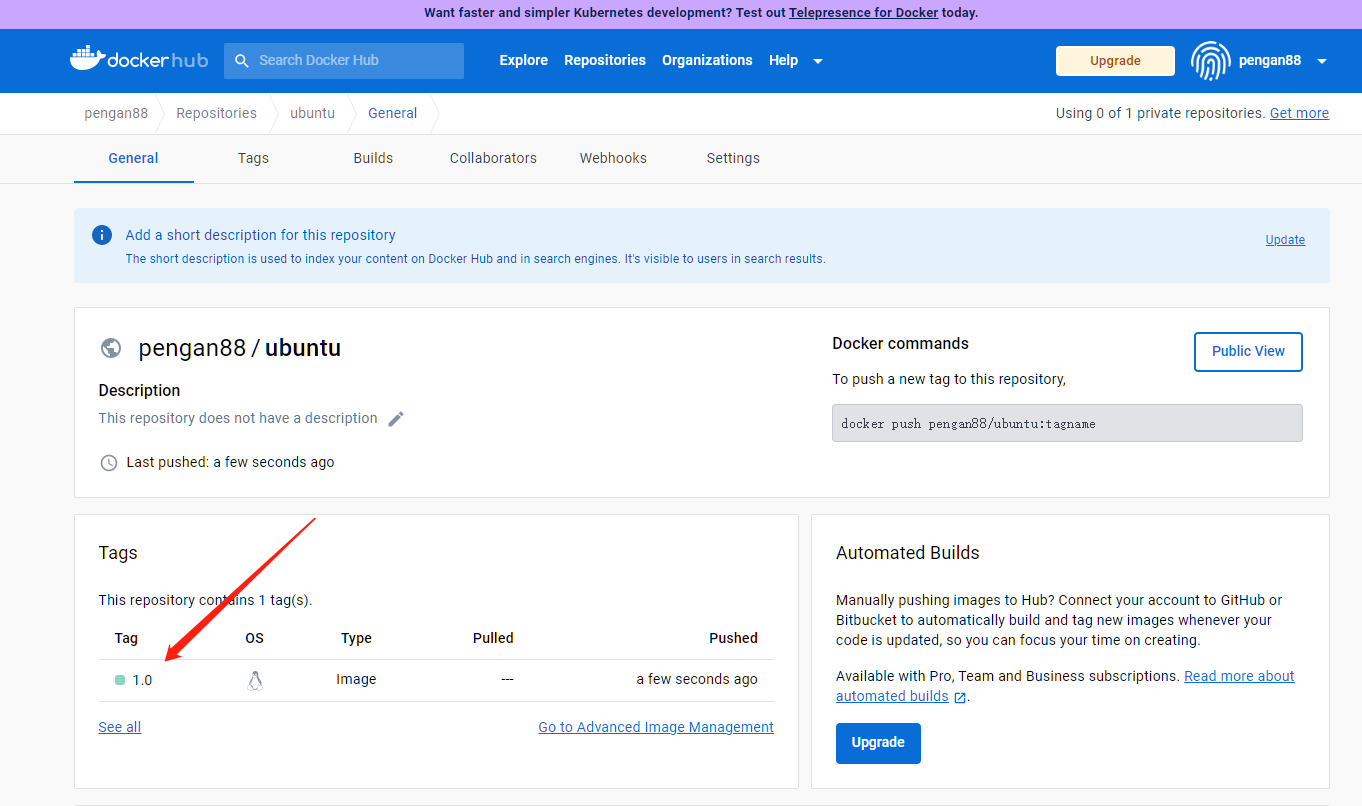
image-20230424152530278

Common commands for docker image containers
Docker hardware interaction and data processing

COMPANY

  • About us
  • Team Style
  • Blog

LEARNING & EXPLORATION

  • Tutorials
  • Edge AI hardware
  • Educational robots
  • Embedded intelligent hardware

WHERE TO BUY

  • Yahboom Online Store
  • Amazon
  • Alibaba
  • AliExpress
  • Mercado

TECHNOLOGY SUPPORT

  • Email: support@yahboom.com

BE A DISTRIBUTOR

  • Email: sales@yahboom.com
QR Code
QR Code

Copyright © 2017-2026 Yahboom. All Rights Reserved.

EN/中文