Welcome to ROSMASTER M3 repository
2.RAG retrieval enhancement and model training samples
RAG Retrieval Enhancement and Training Samples
RAG Retrieval Enhancement and Training Samples1. Course Content2. What is large model hallucination? Why do large models hallucinate?3. RAG Retrieval Enhancement and Training Samples3.1 RAG Retrieval Enhancement3.2 Training Samples4. The Role of RAG Retrieval Enhancement and Training Samples in Robots4.1 Reducing Large Model Hallucination4.2 Increasing the Robot's Scene Generalization Ability
1. Course Content
- Understand and master the three concepts: large model hallucination, RAG retrieval enhancement, and model training samples.
[!TIP]
- This section is a purely theoretical course. If you need to get started quickly and experience the features, you can skip this section for now.
2. What is large model hallucination? Why do large models hallucinate?
The main purpose of RAG retrieval enhancement and model training samples is to reduce large model hallucinations. Let's first understand what large model hallucination is.
Hallucination produced by large models refers to the model outputting content that is inconsistent with real-world facts and logic when understanding the environment, generating instructions, or planning actions, leading to incorrect robot behavior or a large deviation from the user's expected results.
Why do large models hallucinate? Large models are essentially probability prediction systems trained on massive amounts of text. In certain specific domains or unknown task scenarios, the training data may lack sufficient samples, causing the model to "fabricate" content to fill the gaps.
3. RAG Retrieval Enhancement and Training Samples
3.1 RAG Retrieval Enhancement
RAG is an architecture that combines a retrieval system with a generation model, aiming to solve the limitations of traditional generation models in scenarios such as open-domain knowledge question answering and real-time information query (e.g., outdated knowledge, factual hallucinations, long-text dependency, etc.). Its core logic is: to retrieve relevant knowledge and integrate it into the Prompt, allowing the large model to refer to the corresponding knowledge, achieving a "retrieve first, then generate" process.
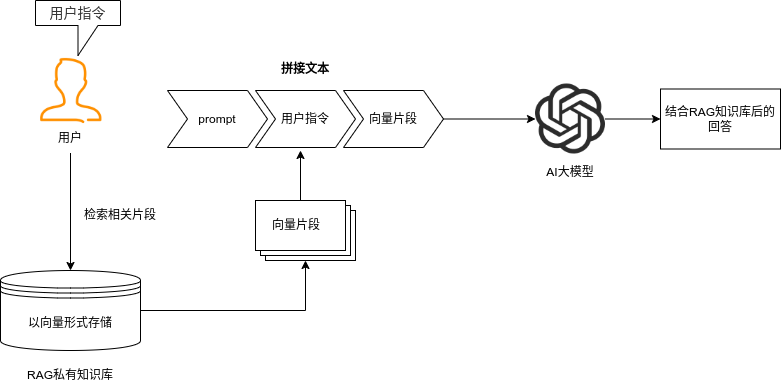
3.2 Training Samples
Training samples are included in the RAG knowledge base. The robot is pre-set with two knowledge bases at the factory: an action function library and a training samples library. The training samples library contains training samples from the course case scenarios, providing ideas for the large model's decision-making and planning in specific scenarios. The subsequent section [2. AI Large Model Basics - 5. Configure AI Large Model] will explain how to configure and extend proprietary knowledge bases and training samples.
4. The Role of RAG Retrieval Enhancement and Training Samples in Robots
4.1 Reducing Large Model Hallucination
When a large model encounters a completely new domain or special user requirements, it will give possible results based on its existing training data. However, this result may differ from what the user hopes for or may not meet the requirements of a specific scenario.
4.2 Increasing the Robot's Scene Generalization Ability
The ROSMASTER-M3Pro robot is pre-set with training samples related to the course cases at the factory (which will be explained in detail in the course on configuring large models). These training samples provide reference information for the large model in specific scenarios. Users can also add their own training samples to customize their own exclusive robot to adapt to different application fields.