yahboom
HomeLearn
Solution
Blog
Online Store
About Us
EN/中文
DOGZILLA-Lite📖
1. Get started quickly
  • 0. Notes (Must Read)new
  • 1. Main interface function experience (cm5)new
  • 1. Main interface function experience(cm4)
  • 2. APP control experience
  • 3. Web page image transmission control
  • 4. LLM-Embodied Intelligence Capabilities
  • 5. LLM-Smart Dog Capabilities
2. Basic operations of Raspberry Pi system
  • 1.SSH remote login
  • 2.VNC remote login desktop
  • 3.Remote file transfer
  • 4.JupyterLab environment construction and use
  • 5.Burn the system image
  • 6.Connect to WiFi
  • 7.Close large programs
  • 8.Raspberry Pi system expansion
3. Basic control of the dogzilla
  • 0. Introduction to DOGZILLA-Lite
  • 1. Screen display control
  • 2. Record Audio
  • 3. Play Audio
  • 4. Text to audio
  • 5. Voice to text
  • 6. Record Video
  • 7. Play Video
  • 8. Video recording function
  • 9. Read the posture angle
  • 10. Battery level reading
  • 11. Read the servo angle
  • 12. Screen display of expressions
  • 13. Calibration of the robot dog
  • 14. Burn the firmware
  • 15. Analysis of common problems
4. Motion control of the dogzilla
  • 1. The dog's forward, backward, left, and right movements and gait
  • 2. Dog Spin
  • 3. The dog adjusts its height and posture
  • 4. Dog periodic translation and rotation
  • 5. Self-balancing mode
  • 6. The dog performs preset actions
  • 7. Single Leg Control
  • 8. Robotic arm control
  • 9. Teaching mode
  • 10. Group Control Performance
  • 11. Teaching demonstration onlinenew
5. Open Source CV
A. Getting started with OpenCV
  • 1. Introduction to OpenCV
  • 2. OpenCV image reading and display
  • 3. OpenCV image writing
  • 4. OpenCV Image Quality
  • 5.OpenCV pixel operations
B. OpenCV geometric transformation
  • 1. Image scaling
  • 2. Image cutting
  • 3. Image translation
  • 4. Image mirroring
  • 5. Affine Transformation
  • 6. Image Rotation
  • 7. Perspective Transformation
C. OpenCV image processing and drawing text segments
  • 1. Grayscale processing
  • 2. Image Binarization
  • 3. Edge Detection
  • 4. Line drawing
  • 5. Rectangle and circle drawing
  • 6. Text and picture drawing
D. Image beautification
  • 1. Color Image Histogram
  • 2. Histogram Equalization
  • 3. Image repair
  • 4. Brightness enhancement
  • 5. Skin whitening
  • 6. Gaussian mean filtering
  • 7. Median Filter
6. AI recognition of the dogzilla
  • 1. Camera driver tutorial
  • 2. Color recognition
  • 3. HSV value test
  • 4. Object Recognition
  • 5. QR code recognition
  • 6. License Plate Recognition
  • 7. Human Pose Estimation
  • 8. Yolo detection
  • 9. Face Detection
  • 10. Human face mask
  • 11. Face effects
  • 12. 3D Object Recognition
  • 13. Paintbrush
  • 14. Finger recognition
  • 15. Gesture Recognition
  • 16. Age and gender identification
  • 17. Background Segmentation
  • 18. Facial Recognitionnew
  • 19. Emotion Recognitionnew
  • 20. Motion Detectionnew
7. Dogzilla AI Interaction
  • 1. Color patrol
  • 2. Line patrol and obstacle removal
  • 3. Color tracking
  • 4. Ball tracking
  • 5. The ball follows
  • 6. QR code recognition exercise
  • 7. Face tracking
  • 8. Remote control
  • 9. Gesture tracking
  • 10. Gesture-controlled movement
  • 11. You Drop, I Pick
  • 12. Independent football exercise
  • 13. Human Body Followingnew
8. AI large model interaction
  • 0.AI large model principle foundation
  • 1.Large model premise use configuration
  • 2.Q&A
  • 3.Embodied intelligence
  • 4.Smart dog
  • 5.Picture to text
  • 6.Intelligent interaction
  • 7.Voice intelligent vision
  • 8.Playing football
  • 9.Block gripping
  • 10.Line tracking and obstacle removal
  • 11.Control object tracking
Download
  • System_File
  • Code
  • Firmware
  • Communication interface
  • Instruction Manual
  • Appendix
Download ZIP

Welcome to DOGZILLA-Lite repository

12. 3D Object Recognition

3D Object Recognition

1. Purpose of the experiment

The robot dog can detect objects such as cups, chairs, shoes, and cameras, and draw 3D results.

2. Experimental path source code

Enter the robot dog system, end the robot dog program, enter "ip (ip is the robot dog's ip): 8888" in the browser, enter the password "yahboom" and log in. Enter the path of DOGZILLA_Lite_class/5.AI Visual Recognition Course/12. Three dimensional object recognition and run Objectron_USB.ipynb .

Or enter the command in the terminal to directly start the Python script

xxxxxxxxxx
cd /home/pi/ DOGZILLA_Lite_class/5.AI Visual Recognition Course/12. Three dimensional object recognition
python3 Objectron_USB.py

3. Experimental Phenomenon

After running the source code, you can see that the robot dog detects objects such as cups, chairs, shoes, and cameras.
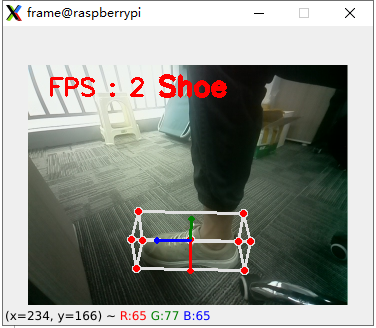
image-2024112100002

Press the "F" button to switch or press the button in the upper right corner of the robot dog's screen to switch and identify different targets. In this experiment, only shoes are identified.

Note: The F key has a switching effect only when running the source code in the terminal. It is not effective when running the source code in jupyter-lab.

4. Main program source code analysis

xxxxxxxxxx
if __name__ == '__main__':
    capture = cv.VideoCapture(0)
    capture.set(6, cv.VideoWriter.fourcc('M', 'J', 'P', 'G'))
    capture.set(cv.CAP_PROP_FRAME_WIDTH, 320)
    capture.set(cv.CAP_PROP_FRAME_HEIGHT, 240)
    print("capture get FPS : ", capture.get(cv.CAP_PROP_FPS))
    pTime = cTime = 0
    objectron = Objectron()
    while capture.isOpened():
        ret, frame = capture.read()
        # frame = cv.flip(frame, 1)
        action = cv.waitKey(1) & 0xFF
        if action == ord('q'): break
        if action == ord('f') or action == ord('F') : objectron.configUP()
        
        # 按屏幕的按键进行切换  Press the button on the screen to switch
        if button.press_d():
            objectron.configUP()
​
        frame = objectron.findObjectron(frame)
        cTime = time.time()
        fps = 1 / (cTime - pTime)
        pTime = cTime
        text = "FPS : " + str(int(fps))
        cv.putText(frame, text, (20, 30), cv.FONT_HERSHEY_SIMPLEX, 0.8, (0, 0, 255), 2)
        cv.imshow('frame', frame)
​
        #把画面显示在lcd屏上 Display the image on the LCD screen
        b, g, r = cv.split(frame)
        image = cv.merge((r, g, b))
        imgok = Image.fromarray(image)
        display.ShowImage(imgok)
​
​
    capture.release()
    cv.destroyAllWindows()

From the source code analysis, it can be seen that the robot dog will call the camera and the recognition model to determine the recognized target. If it is a target in the model, the recognition result will be displayed on the screen of the computer and the robot dog, and the target to be recognized will be switched through the button in the upper right corner of the robot dog.

Face effects
Paintbrush

COMPANY

  • About us
  • Team Style
  • Blog

LEARNING & EXPLORATION

  • Tutorials
  • Edge AI hardware
  • Educational robots
  • Embedded intelligent hardware

WHERE TO BUY

  • Yahboom Online Store
  • Amazon
  • Alibaba
  • AliExpress
  • Mercado

TECHNOLOGY SUPPORT

  • Email: support@yahboom.com

BE A DISTRIBUTOR

  • Email: sales@yahboom.com
QR Code

Copyright © 2017-2026 Yahboom. All Rights Reserved.

EN/中文