Welcome to Muto RS Robot repository
4.MutoRS Study Guide
Muto-RS Tutorial Learning Path Recommendations
The recommended learning path will vary depending on the user. If you want to quickly experience the core functions of Muto-RS and see results quickly, we recommend following the "Function Experience-Oriented Learning Path" below. If you want to systematically learn the core technologies of Muto-RS and gain a deep understanding of its working principles, you can follow the "Solid Foundation-Oriented Learning Path" below.
The two learning paths only differ in the learning order; you don't need to worry about missing any important content.
In the following content, operations mentioned as running in the
/rootpath require entering the Docker environment; those in the/home/pipath are run on the host machine (i.e., the Raspberry Pi system).
I. Function Experience-Oriented Learning Path
This path is suitable for users who want to quickly experience the core functions of Muto-RS and see results quickly.
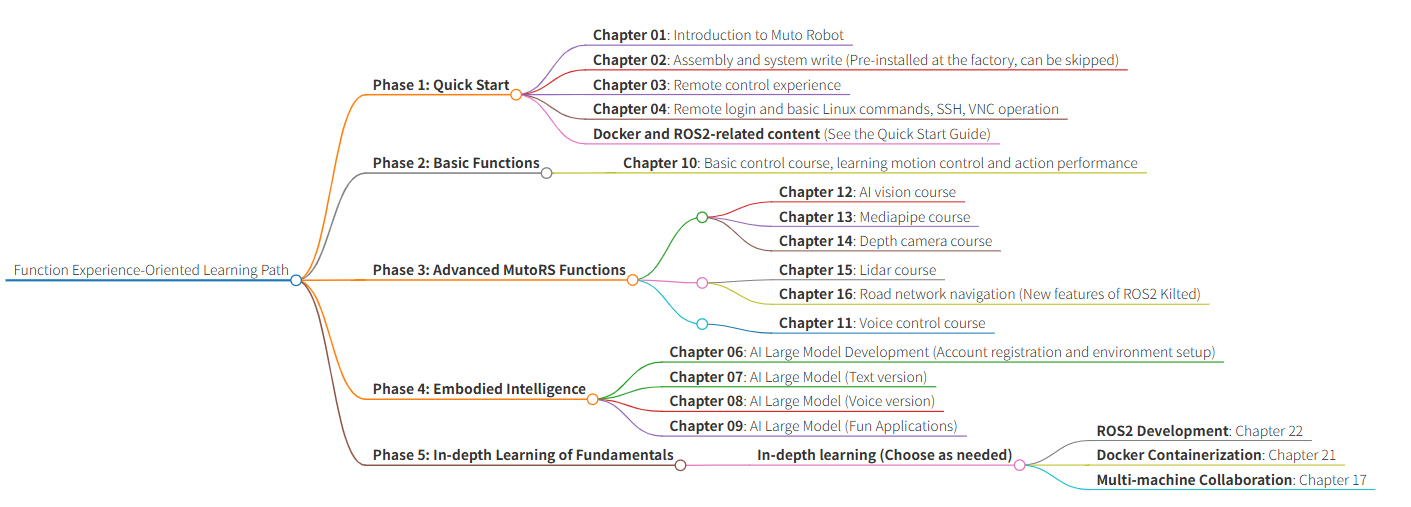
Phase 1: Quick Start
Hardware Preparation and Basic Operations
Chapter 01: Introduction to Muto Robot (Quick overview)
Chapter 02: Assembly and write system (This part is pre-installed at the factory and can be skipped)
Chapter 03: Remote control course (Experience various preset control methods)
Chapter 04: Remote login operation (Must-read, master the use of JupyterLab and methods for connecting SSH and VNC)
- Using SSH requires understanding some basic Linux commands, such as ls, cd, etc. (See the Linux basics section in 06. Quick Start Guide)
Docker related content (See the Docker section in 06. Quick Start Guide)
Quick start section for ROS2 related content (See the ROS2 section in 06. Quick Start Guide)
Phase 2: Basic Functions
Basic Motion Control
Chapter 10: Robot basic course
- Directly learn core functions such as motion control and action performance
Phase 3: Advanced MutoRS Functions
【Depth Camera】 Visual Function Experience
- Chapter 12: AI vision course (Basic vision functions, can also be achieved with a regular camera)
- Chapter 13: Mediapipe course (Basic vision functions, can also be achieved with a regular camera)
- Chapter 14: Depth camera course (Combining depth camera features)
【Lidar】 Mapping and Navigation Function Experience
- Chapter 15: Lidar course (Focus on learning obstacle avoidance, mapping, and navigation)
- Chapter 16: Road network navigation (Experience the cutting-edge new features of ROS2 Kilted's road_server)
【Voice Module】 Voice Control Integration
Chapter 11: Voice control course
- Combining the previously learned motion, vision, and navigation functions with the voice control module
Phase 4: Embodied Intelligence
Embodied Intelligence Combined with Robot Functions
Chapter 06: 06. AI Large Model Development
- The focus is on registering an account with a model service provider and setting up the environment according to the first and second sections of this chapter.
- The remaining chapters can be skipped, and then you can directly refer to Chapter 07's [0. MutoRS Model Setup & Details]
Chapter 07: AI Large Model (Text Version)
Chapter 08: AI Large Model (Voice Version)
Chapter 09: AI Large Model (Fun Applications)
Phase 5: In-depth Learning of Fundamental Knowledge
In-depth learning of theory-oriented knowledge as needed
Choose to learn as needed:
- ROS2 Development (Chapter 22)
- Docker Containerization (Chapter 21)
- Multi-machine Collaboration (Chapter 17)
II. Solid Foundation-Oriented Learning Path
This path is suitable for users who want to systematically learn ROS2 robot development, AI technology, Docker, and other core technologies through the MutoRS system, progressing from theoretical parts to advanced topics in a step-by-step manner.
Phase 1: Fundamentals
Robot Cognition and Hardware Preparation
Chapter 01: Introduction to the Hexapod Robot
- Understand the robot's hardware components, version configuration, and battery usage precautions.
- Prerequisites: None
Chapter 02: Assembly and write system
- Learn robot assembly and Raspberry Pi system flashing.
- Prerequisites: Basic hardware operation skills
Basic Operation and Remote Control
Chapter 03: Remote control course
- Master remote control methods such as mobile APP, USB gamepad, and web-based control panel.
- Prerequisites: Chapters 01-02
Chapter 04: Remote login operation
- Learn SSH, VNC, and JupyterLab remote login methods.
- Prerequisites: Chapter [02. Assembly and write system], and some basic Linux commands
Chapter 21: Docker
Master container technology, environment setup, and image management.
Prerequisites: Chapters [23. Linux basic course], Chapters [22. ROS2 basic course]
Note: Many subsequent ROS2 functions will require operation within a Docker container.
Chapter 22: ROS2 basic course
Systematically learn ROS2 architecture, node communication, tool usage, etc.
Prerequisites: Chapters [23. Linux basic course], Chapters [19. Raspberry Pi course], C++/Python basics
Chapter 18: .Robot chassis control
In-depth study of hexapod gait, kinematic solving, and URDF modeling.
Prerequisites: Chapters [22. ROS2 basic course], Chapters [10. Robot basic course]
Phase 2: Programming Fundamentals
Linux and Python Basics
Chapter 23: Linux basic course
- Master basic Linux commands, file system, process management, etc.
- Prerequisites: Completion of Chapter [04. Remote login operation]
Chapter 19: Raspberry Pi course
- Learn Python environment setup, GPIO control, serial communication, etc.
- Prerequisites: Chapters [23. Linux basic course] and basic Python syntax
Robot Basic Control
- Chapter 10: Robot Basic Control
- Mastering basic functions such as servo control, motion control, and data reading.
- Prerequisites: Chapters [19. Raspberry Pi course] and Python basics
Phase 3: Vision and Perception Technology
Computer Vision Fundamentals
Chapter 20: OpenCV course
- Master basic image processing, feature detection, and object recognition.
- Prerequisites: Chapters [19. Raspberry Pi course], Python basics
Chapter 12: AI Vision Applications
Learn applications such as color recognition, face detection, and visual line following.
Prerequisites: Chapter [20. OpenCV course]
Advanced Computer Vision Techniques
Chapter 13: Mediapipe course
- Master hand detection, pose estimation, and face recognition.
- Prerequisites: Chapter [12. AI vision course], Chapter [20. OpenCV course]
Chapter 14: Depth Camera Series Courses
- Learn how to use depth cameras (requires a basic understanding of ROS2), AR vision, etc.
- Prerequisites: Chapter [12. AI vision course], Chapter [20. OpenCV course]
Phase 4: Lidar and Navigation
Lidar and SLAM Mapping and Navigation
Chapter 15: Lidar course
- Master lidar usage, obstacle avoidance, SLAM mapping, and navigation.
- Prerequisites: Chapter [23. Linux basic course], basic Linux operations
Chapter 16: Road network navigation
- Learn road network planning, pose mapping, and path replanning.
- Prerequisites: Chapter [15. Lidar course]
Phase 5: Advanced Development Techniques
Chapter 17: Multi-machine control course
- Learn advanced functions such as multi-robot control and collaborative navigation.
- Prerequisites: Chapter [22. ROS2 basic course]
Chapter 11: Voice Control Series Courses
- Implement functions such as voice-controlled movement, line following, and navigation.
- Prerequisites: Chapter [10. Robot basic course], Chapter [12. AI vision course], Chapter [16. Road network navigation]
Phase 6: Comprehensive Applications
Chapter 24: Mainboard Large Model Course
Chapter 05: AI Large Model Basics
- Learn about the principles of AI large models, RAG retrieval augmentation, and embodied intelligence architecture.
- Prerequisites: None, but programming experience is recommended.
Chapter 06: AI Large Model Development
- Learn about using the Dify platform, RAG knowledge base deployment, and intelligent agent development.
- Prerequisites: Chapter 05
Chapter 07: AI Large Model (Text Version)
Chapter 08: AI Large Model (Voice Version)
Chapter 09: AI Large Model (Fun Applications)
- Prerequisites: Chapters 05-06