yahboom
HomeLearn
Solution
Blog
Online Store
About Us
EN/中文
Muto RS Robot📖
01.Introduction to Muto Robot
  • 1.Accessories introduction
  • 2.Precautions for battery
  • 3.FAQ
  • 4.MutoRS Study Guide
  • 5.Quick Start Guide
02.Assembly and write system
  • 1.Raspberry Pi write system
  • 2.Assembly video
03.Remote control course
  • 1.Open and Close APP Control Program
  • 2.Mobile APP Remote Control
  • 3.USB Wireless Controller Remote Control
  • 4.Web Host Computer Remote Control
04.Remote login operation
  • 1.SSH and VNC remote login
  • 2.Jupyter Lab login and running example code
05.AI Large Model Basicsnew
  • 1.AI Large Model Types and Principles
  • 2.RAG Retrieval Enhancement and Model Training Samples
  • 3.Embodied Intelligent Robot System Architecture
  • 4.Embodied Intelligent Functions Core Source Code
06.AI Large Model Developmentnew
  • 1.Register a model service provider account
  • 2.Configure API-KEY
  • 3.Introduction to Dify
  • 4.Dify Basic function
  • 5.AI large model development - Chatbot
  • 6.Deploy the RAG knowledge base
  • 7.RAG knowledge base + Chatbot
  • 8.AI agent workflow
  • 9.Custom wake-up response
  • 10.Core module testing tools
07.AI Large Model (Text Version)new
  • 0.MutoRS Model Setup & Details
  • 1.Semantic Understanding, Instruction Following
  • 2.Multimodal Visual Understanding
  • 3.Multimodal Visual Understanding + Depth Camera Distance Q&A
  • 4.Multimodal Visual Understanding + Visual Line Following
  • 5.Multimodal Visual Understanding + Visual Following
  • 6.Multimodal Visual Understanding + SLAM Navigation
  • 7.Multimodal Visual Understanding + SLAM Navigation + Visual Line Following
  • 8.Intention Estimation + Multimodal Visual Understanding + SLAM Navigation + Visual Functions
08.AI Large Model (Voice Version)new
  • 0.MutoRS Model Setup & Details
  • 1.Semantic Understanding, Instruction Following
  • 2.Multimodal Visual Understanding
  • 3.Multimodal Visual Understanding + Depth Camera Distance Q&A
  • 4.Multimodal Visual Understanding + Visual Line Following
  • 5.Multimodal Visual Understanding + Visual Following
  • 6.Multimodal Visual Understanding + SLAM Navigation
  • 7.Multimodal Visual Understanding + SLAM Navigation + Visual Line Following
  • 8.Intention Estimation + Multimodal Visual Understanding + SLAM Navigation + Visual Functions
09.AI Large Model (Fun Applications)new
  • 1.Versatile performer
  • 2.Action Imitation
  • 3.Problem Solving Expert
  • 4.Exploring Unfamiliar Environments
10.Robot basic course
  • 1)Control buzzer
  • 2)Control PWM servo
  • 3)Control bus servo
  • 4)Robot forward and backward
  • 5)Robot move left and right
  • 6)Robot rotate left and right
  • 7)Control height
  • 8)Control head
  • 9)Action group performance
  • 10)Read data
  • 11)Host computer control
  • 12)Camera driver
11.Voice control coursenew
  • 1.Control Muto motion
  • 2.Control Muto tracking
  • 3.Control Muto color recognition
  • 4.Control Muto color tracking
  • 5.Control multi-point navigation
12.AI vision course
  • 0)Color HSV Calibration
  • 1)Color recognition
  • 2)Color following
  • 3)Color recognition action group
  • 4)Face detection
  • 5)QR code recognition
  • 6)QR code instructions
  • 7)Visual line following
  • 8)Motion learning
  • 9)Synchronous action teaching
13.Mediapipe course
  • 1)Hand detection
  • 2)Attitude detection
  • 3)Overall inspection
  • 4)Face detection
  • 5)Face recognition
  • 6)Face effects
  • 7)Face detection
  • 8)3D object recognition
  • 9)Brush
  • 10)Finger control
  • 11)Gesture recognition
14.Depth camera course
  • 1)Depth camera use
  • 2)Internal reference calibration
  • 3)Web page real-time monitoring
  • 4)ROS+opencv application
  • 5)QR code creation and recognition
  • 6)AR vision
  • 7)Tracking
  • 8)Obstacle recognition
  • 9)Color tracking
  • 10)KCF object tracking
  • 11)RTAB-Map 3D mapping navigation
15.Lidar course
  • 1)About lidar
  • 2)Lidar obstacle avoidance
  • 3)Lidar tracking
  • 4)Lidar guard
  • 5)Patrol
  • 6)SLAM overview
  • 7)ROS2_Gmapping mapping algorithm
  • 8)ROS2_Cartographer mapping algorithm
  • 9)About ROS2 Navigation
  • 10)ROS2 navigation and avoid
  • 11) APP mapping
  • 12)APP navigation
16.Road network navigationnew
  • 1.Road network planning and navigation environment deployment
  • 2.Constructing pose maps
  • 3.Road network annotation
  • 4.Inter-road network planning and navigation
  • 5.Road network navigation under arbitrary poses
  • 6.Path replanning
17.Multi-machine control course
  • 1)Multi-vehicle control
  • 2)Multi-vehicle navigation
18.Robot chassis control
  • 1)Hexapod gait and kinematics
  • 2)Robot information release
  • 3)Robot control
  • 4)URDF model
19.Raspberry Pi course
  • 1)Python usage
  • 2)Use APT to install Python packages
  • 3)Python virtual environment
  • 4)GPIO Zero
  • 5)Pin output high and low levels
  • 6)Pin reads high and low levels
  • 7)Pin output PWM
  • 8)Serial communication
  • 9)I2C communication
20.OpenCV course
  • 1)Introduction to Open Source CV
  • 2)Image reading and display
  • 3)Picture writing
  • 4)Image Quality
  • 5)Pixel operations
  • 6)Image zoom
  • 7)Picture cut
  • 8)Picture pan
  • 9)Picture mirroring
  • 10)Affine transformation
  • 11)Picture rotation
  • 12)perspective transformation
  • 13)Grayscale processing
  • 14)Binary image
  • 15)Edge green detection
  • 16)Line segment drawing
  • 17)Rectangular circle drawing
  • 18)Text and picture drawing
21.Docker course
  • 1)Overview and installation
  • 2)Common commands
  • 3)Deeply understand and publish images
  • 4)Hardware interaction and data processing
  • 5)Enter docker container
  • 6)Robot development environment construction
  • 7)Update docker images
22.ROS2 basic course
  • 1) Introduction to ROS2
  • 2)ROS2 install Humble
  • 3)ROS2 development environment
  • 4)ROS2 workspace
  • 5)ROS2 function package
  • 6)ROS2 node
  • 7)ROS2 topic communication
  • 8)ROS2 service communication
  • 9)ROS2 action communication
  • 10)ROS2 custom interface message
  • 11)ROS2 parameter service case
  • 12)ROS2 meta-function package
  • 13)ROS2 distributed communication
  • 14)ROS2 DDS
  • 15)ROS2 time related API
  • 16)ROS2 common command tools
  • 17)ROS2 rviz2 use
  • 18)ROS2 rqt toolbox
  • 19)ROS2 Launch startup file configuration
  • 20)ROS2 recording and playback tool
  • 21)ROS2 URDF model
  • 22)ROS2 Gazebo simulation platform
  • 23)ROS2 TF2 coordinate transformation
23.Linux basic course
  • 1)Introduction to Linux system
  • 2)Ubuntu file system
  • 3)Ubuntu common commands
  • 4)Ubuntu common editors
  • 5)Ubuntu software operation commands
  • 6)Virtual machine installation
  • 7)SSH remote control
  • 8)VNC remote control
  • 9)Driver library and communication
  • 10)Static IP and hotspot mode
  • 11)Bind device ID
  • 12)Capacity expansion and resource allocation
  • 13)Back up system image
  • 14)Update system software sources
  • 15)Set root user password
  • 16)sudo free password
  • 17)Connect to WiFi network
  • 18)View system version
  • 19)Customized service management
  • 20.Back up system image
24.Mainboard Large Model Course
Offline large model (Text Interaction)
  • 0. AI large model image description
  • 1. Deployment of large AI model environments
  • 2. Installation of large model dialogue platform
  • 3. Meta AI Llama 3.2 model
  • 4. Alibaba Cloud Qwen3 Model
  • 5. Microsoft Phi-4-mini model
  • 6. DeepSeek DeepSeek-R1 model
  • 7. Alibaba Cloud Qwen2.5vl Visual Multimodal Large Model
  • 8. Google Gemma3 Visual Multimodal Large Model
  • 9. Llava Visual Multimodal Large Model
  • 10. MiniCPM-V Visual Multimodal Large Model
  • 11. Multimodal Visual Understanding Applications
  • 12. Multimodal Text-Based Image Application
  • 13. Multimodal Video Analysis Application
  • 14. Multimodal visual positioning applications
  • 15. Multimodal table scanning application
  • 16. Multimodal Autonomous Agent Application
Offline large model (Voice Interaction)
  • 0. Voice Interaction Hardware Connection (Must Read)
  • 1. Offline speech-to-text (ASR)
  • 2. Offline Text-to-Speech (TTS)
  • 3. AI large model voice interaction
  • 4. Multimodal visual understanding and voice interaction
  • 5. Multimodal Text-Based Image Application
  • 6. Multimodal Video Analysis Application
  • 7. Multimodal visual positioning applications
  • 8. Multimodal table scanning application
  • 9. Multimodal Autonomous Agent Applications
  • 10. AI large model offline voice assistant
Online large model (text interaction)
  • 1.OpenRouter Large Model API Aggregation Platform
  • 2. Multimodal Visual Understanding Applications
  • 3. Multimodal visual positioning applications
  • 4. Multimodal table scanning application
  • 5. Multimodal Autonomous Agent Applications
Online large model (voice interaction)
  • 0. Voice Interaction Hardware Connection (Must Read)
  • 1. Online speech-to-text (ASR)
  • 2. Online Text-to-Speech (TTS)
  • 3. AI large model voice interaction
  • 4. Multimodal visual and voice interaction
  • 5. Multimodal visual positioning applications
  • 6. Multimodal table scanning application
  • 7. Multimodal Autonomous Agent Applications
  • 8. AI large model online voice assistant
Download
  • RemoteCtrl_APP(iOS/Android)
  • Mapping_APP(iOS_Android)
  • SystemFile_For_RPi5
  • SystemFile_Jetson
  • SystemFile_RPi
  • Code
  • VM File
  • Hardware Info
  • Instruction Manual
  • Jetson_Boot_USB.tar.gz
  • ROS2_Basic_VM
Download ZIP

Welcome to Muto RS Robot repository

3)Color recognition action group

3.Color recognition action group

3.Color recognition action group1. Introduction2. Core content analysis3. Operation

1. Introduction

This course focuses on identifying red, green, blue and yellow, and performing different actions based on these four colors.


2. Core content analysis

Color_HSV defines the HSV value of a color. Since the color of an object has color differences and light effects, if the recognition of a certain color is inaccurate, you can adjust the course based on the color HSV value. After adjusting for the best effect, record the data and update the HSV value of the corresponding color.

Color_HSV  = {"Red"   : ((0, 70, 72), (7, 255, 255)),
              "Green" : ((54, 109, 78), (77, 255, 255)),
              "Blue"  : ((92, 100, 62), (121, 251, 255)),
              "Yellow": ((26, 100, 91), (32, 255, 255))}

Create a new image processing task, then analyze the image content to obtain relevant information and control the robot movement.

xxxxxxxxxx
def task_processing():
    global g_stop_program, g_start_function
    t_start = time.time()
    m_fps = 0
    while g_camera.isOpened():
        if g_stop_program:
            break
        ret, frame = g_camera.read()
        frame, hsv_name = get_color(frame, Color_HSV)
        if g_start_function:
            robot_action(hsv_name)
        m_fps = m_fps + 1
        fps = m_fps / (time.time() - t_start)
        if (time.time() - t_start) >= 2:
            m_fps = fps
            t_start = time.time() - 1
        cv2.putText(frame, "FPS " + str(int(fps)), (10,20), cv2.FONT_HERSHEY_SIMPLEX, 0.5, (0,255,255), 1)
        
        # 图像传输给显示组件 The image is transmitted to the display component
        image_widget.value = bgr8_to_jpeg(frame)
        # time.sleep(.01)

Analyze images based on color HSV values.

xxxxxxxxxx
def get_color(image, color_hsv):
    hsv_name = None
    # image = cv2.resize(image, (320, 240), )
    for key, value in color_hsv.items():
        color_contours, binary = Image_Processing(image, color_hsv[key])
        hsv_name = draw_contours(image, key, color_contours)
        if hsv_name is not None:
            break
    return image, hsv_name

Image processing and analysis to obtain the outline of the color block.

xxxxxxxxxx
def Image_Processing(image, hsv_range):
        (lowerb, upperb) = hsv_range
        color_mask = image.copy()
        hsv_img = cv2.cvtColor(image, cv2.COLOR_BGR2HSV)
        # 筛选出位于两个数组之间的元素。 Filters out the elements between two arrays.
        color = cv2.inRange(hsv_img, lowerb, upperb)
        # 设置非掩码检测部分全为黑色 Set the non-mask detection part to black
        color_mask[color == 0] = [0, 0, 0]
        # 将图像转为灰度图 Convert the image to grayscale
        gray_img = cv2.cvtColor(color_mask, cv2.COLOR_RGB2GRAY)
        # 获取不同形状的结构元素 Gets structure elements of different shapes
        kernel = cv2.getStructuringElement(cv2.MORPH_RECT, (5, 5))
        dst_img = cv2.morphologyEx(gray_img, cv2.MORPH_CLOSE, kernel)
        # 图像二值化操作 Image binarization operation
        ret, binary = cv2.threshold(dst_img, 10, 255, cv2.THRESH_BINARY)
        # 获取轮廓点集(坐标) Get contour point (coordinates)
        version = cv2.__version__
        if int(version[0]) < 4:
            _, contours, heriachy = cv2.findContours(binary, cv2.RETR_EXTERNAL, cv2.CHAIN_APPROX_SIMPLE) # opencv3
        else:
            contours, heriachy = cv2.findContours(binary, cv2.RETR_EXTERNAL, cv2.CHAIN_APPROX_SIMPLE)  # opencv4
        return contours, binary

Draw the outline of the color in the image, where area_threshold is the threshold that controls the color recognition, and the value can be modified according to the size of the recognized color object.

xxxxxxxxxx
def draw_contours(image, hsv_name, contours, area_threshold=3000):
    for i, cnt in enumerate(contours):
        mm = cv2.moments(cnt)
        if mm['m00'] == 0:
            continue
        cx = mm['m10'] / mm['m00']
        cy = mm['m01'] / mm['m00']
        (x, y) = (np.int(cx), np.int(cy))
        # 计算轮廓的⾯积 Calculate the area of the contour
        area = cv2.contourArea(cnt)
        # print("area:", area)
        if area > area_threshold:
            # 绘制最小矩形轮廓和中心点 Draw the minimum rectangle outline and center point
            cv2.circle(image, (x, y), 5, (0, 0, 255), -1)
            rect = cv2.minAreaRect(cnt)
            box = cv2.boxPoints(rect)
            box = np.int0(box)
            cv2.drawContours(image, [box], 0, (255, 0, 0), 2)
            cv2.putText(image, hsv_name, (int(x - 15), int(y - 15)),
                       cv2.FONT_HERSHEY_SIMPLEX, 1, (255, 0, 255), 2)
            return hsv_name
    return None

Control the robot to perform action group movements based on the colors in the image. Among them, red corresponds to the stretching movement, green corresponds to the spinning movement, blue corresponds to the greeting movement, and yellow corresponds to the warm-up squatting movement.

xxxxxxxxxx
def robot_action(color):
    global g_time_pass
    if g_time_pass >= 0:
        return
    if color is None:
        return
    elif color == "Red":
        print("Red Color")
        # 伸懒腰 stretch 
        g_bot.action(1)
        g_time_pass = 10
    elif color == "Green":
        print("Green Color")
        # 原地转圈 circle around
        g_bot.action(5)
        g_time_pass = 10 * 5
    elif color == "Blue":
        print("Blue Color")
        # 打招呼 greet
        g_bot.action(2)
        g_time_pass = 10 * 1
    elif color == "Yellow":
        print("Yellow Color")
        # 热身蹲起 Warm-up
        g_bot.action(4)
        g_time_pass = 10 * 2.5

Every time an action is executed, there will be a detection timeout. Before the timeout reaches zero, no action instructions will be sent to avoid sending action instructions frequently.

xxxxxxxxxx
def task_time():
    global g_time_pass
    while True:
        if g_time_pass > 0:
            g_time_pass = int(g_time_pass - 1)
            if g_time_pass == 0:
                g_bot.zero_reset()
                time.sleep(.5)
                g_time_pass = -1
        time.sleep(.1)

image-20230814165411465

3. Operation

Open the jupyterLab client and find the code path:

xxxxxxxxxx
muto/Samples/AI_Samples/04_color_action/color_action.ipynb

Click to run all cells, and then scroll to the bottom to see the generated controls.

image-20220810163917767

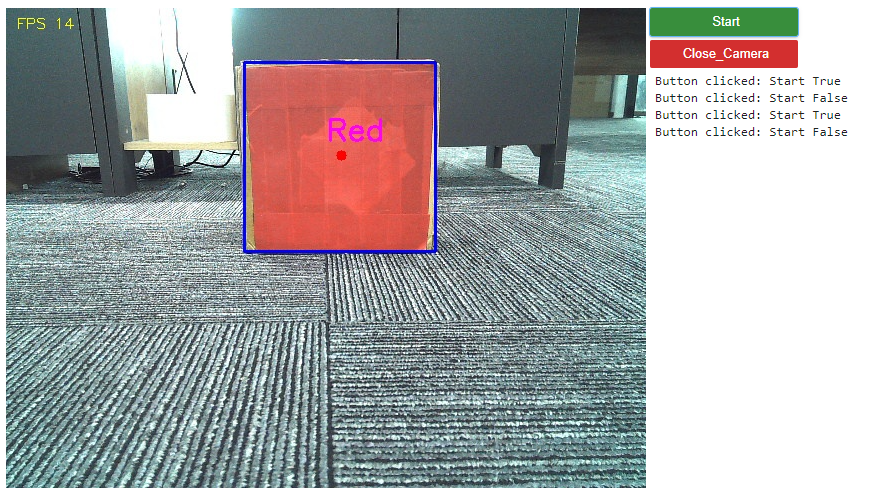
The camera recognizes red, green, blue and yellow, outlines the color, and displays the color name. At this time, whether the robot is moving or not, you need to click the Start button before the robot will make corresponding action responses based on the recognized colors. Click the Start button again to turn off robot motion.

image-20230814165411465

Finally click the Close_Camera button to close the camera.

Color following
Face detection

COMPANY

  • About us
  • Team Style
  • Blog

LEARNING & EXPLORATION

  • Tutorials
  • Edge AI hardware
  • Educational robots
  • Embedded intelligent hardware

WHERE TO BUY

  • Yahboom Online Store
  • Amazon
  • Alibaba
  • AliExpress
  • Mercado

TECHNOLOGY SUPPORT

  • Email: support@yahboom.com

BE A DISTRIBUTOR

  • Email: sales@yahboom.com
QR Code

Copyright © 2017-2026 Yahboom. All Rights Reserved.

EN/中文