yahboom
HomeTutorialsProduct
Solution
Blog
Online Store
About Us
EN/中文
Store
Jetson Orin NX Developer Kit📖
01.Get started
  • 01.Learning route
  • 02.Quick start
  • 03.System Update Notes
  • 04.Disabling automatic updates and troubleshooting issues
02.Jetson basic course
  • 01.Jetson board introduction
  • 02.Write Jetson original system
  • 03.Installing Jetson environment
  • 04.Backup SSD system
  • 05.Restore initial image system
  • 06.Upgrade to SUPER version (Optional)
  • 07.Write SUPER boot (Must read)
  • 08.SSD expansion
  • 09.Jetpack old system upgraded to Yahboom SUPER factory system
  • 10.Write the system onto your own SSD
03.Basic setting course
  • 01.Basic knowledge
  • 02.Network configuration
  • 03.SSH remote login
  • 04.VNC remote control
  • 05.RDP remote control
  • 06.Remote file transfer
  • 07.Jtop tool
  • 08.Exchange space expansion
  • 09.Use VSCode
  • 10.Use VMware
  • 11.Modify screen resolution
04.GPIO control course
  • 01.GPIO description
  • 02.GPIO library installation
  • 03.GPIO reading
  • 04.GPIO output
  • 05.Serial communication
  • 06.I2C communication
05.Vision basic course
  • 01.CSI camera preview
  • 02.USB camera preview
  • 03.Use Jupyter Lab
  • 04.Use JetCam
06.OpenCV basic course
  • 01.Image reading
  • 02.Image saving
  • 03.Image modification
  • 04.Image scaling
  • 05.Image cropping
  • 06.Image translation
  • 07.Image mirroring
  • 08.Image grayscale conversion
  • 09.Image binarization
  • 10.Image edge detection
  • 11.Add line segments
  • 12.Add rectangles
  • 13.Add circular shape
  • 14.Add ellipses
  • 15.Add polygons
  • 16.Add Text
  • 17.Preview USB camera image
  • 18.Preview CSI camera image
07.Vision advanced course
01.Environment construction
  • 01.TensorFlow
  • 02.PyTorch
  • 03.Torchvision
02.DeepStream development
  • 01.DeepStream environment
  • 02.License plate detection and recognition
  • 03.Parallel multi-model inference
  • 04.Object embedding vector generation
  • 05.Pose recognition
  • 06.NV optical flow anomaly detection
  • 07.Single-view 3D tracking
  • 08.Multi-view 3D tracking
03.NVIDIA TAO toolkit application
  • 01.Traffic scene object detection
  • 02.Person object detection
  • 03.Vehicle brand classification
  • 04.Vehicle model classification
  • 05.License plate detection and recognition
  • 06.Person semantic segmentation
  • 07.Optical character detection and recognition
  • 08.Retail product detection and recognition
  • 09.Person feature extraction and matching (ReID)
  • 10.Person action and pose classification
  • 11.Transformer-based person detection
  • 12.3D human skeleton detection
  • 13.LiDAR 3D point cloud detection
04.YOLO11 development
  • 01.YOLO environment construction
  • 02.CLI use
  • 03.Object detection
  • 04.Instance segmentation
  • 05.Pose estimation
  • 06.Image classification
  • 07.Oriented object detection
  • 08.Model conversion
  • 09.Dataset annotation
  • 10.Model training conversion
  • 11.Model prediction
05.YOLO26 development
  • 01.YOLO environment construction
  • 02.CLI use
  • 03.Object detection
  • 04.Instance segmentation
  • 05.Pose estimation
  • 06.Image classification
  • 07.Oriented object detection
  • 08.Model conversion
  • 09.Dataset annotation
  • 10.Model training conversion
  • 11.Model prediction
06.Mediapipe development
  • 01.Mediapipe environment
  • 02.Hand detection
  • 03.Face detection
  • 04.Face effects
  • 05.3D object recognition
  • 06.Virtual brush
  • 07.Gesture recognition
  • 08.Finger control
  • 09.Posture estimation
  • 10.Face mask
  • 11.Overall detection
  • 12.Background removal(Human)
07.QR code recognition
  • QR code recognition
08.Docker basic course
  • 01.Docker introduction
  • 02.Docker installation
  • 03.Docker command
  • 04.Docker usage
  • 05.Docker interaction
09.ROS2-Jazzy
01.ROS2 basic course
  • 1.Introduction to ROS2
  • 2.ROS2 install Jazzy
  • 3.ROS2 development environment
  • 4.ROS2 workspace
  • 5.ROS2 function package
  • 6.ROS2 node
  • 7.ROS2 topic communication
  • 8.ROS2 service communication
  • 9.ROS2 action communication
  • 10.ROS2 custom interface message
  • 11.ROS2 parameter service case
  • 12.ROS2 meta-function package
  • 13.ROS2 distributed communication
  • 14.ROS2 DDS
  • 15.ROS2 time related API
  • 16.ROS2 common command tools
  • 17.ROS2 rviz2 use
  • 18.ROS2 rqt toolbox
  • 19.ROS2 Launch startup file configuration
  • 20.ROS2 recording and playback tool
  • 21.ROS2 URDF model
  • 22.ROS2 Gazebo simulation platform
  • 23.ROS2 TF2 coordinate transformation
02.ROS2 vision course
  • 01.Camera preview (USB)
  • 02.Camera preview (CSI)
  • 03.Camera calibration (USB)
  • 04.Camera calibration (CSI)
  • 05.AR vision (USB)
  • 06.AR vision (CSI)
10.Large model basic course
01.Offline large model
  • 01.AI large model environment deployment
  • 02.Install large model dialogue platform
  • 03.Meta AI - Llama model
  • 04.Alibaba Cloud - Qwen model
  • 05.Microsoft - Phi-4-mini model
  • 06.DeepSeek - DeepSeek model
  • 07.Alibaba Cloud - Qwen-VL visual multimodal large model
  • 08.Google - Gemma visual multimodal large model
  • 09.Llava visual multimodal large model
  • 10.MiniCPM-V visual multimodal large model
  • 11.High-quality vision-language grounding (LocateAnything)
02.Online large model
  • 01.Tongyi Qianwen large model
  • 02.OpenRouter large model API aggregation platform
11.Large model application practice
01.Voice interaction application
  • 0.Voice interaction hardware connection (Must read)
  • 1.Speech to text (ASR)
  • 2.Text to speech (TTS)
  • 3.AI large model voice interaction
  • 4.AI large model voice assistant
02.Multimodal large model application (Online_Offline large model + Text_Voice interaction)
  • 01.Multimodal visual understand application
  • 02.Multimodal text image application
  • 03.Multimodal video analysis application
  • 04.Multi module visual position application
  • 05.Multimodal table scanning application
  • 06.Multimodal autonomous agent application
12.NVIDIA Isaac ROS course
  • 01.Build Isaac ROS environment
  • 02.Deep segmentation
  • 03.DNN stereoscopic depth
  • 04.Free space segmentation
  • 05.Image distortion processing
  • 06.Image segmentation
  • 07.3D scene reconstruction and mapping
  • 08.Object detection
  • 09.3D attitude estimation
  • 10.Visual SLAM
13.OpenClaw deployment and basic usage
01.OpenClaw deployment and introduction
  • 01.Directly use the pre-configured environment (Recommended)
  • 02.OpenClaw Deployment
  • 03.OpenClaw WhatsApp Plugin Application
  • 04.OpenClaw WebChat Interaction
  • 05.OpenClaw TUI Interaction
  • 06.OpenClaw Tools Introduction
  • 07.OpenClawGate Gateway User Manual
  • 08.OpenClawHub Introduction (Skill Installation)
  • 09.OpenClaw Features Overview
02.OpenClaw basic application
  • 01.OpenClaw Application - File Management
  • 02.OpenClaw Application - Camera
  • 03.OpenClaw Application - Browser Control
  • 04.OpenClaw Application - Script Execution
  • 05.OpenClaw Application - AI Programming (Peripheral & GPIO Control)
  • 06.OpenClaw Application - Dedicated AI Assistant
  • 07.OpenClaw Web Search Capability Configuration
03.NVIDIA official Agent Skills application
  • 01.AI-assisted development with VS Code or Cursor
  • 02.Jetson device skills
  • 03.Jetson BSP custom agent skills
14.OpenClaw advanced development
01.Preparation Before Use
  • 01. Peripheral Hardware Configuration
  • 02. OpenClaw API-KEY Configuration
  • 03. OpenClaw Model Switching
  • 04. OpenClaw Prompts
  • 05. AI Voice Interaction Configuration
  • 06. Three Dialogue Configuration Tests
02.OpenClaw AI Programming Peripheral Control
  • 1. Servo Control
  • 2. RGB Strip
  • 3. OLED Display
  • 4. Temperature and Humidity Sensor
  • 5. Camera Application
  • 6. AI Script Peripheral Control
03.OpenClaw Peripheral Integration Applications
  • 1. Plant Care Assistant
  • 2. AI Calorie Estimation
  • 3.AI Rock Paper Scissors Game
  • 4.AI Pet
  • 5.AI Weather Station
  • 6.Temperature Humidity Dashboard
  • 7.Scheduled Tasks
Download
  • System_File
  • VMFile_BootFile
  • Code
  • 3D Model File
  • DataSheet
  • Manual
Download ZIP

Welcome to Jetson Orin NX Developer Kit repository

当製品の日本語版マニュアル資料は、こちらからご取得ください。

05.License plate detection and recognition

TAO LPDNet and LPRNet license plate detection and recognition

TAO LPDNet and LPRNet license plate detection and recognition1. Case goal and processing flow2. The checks before running it3. Start the detection4. The real-time detection with a USB camera5. The real-time detection with a CSI camera6. Frequently asked questions7. References

Applicable environment: Jetson Orin NX, JetPack 7.2.1, DeepStream 9.1.

1. Case goal and processing flow

TrafficCamNet detects the vehicles first, LPDNet locates the region of the license plate, and LPRNet recognizes the characters on the cropped license plate. The Chinese version and the US version use different models and different dictionaries, so they have to be selected according to the region.

Video/USB/CSI → TrafficCamNet → LPDNet license plate detection → LPRNet character recognition
             → the preview/the video output

2. The checks before running it

​x
cd ~/deepstream_tao_apps/deepstream_app_tao_configs

# Confirm the configuration and the input source
grep -E "uri=|config-file=" run_lpr_china.txt
grep -E "uri=|config-file=" run_lpr_us.txt

# Confirm the models and the dictionaries
ls -la /opt/nvidia/deepstream/deepstream-9.1/samples/models/tao_pretrained/lprnet_vdeployable_onnx_v1.1/
ls -la /opt/nvidia/deepstream/deepstream-9.1/samples/models/tao_pretrained/lpdnet_vpruned_v2.3.1/
ls -la ~/deepstream_tao_apps/apps/tao_others/deepstream_lpr_app/dict_ch.txt
ls -la ~/deepstream_tao_apps/apps/tao_others/deepstream_lpr_app/dict_us.txt

Confirm that the material of the target region exists. The real-time camera uses the Jetson desktop/VNC; the camera image should have clear and sufficiently large vehicles and license plates.

3. Start the detection

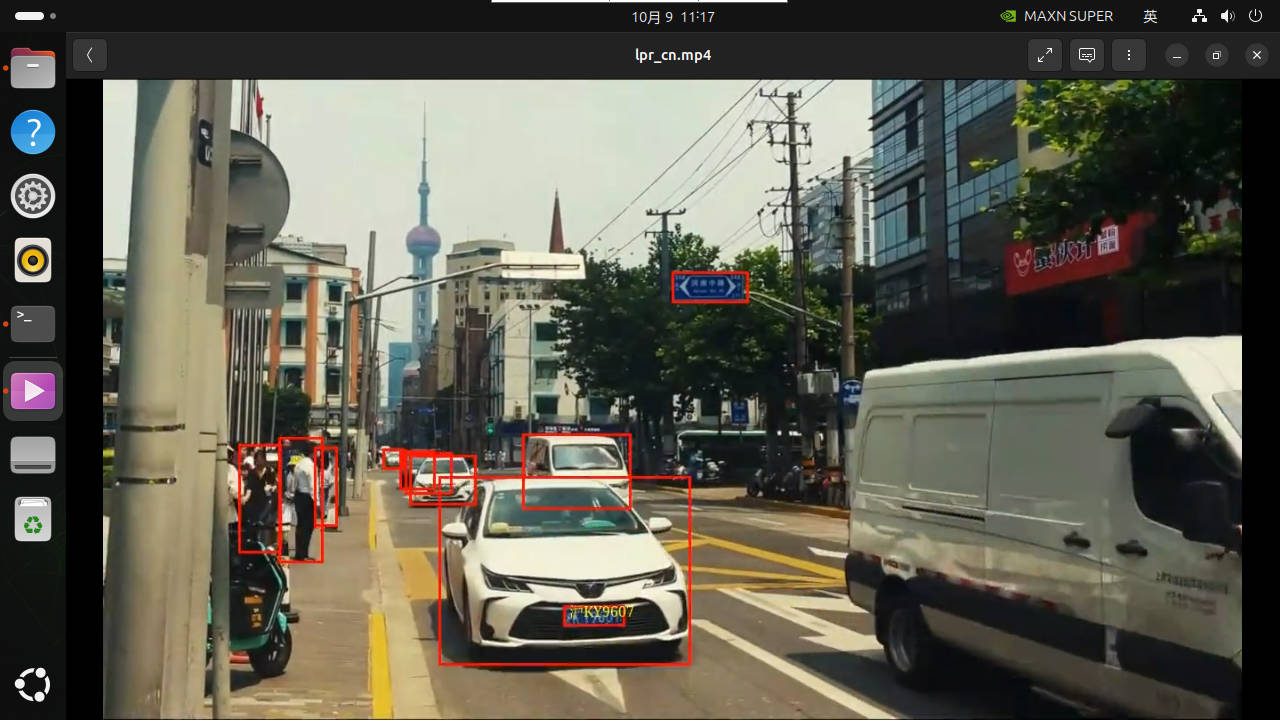
The Chinese version (the video):

xxxxxxxxxx
cd ~/deepstream_tao_demo && export DISPLAY=:0 && ./run_lpr_cn.sh
The US version (the video):

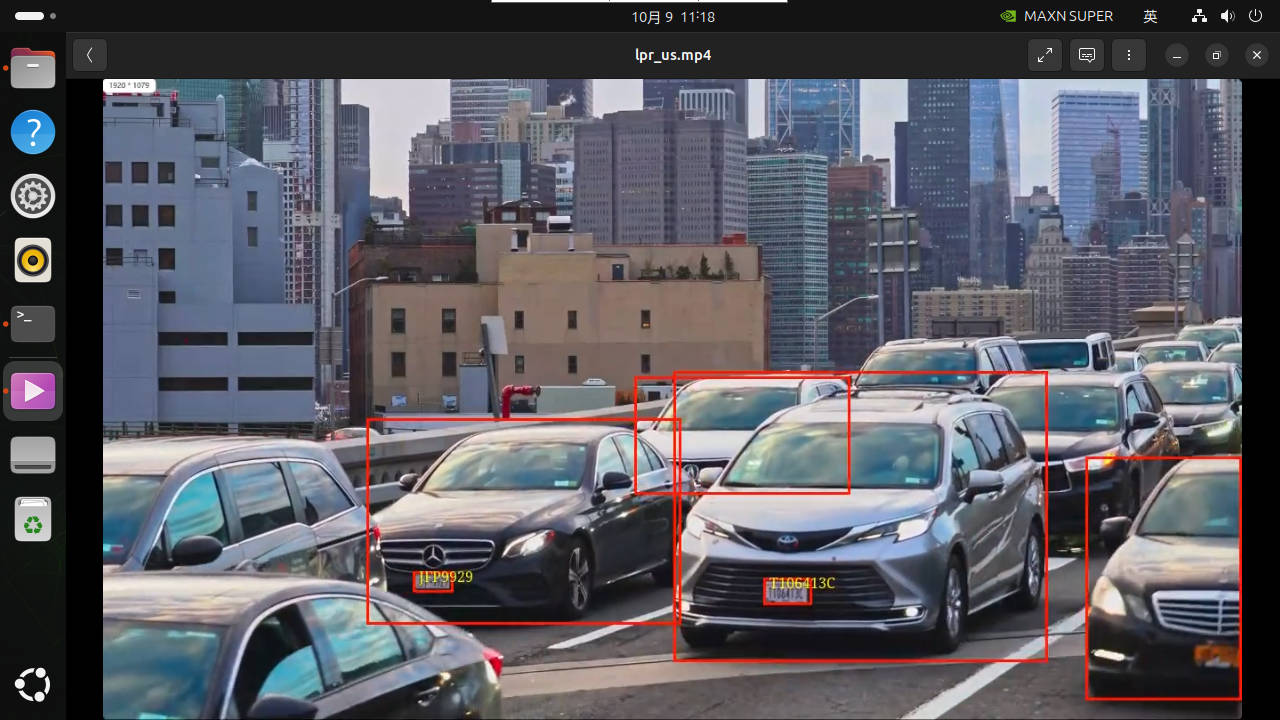
xxxxxxxxxx
cd ~/deepstream_tao_demo && export DISPLAY=:0 && ./run_lpr_us.sh /absolute/path/us.mp4
The corresponding inputs are:

  • The Chinese version: ~/Videos/Video007.mp4

  • The US version: ~/Videos/us.mp4; if it does not exist, the script uses 02.DeepStream development/02.License plate detection and recognition/Test cases/us.mp4

The corresponding configuration files:

  • The Chinese version: ~/deepstream_tao_apps/deepstream_app_tao_configs/run_lpr_china.txt

  • The US version: ~/deepstream_tao_apps/deepstream_app_tao_configs/run_lpr_us.txt

The license plate boxes and the character text represent the result of the localization stage and of the recognition stage respectively.

To replace the test video: pass the absolute path directly to run_lpr_cn.sh or run_lpr_us.sh; the script generates a temporary configuration and it does not rewrite the template in the repository any more. You must not only replace the material while still using the model/dictionary of the other region.

4. The real-time detection with a USB camera

The LPR USB entry uses the parameter of the specified region. First check the USB camera node and the formats:

xxxxxxxxxx
ls -l /dev/video*
v4l2-ctl -d /dev/video0 --list-formats-ext

The Chinese version:

xxxxxxxxxx
cd ~/deepstream_tao_demo && export DISPLAY=:0 && ./run_case.sh lpr_china usb

The US version:

xxxxxxxxxx
cd ~/deepstream_tao_demo && export DISPLAY=:0 && ./run_case.sh lpr_us usb
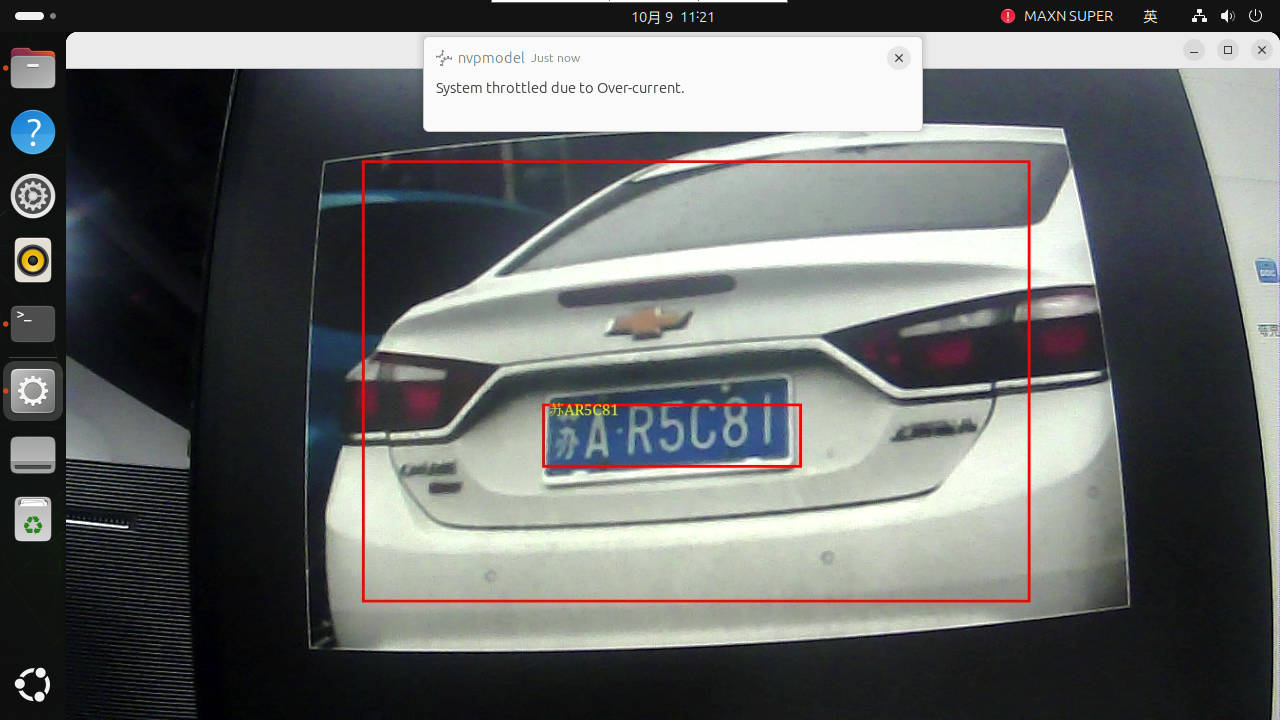
The real-time preview does not produce an offline MP4; the recognition result depends on the resolution of the camera, on the shutter/motion blur and on the pixel size of the license plate in the frame.

Press Ctrl+C once and wait for the application to exit and for the camera to be released.

5. The real-time detection with a CSI camera

The CSI entry supports the real-time preview; it uses the Jetson Argus instead of the USB V4L2 device path. After connecting a compatible module and confirming that the driver and the Argus work normally, run:

The Chinese version:

xxxxxxxxxx
cd ~/deepstream_tao_demo && export DISPLAY=:0 && ./run_case.sh lpr_china csi

The US version:

xxxxxxxxxx
cd ~/deepstream_tao_demo && export DISPLAY=:0 && ./run_case.sh lpr_us csi
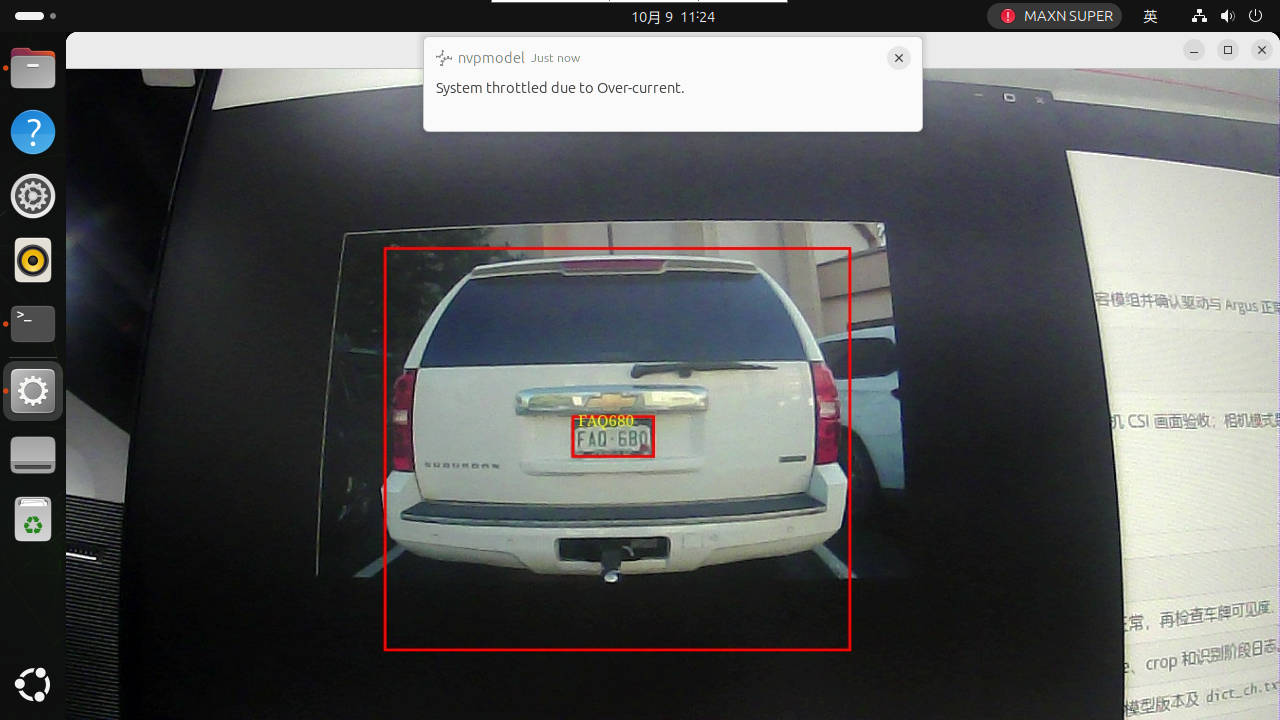
CSI uses the native Argus type=5 and it does not read /dev/video10. The entry supports the real-time preview and it does not produce an MP4.

6. Frequently asked questions

SymptomThe check and the handling
There are no license plate boxesFirst confirm that the vehicle detection boxes are normal, and then check the visibility and the size of the license plate and the LPDNet configuration. The Chinese and the US plates must not use the wrong LPD: the Chinese one uses sgie_lpd_DetectNet2_ch.txt and the US one uses sgie_lpd_DetectNet2_us.txt.
There are license plate boxes but no textCheck the LPRNet engine, the crop and the log of the recognition stage.
The characters are garbled/the region does not matchCheck the run script, the model version and dict_ch.txt/dict_us.txt.
open dictionary file failed + std::bad_allocThe current working directory has no dict.txt, or the symlink points to a file that does not exist. The six scripts already have the dictionary switching logic built in, so you can use run_lpr_*.sh directly.
The US plate shows garbled ChineseConfirm that you use run_lpr_us*.sh; the script switches to LPDNet_usa + us_lprnet + dict_us.
There is no image with USBCheck the node, the format, the permissions, the occupancy and the display session. The resolution has to match the camera-width/camera-height/camera-fps in the configuration file (640x480@15 in the YUYV mode).
The CSI did not startDo not switch manually to the writer; the script stops the relay internally and opens the Argus directly. Check the module, the sensor driver, nvargus-daemon and whether the camera is in use.
nvv4l2h264enc has no property named 'gpu-id'It is a known non-blocking warning of DS 9.1 and it does not affect the inference or the display.

7. References

  • The NVIDIA DeepStream TAO application examples: https://github.com/NVIDIA/DeepStream/tree/main/src/apps/tao_apps

  • The DeepStream TAO integration documentation: https://docs.nvidia.com/metropolis/deepstream/dev-guide/text/DS_TAO_integration.html

Vehicle model classification
Person semantic segmentation

COMPANY

  • About us
  • Team Style
  • Blog

LEARNING & EXPLORATION

  • Tutorials
  • Edge AI hardware
  • Educational robots
  • Embedded intelligent hardware

WHERE TO BUY

  • Yahboom Online Store
  • Amazon
  • Alibaba
  • AliExpress
  • Mercado

TECHNOLOGY SUPPORT

  • Email: support@yahboom.com

BE A DISTRIBUTOR

  • Email: sales@yahboom.com
QR Code

Copyright © 2017-2026 Yahboom. All Rights Reserved.

EN/中文