Welcome to Jetson Orin NX Developer Kit repository
当製品の日本語版マニュアル資料は、こちらからご取得ください。
04.Instance segmentation
Instance segmentation
Instance segmentation1. Enable the maximum performance of the mainboard1.1. Enable the MAX power mode1.2. Enable the Jetson clocks2. Instance segmentation: the imageEffect preview3. Instance segmentation: the videoEffect preview4. Instance segmentation: the real time detection4.1. USB cameraEffect previewReferences
Use Python to demonstrate Ultralytics: the effect of Instance Segmentation on the images, the videos and the real time detection.
1. Enable the maximum performance of the mainboard
1.1. Enable the MAX power mode
Enabling the MAX Power Mode (the maximum power mode) on the Jetson ensures that all the CPU and GPU cores are turned on:
sudo nvpmodel -m 0
1.2. Enable the Jetson clocks
Enabling the Jetson Clocks ensures that all the CPU and GPU cores run at the maximum frequency:
xxxxxxxxxxsudo jetson_clocks
2. Instance segmentation: the image
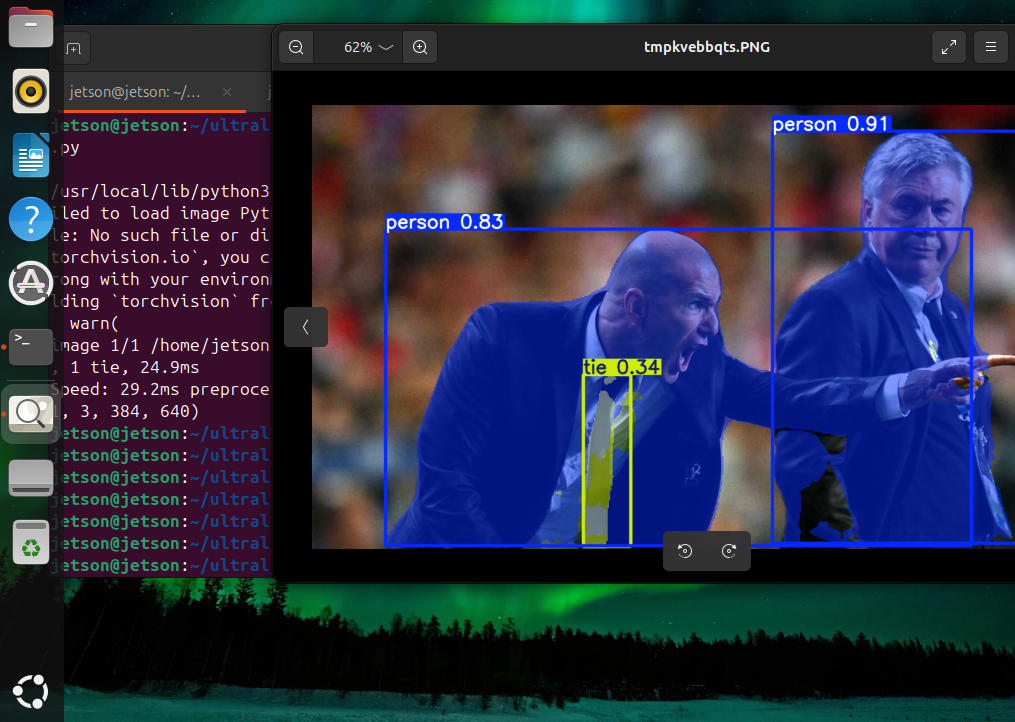
Use yolo26n-seg.pt to predict the images that come with the ultralytics project.
Enter the code folder:
xxxxxxxxxxcd /home/jetson/ultralytics/ultralytics/yahboom_yolo26
Run the code:
xxxxxxxxxxpython3 02.segmentation_image.py
Effect preview
The location of the image output by yolo: /home/jetson/ultralytics/ultralytics/output/
The sample code:
xfrom ultralytics import YOLO
# Load a modelmodel = YOLO("/home/jetson/ultralytics/ultralytics/yolo26n-seg.pt")
# Run batched inference on a list of imagesresults = model("/home/jetson/ultralytics/ultralytics/assets/zidane.jpg") # return a list of Results objects
# Process results listfor result in results: # boxes = result.boxes # Boxes object for bounding box outputs masks = result.masks # Masks object for segmentation masks outputs # keypoints = result.keypoints # Keypoints object for pose outputs # probs = result.probs # Probs object for classification outputs # obb = result.obb # Oriented boxes object for OBB outputs result.show() # display to screen result.save(filename="/home/jetson/ultralytics/ultralytics/output/zidane_output.jpg") # save to disk3. Instance segmentation: the video
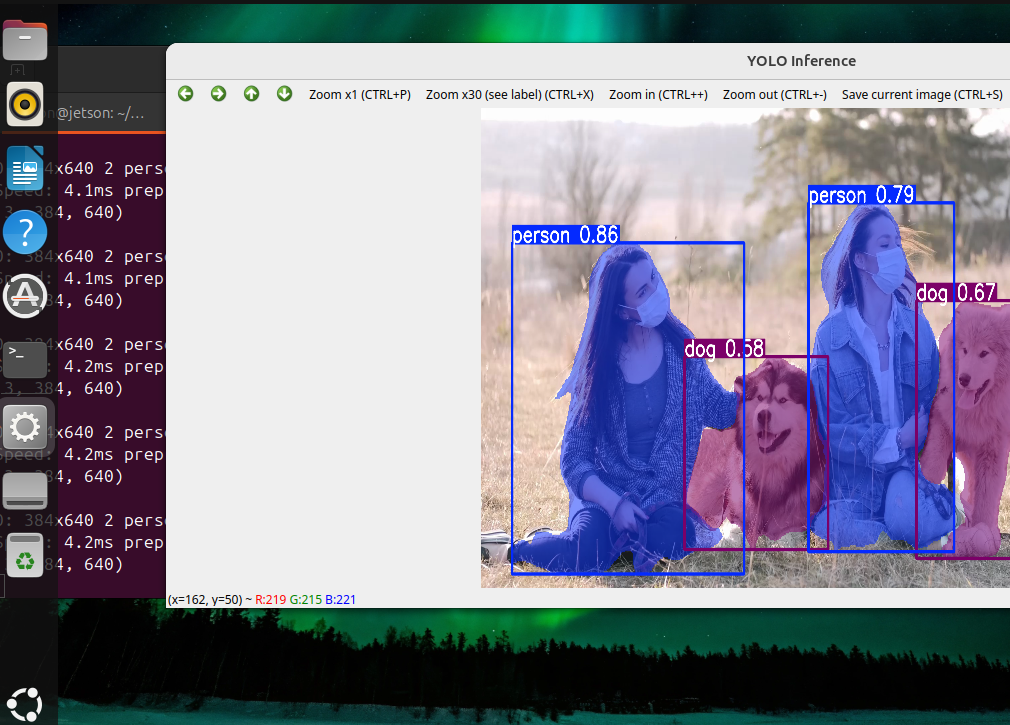
Use yolo26n-seg.pt to predict the videos under the ultralytics project (not the videos that come with ultralytics).
Enter the code folder:
xxxxxxxxxxcd /home/jetson/ultralytics/ultralytics/yahboom_yolo26
Run the code:
xxxxxxxxxxpython3 02.segmentation_video.py
Effect preview
The location of the video output by yolo: /home/jetson/ultralytics/ultralytics/output/
The sample code:
xxxxxxxxxximport cv2from ultralytics import YOLO
# Load the YOLO modelmodel = YOLO("/home/jetson/ultralytics/ultralytics/yolo26n-seg.pt")
# Open the video filevideo_path = "/home/jetson/ultralytics/ultralytics/videos/people_animals.mp4"cap = cv2.VideoCapture(video_path)
# Get the video frame size and frame rateframe_width = int(cap.get(cv2.CAP_PROP_FRAME_WIDTH))frame_height = int(cap.get(cv2.CAP_PROP_FRAME_HEIGHT))fps = int(cap.get(cv2.CAP_PROP_FPS))
# Define the codec and create a VideoWriter object to output the processed videooutput_path = "/home/jetson/ultralytics/ultralytics/output/02.people_animals_output.mp4"fourcc = cv2.VideoWriter_fourcc(*'mp4v')  # You can use 'XVID' or 'mp4v' depending on your platformout = cv2.VideoWriter(output_path, fourcc, fps, (frame_width, frame_height))
# Loop through the video frameswhile cap.isOpened():    # Read a frame from the video    success, frame = cap.read()
    if success:        # Run YOLO inference on the frame        results = model(frame)
        # Visualize the results on the frame        annotated_frame = results[0].plot()
        # Write the annotated frame to the output video file        out.write(annotated_frame)
        # Display the annotated frame        cv2.imshow("YOLO Inference", cv2.resize(annotated_frame, (640, 480)))
        # Break the loop if 'q' is pressed        if cv2.waitKey(1) & 0xFF == ord("q"):            break    else:        # Break the loop if the end of the video is reached        break# Release the video capture and writer objects, and close the display windowcap.release()out.release()cv2.destroyAllWindows()
4. Instance segmentation: the real time detection
4.1. USB camera
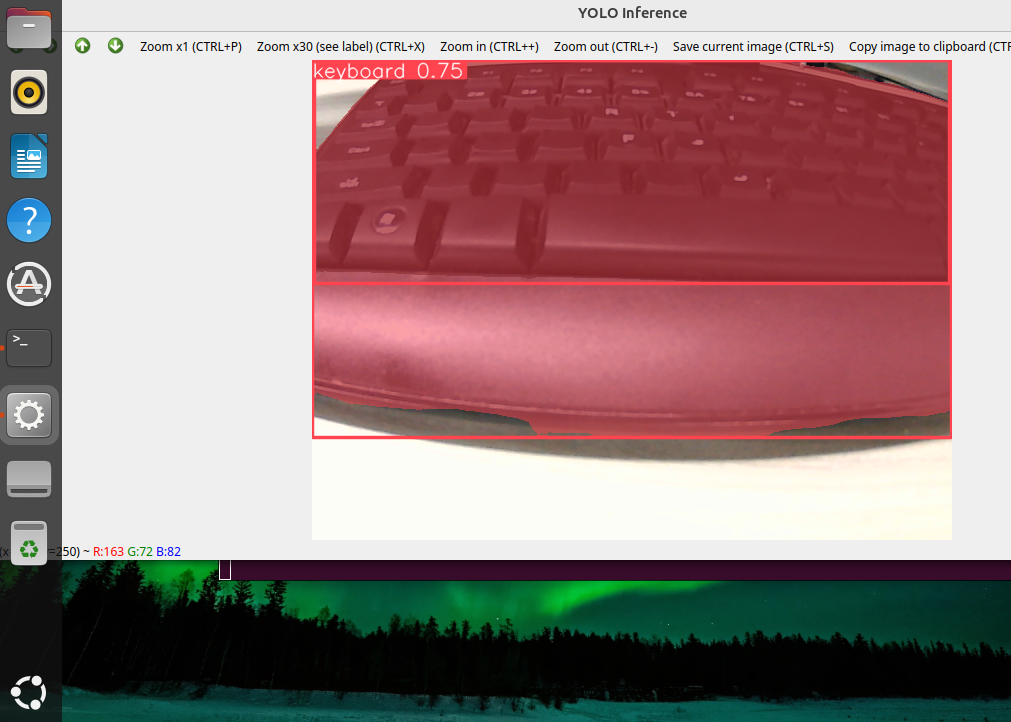
Use yolo26n-seg.pt to predict the image of the USB camera.
Enter the code folder:
xxxxxxxxxxcd /home/jetson/ultralytics/ultralytics/yahboom_yolo26
Run the code: click the preview window and press the q key to terminate the program!
xxxxxxxxxxpython3 02.segmentation_camera_usb.py
Effect preview
The location of the video output by yolo: /home/jetson/ultralytics/ultralytics/output/
The sample code:
xxxxxxxxxximport cv2from ultralytics import YOLO
# Load the YOLO modelmodel = YOLO("/home/jetson/ultralytics/ultralytics/yolo26n-seg.pt")
# Open the cammeracap = cv2.VideoCapture(0)
# Get the video frame size and frame rateframe_width = int(cap.get(cv2.CAP_PROP_FRAME_WIDTH))frame_height = int(cap.get(cv2.CAP_PROP_FRAME_HEIGHT))fps = int(cap.get(cv2.CAP_PROP_FPS))
# Define the codec and create a VideoWriter object to output the processed videooutput_path = "/home/jetson/ultralytics/ultralytics/output/02.segmentation_camera_usb.mp4"fourcc = cv2.VideoWriter_fourcc(*'mp4v')  # You can use 'XVID' or 'mp4v' depending on your platformout = cv2.VideoWriter(output_path, fourcc, fps, (frame_width, frame_height))
# Loop through the video frameswhile cap.isOpened():    # Read a frame from the video    success, frame = cap.read()
    if success:        # Run YOLO inference on the frame        results = model(frame)
        # Visualize the results on the frame        annotated_frame = results[0].plot()
        # Write the annotated frame to the output video file        out.write(annotated_frame)
        # Display the annotated frame        cv2.imshow("YOLO Inference", cv2.resize(annotated_frame, (640, 480)))
        # Break the loop if 'q' is pressed        if cv2.waitKey(1) & 0xFF == ord("q"):            break    else:        # Break the loop if the end of the video is reached        break# Release the video capture and writer objects, and close the display windowcap.release()out.release()cv2.destroyAllWindows()