yahboom
HomeLearn
Solution
Blog
Online Store
About Us
EN/中文
MicroROS V2 Robot Car📖
01.Introduction
  • 0.Unboxing Video
  • 1. Readme Learning Route
  • 2. Must Read Before Use
  • 3. Introduction to MicroROS V2 Control Board
  • 4. Introduction to LiDAR
  • 5. Introduction to ESP32 Camera Module
  • 6. FAQ
  • 7. About Charging
02.Assembly course
  • Assembly Video
03.Preparation
  • 1. Quickly Start
  • 2. Write Firmware
  • 3. Install VM and Start System
  • 4. Configure VM and Connect Robot
  • 5. Connect to MicroROS Agent
04.Quick start control course
  • 1. VM Keyboard Remote Control
  • 2. VM Handle Remote Control
  • 3. USB Handle Control
05.Robot control course
  • 1. Robot Information Release
  • 2. Robot Keyboard Control
  • 3. Robot Handle Control
  • 4. Robot State Estimation
  • 5. Linear Speed Calibration
  • 6. Angular Velocity Calibration
  • 7. Robot URDF Model
06.Lidar course
  • 1. Precautions for LiDAR Mapping and Navigation
  • 2. Lidar Avoid
  • 3. Lidar Following
  • 4. Lidar Guard
  • 5. Lidar Patrol
  • 6. Gmapping Mapping
  • 7. Cartographer Mapping
  • 8. Cartographer Quickly Repositioning Navigation
  • 9. Slam Toolx Mapping
  • 10. Navigation2 Single Point Navigation
  • 11. Navigation2 Multi Point Navigation
  • 12. Ros Robot App Mapping And Navigation
07.Road network planning
  • 1. Introduction to Road Network Planning and Quick Start
  • 2. Build a Pose Map
  • 3. Road Network Annotation
  • 4. Planning and Navigation Between Road Networks
  • 5. Road Network Navigation in Any Pose
  • 6. Path Replanning
08.Vision basic course
OpenCV Image Processing
  • 1. Introduction to OpenCV Source CV
  • 2. Open Source CV Geometric Transformation
  • 3. Open Source CV Image Processing and Drawing Text Line Segments
  • 4. Open Source CV Image Beautification
09.Visual General Course (For Standard&Superior version)
4. Yolov11&26 Visual Recognition
  • 1. YOLO Environment Setup
  • 2. CLI Usage
  • 3. Object Detection
  • 4. Instance Segmentation
  • 5. Pose Estimation
  • 6. Image Classification
  • 7. Oriented Bounding Boxes Object Detection
  • 8. Model Prediction
1. ESP32 Visual Recognition Module Configuration
  • 1. Serial Port Configuration WiFi Instructions
  • 2. Use ESP32 Camera Module in Robot Car
  • 3. Servo PTZ Calibration
2. OpenCV Visual Recognition
  • 1. Human Pose Estimation
  • 2. Object Detection
  • 3. AR Vision
  • 4. QR Code
  • 5. Color Recognition
  • 6. Facial Recognition
  • 7. AprilTag Machine Code Recognition
3. Mediapipe Visual Recognition
  • 1. Hand Detection
  • 2. Pose Detection
  • 3. Holistic Detection
  • 4. Facial Detection
  • 5. Facial Recognition
  • 6. Facial Special Effects
  • 7. 3D Object Recognition
  • 8. Brush
  • 9. Gesture Recognition
  • 10. Palm Target Localization
  • 11. Fingertip Trajectory Recognition
10.Visual Advanced Course (Just for Standard version)
1. Visual Control
  • 1. QR Code Recognition Control Action
  • 2. AprilTag Control Car Action Group
  • 3. Gesture Control Car Action Group
  • 4. Visual Line Tracking
2. Visual Tracking
  • 1. Color Tracking
  • 2. Facial Tracking
  • 3. QR Code Tracking
  • 4. Object Recognition And Tracking
  • 5. Mediapipe Palm Tracking
  • 6. Mediapipe Gesture Tracking
  • 7. Mediapipe Human Pose Tracking
  • 8. KCF Object Tracking
  • 9. AprilTag Machine Code Tracking
3. Visual Following
  • 1. Color Follow
  • 2. Face Follow
  • 3. QR Code Follow
  • 4. Mediapipe Palm Follow
  • 5. Mediapipe Gesture Follow
  • 6. Mediapipe Human Posture Follow
  • 7. AprilTag Machine Code Follow
  • 8. Object Follow
11.Visual Advanced Course (Just for Superior version)
1. Visual Control
  • 1. QR Code Recognition Control Action
  • 2. AprilTag Control Car Action Group
  • 3. Gesture Control Car Action Group
  • 4. Visual Line Tracking
2. Visual Tracking
  • 1. Color Tracking
  • 2. Facial Tracking
  • 3. QR Code Tracking
  • 4. YOLO Object Recognition and Tracking
  • 5. Mediapipe Palm Tracking
  • 6. Mediapipe Gesture Tracking
  • 7. Mediapipe Human Pose Tracking
  • 8. KCF Object Tracking
  • 9. AprilTag Machine Code Tracking
3. Visual Follow
  • 1. Color Follow
  • 2. Face Follow
  • 3. QR Code Follow
  • 4. Mediapipe Palm Follow
  • 5. Mediapipe Gesture Follow
  • 6. Mediapipe Human Pose Follow
  • 7. AprilTag Machine Code Follow
  • 8. Object Follow
12.AI Large Model Basic and Applications Course
1. AI Large Model Preparation
  • 1.AI Large Model Preparation
2. AI Large Model Basic Course
  • 1. AI Large Model Types and Principles
  • 2. RAG Retrieval Augmented and Training Samples
  • 3. Embodied Intelligent System Architecture
  • 4. Embodied Intelligence Core Source Code
3. AI Large Model Development
  • 1. Register Model Service Account
  • 2. Configure API KEY
  • 3. Dify Introduction
  • 4. Dify Basic Features
  • 5. RAG Knowledge Base Deployment
  • 6. AI Application Development Chatbot
  • 7. RAG Knowledge Base and Chatbot
  • 8. AI Agent Workflow
4. AI Large Model (Text Version)
  • 1. Semantic Understanding and Instruction Following
  • 2. Multimodal Visual Understanding
  • 3. Multimodal Visual Understanding + Basic Control
  • 4. Multimodal Visual Understanding + Object Following
  • 5. Multimodal Visual Understanding + Visual Line Following
  • 6. Multimodal Visual Understanding + SLAM Navigation
  • 7. Multimodal Visual Understanding + SLAM Navigation + Visual Line Following
  • 8. Multimodal Visual Understanding + SLAM Navigation + Object Following
  • 9. Intent Inference + Multimodal Visual Understanding + SLAM Navigation
13.Openclaw Basics Course
  • 1. Openclaw Introduction
  • 2. Openclaw Core Concepts
  • 3. Openclaw Api-Key Configuration
  • 4. Openclaw Switching Models
  • 5. Openclaw System Prompt
  • 6. Openclaw Common CLI Command
14. Openclaw Interaction Course
  • 1. Openclaw Webchat Interaction
  • 2. Openclaw Tui Interaction
  • 3. Openclaw Whatsapp Interaction
15.Openclaw Development Course
  • 1. Openclaw Robot Mcp Service Integration
  • 2. Robot CLI Command Tools
  • 3. Robot-Control Plugin Tools
  • 4. Openclaw Skills Development
  • 5. Openclaw Scheduled Tasks
  • 6. Openclaw Multi Agent System
  • 7. Openclaw Proactive Interaction
  • 8. Openclaw Vector Memory
16.Openclaw Embodied Intelligence Course
  • 1. OpenClaw Natural Interaction + Basic Control
  • 2. OpenClaw Natural Interaction + Slam Navigation
  • 3. OpenClaw Natural Interaction + Multimodal Visual Understand
  • 4. OpenClaw Natural Interaction + Multimodal Visual Understand + Slam Navigation + Visual Follow
  • 5. OpenClaw Natural Interaction + Multimodal Visual Understand + Slam Navigation + Visual Track
17.Multi-machine Course
  • 1. Multi Machine Handle Control
  • 2. Multi Machine Keyboard Control
  • 3. Multi Machine Navigation
18.MicroROS-V2 Control Board Development Environment
  • 1. Set Up the ESP32-IDF Development Environment
  • 2. ESP32-IDF Configuration Tool
  • 3. ESP Flash Tool Flashing Firmware
  • 4. Install ESP32 Microros Components
  • 5. Install And Start Microros Agent
19.MicroROS-V2 Control Board ESP32 Basic Course
  • 1. Led Light Up
  • 2. Button Function
  • 3. Drive Buzzer
  • 4. Oled
  • 5. Usb Host Function
  • 6. Serial Communication
  • 7. Battery Voltage Detection
  • 8. Drive Pwm Servo
  • 9. Drive Motors
  • 10. Read Motor Encoder Data
  • 11. Pid Motor Speed Control
  • 12. Robot Kinematics Analysis Theory
  • 13. Read Imu Data
  • 14. Read Lidar Data
  • 15. Flash Data Storage
  • 16. Custom Partition Table
  • 17. Bluetooth Communication
  • 18. Wifi Connection
  • 19. ESP32 Visual Recognition Module
20.MicroROS-V2 Control Board Micro_ros Basic Course
  • 1. Publish Topics
  • 2. Subscribe To Topics
  • 3. Multi Topic Subscription And Publishing
  • 4. Subscribe To Buzzer Topic
  • 5. Subscribe To Pwm Servo Topic
  • 6. Subscribe To Speed Control Topic
  • 7. Publish Odometry Topic
  • 8. Publish Imu Data Topic
  • 9. Publish Lidar Data Topic
21. Linux System Course
  • 1.Introduction to Linux system
  • 2.Ubuntu file system
  • 3.Ubuntu common commands
  • 4.Ubuntu common editors
  • 5.Ubuntu software operation commands
  • 6.Virtual machine installation
  • 7.SSH remote control
  • 8.VNC remote control
  • 9.Transfer files remotely
  • 10.Driver library and communication
  • 11.Static IP and hotspot mode
  • 12.Bind device ID
  • 13.Capacity expansion and resource allocation
  • 14.Update system software sources
  • 15.Set root user password
  • 16.sudo free password
  • 17.Connect to WiFi network
  • 18.View system version
  • 19.Customized service management
  • 20.Back up system image
22.Docker Course
  • 1.Docker overview and docker installation
  • 2.Common commands for docker image containers
  • 3.Docker images deeply understand and publish images
23.ROS Basic Course
  • 1.Introduction to ROS2
  • 2.ROS2 install Humble
  • 3.ROS2 development environment
  • 4.ROS2 workspace
  • 5.ROS2 function package
  • 6.ROS2 node
  • 7.ROS2 topic communication
  • 8.ROS2 service communication
  • 9.ROS2 action communication
  • 10.ROS2 custom interface message
  • 11.ROS2 parameter service case
  • 12.ROS2 meta-function package
  • 13.ROS2 distributed communication
  • 14.ROS2 DDS
  • 15.ROS2 time related API
  • 16.ROS2 common command tools
  • 17.ROS2 rviz2 use
  • 18.ROS2 rqt toolbox
  • 19.ROS2 Launch startup file configuration
  • 20.ROS2 recording and playback tool
  • 21.ROS2 URDF model
  • 22.ROS2 Gazebo simulation platform
  • 23.ROS2 TF2 coordinate transformation
Download
  • Mapping_APP(iOS_Android)
  • Code
  • Software_Tools
  • VM_System_File
  • 3D_Model_File
  • ESP32_Firmware
  • Dify LLM Base
  • Instruction_Manual
  • VMware
Download ZIP

Welcome to MicroROS V2 Robot Car repository

7. AprilTag Machine Code Recognition

AprilTag Recognition

1. Experiment Objective

Use dt_apriltags to detect AprilTag fiducial markers and obtain their position, ID, and 3D pose in the image.

2. Experiment Principle

1. Key Terms

TermDescription
AprilTagA visual fiducial marker system based on 2D matrix codes; each Tag carries a unique ID and supports high-accuracy 3D pose estimation
dt_apriltagsA Python AprilTag detection library (a wrapper of C++ Apriltag 3); its Detector class provides the detection and pose estimation API
tag36h11The default AprilTag family; 36-bit encoding + 11 Hamming distance, offering strong resistance to false detections
3D Pose EstimationCombined with the camera intrinsics and the actual Tag size, PnP solves the translation vector (X/Y/Z in meters) and the rotation matrix (Roll/Pitch/Yaw in degrees)
Camera IntrinsicsThe focal lengths (fx/fy) and principal point (cx/cy) loaded from camera.yaml; automatically scaled proportionally when the image size changes
Primary Tag Selection Strategysmallest_id (smallest ID) / largest (largest area) / nearest_center (closest to center)

2. Technical Architecture

Terminal 1: start agent + camera + joint models
Terminal 2: start AprilTag recognition

Data Flow: Image subscription → image conversion → orientation correction → resize → grayscale conversion → dt_apriltags.Detector.detect() → 3D pose estimation combined with camera intrinsics + tag_size → draw border/center point/coordinate axes/labels → real-time display.

3. Experiment Steps

1. Hardware Preparation

HardwareRequirement
PTZ Version✅ Supported
No-PTZ Version✅ Supported
Required PeripheralsESP32 camera, AprilTag markers (tag36h11 family)

2. Start Agent + Camera + Joint Model (Terminal 1)

xxxxxxxxxx
ros2 launch microros_v2_bringup car_base.launch.py
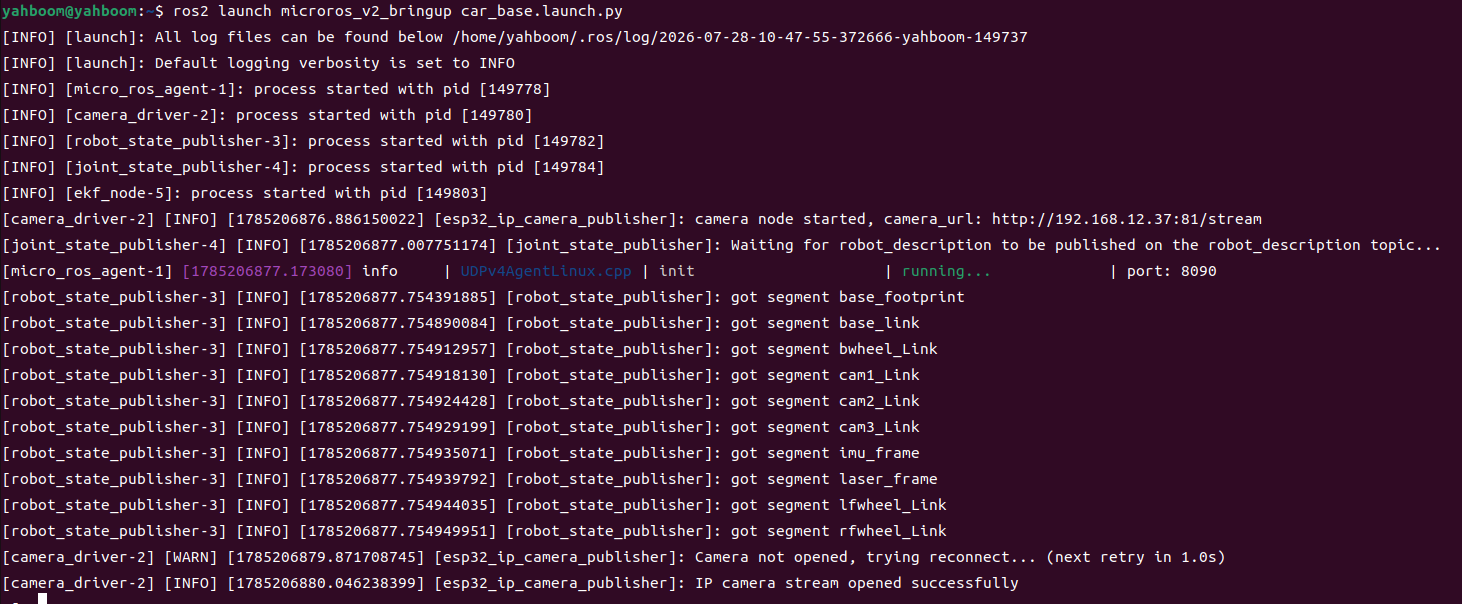
image-20260728121816897

3. Start AprilTag Recognition (Terminal 2)

xxxxxxxxxx
ros2 launch microros_v2_opencv_visual_pkg detect_apriltag.launch.py

4. Operation Instructions

Workflow:

  1. Grayscale conversion → dt_apriltags.Detector.detect() multi-threaded scan
  2. Returns each Tag's ID, center coordinates, 4 corners, Hamming distance, and decision margin
  3. PnP pose estimation combined with the camera intrinsics (camera.yaml) and tag_size (default 0.025 m)
  4. Select the primary Tag by strategy (smallest_id / largest / nearest_center)
  5. Draw the Tag border (green/purple for the primary Tag), center yellow dot, id:N label, Z:N.NNm distance, and 3D coordinate axes (RGB→XYZ)
OperationFunction
q / ESCExit

5. How to Stop

Press Ctrl+C to stop the terminals one by one.

4. Experiment Observations

  • Single Tag detection: Tag border (green polygon), 4 corner red dots numbered 0~3, center yellow dot + id:N + distance label
  • Multiple Tags: Multiple Tags are marked simultaneously; the primary Tag (smallest ID/largest area) is highlighted in purple
  • 3D coordinate axes: RGB three-color axes (red=X, green=Y, blue=Z) indicate the Tag's spatial orientation
  • Real-time distance update: the Z:N.NNm distance label follows the Tag movement and updates in real time
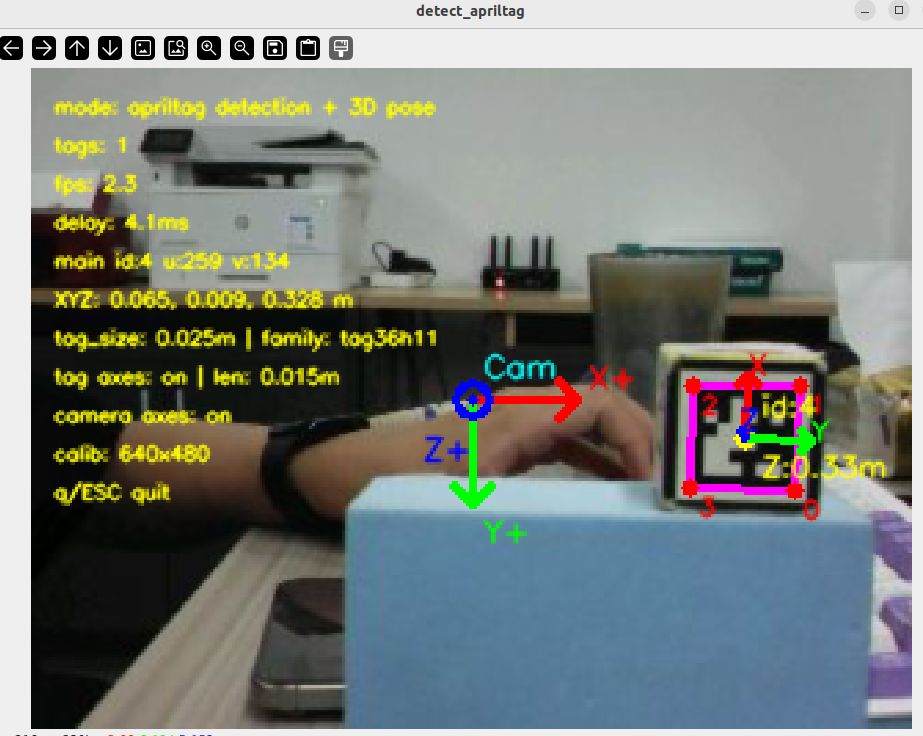
image-20260728121930727

5. Program Analysis

Source code paths:

  • Launch: ~/microros_ws/src/microros_v2_opencv_visual_pkg/launch/detect_apriltag.launch.py
  • Node: ~/microros_ws/src/microros_v2_opencv_visual_pkg/microros_v2_opencv_visual_pkg/detect_apriltag.py

1. Core Node Analysis

DetectAprilTagNode uses dt_apriltags to detect Tags and estimate their 3D pose, overlaying annotations and coordinate axes on the image.

​x
# Source file: ~/microros_ws/src/microros_v2_opencv_visual_pkg/microros_v2_opencv_visual_pkg/detect_apriltag.py
import dt_apriltags
​
class DetectAprilTagNode(Node):
    def __init__(self):
        super().__init__('detect_apriltag_node')
        self.declare_parameter('tag_family', 'tag36h11')
        self.declare_parameter('tag_size', 0.025)
        self.declare_parameter('tag_select_strategy', 'smallest_id')
​
        # Load camera intrinsics
        self.load_camera_intrinsics()
​
        # Create the dt_apriltags detector
        family = self.get_parameter('tag_family').value
        self.detector = dt_apriltags.Detector(
            families=family, nthreads=4,
            quad_decimate=1.0, quad_sigma=0.0,
            decode_sharpening=0.25)
​
    def image_callback(self, msg):
        frame = self.bridge.imgmsg_to_cv2(msg, 'bgr8')
        gray = cv.cvtColor(frame, cv.COLOR_BGR2GRAY)
​
        # dt_apriltags detection
        tags = self.detector.detect(
            gray, estimate_tag_pose=True,
            camera_params=(fx, fy, cx, cy),
            tag_size=self.tag_size)
​
        for tag in tags:
            # Draw the Tag border (connecting the 4 corners)
            corners = tag.corners.astype(int)
            cv.polylines(frame, [corners], True, color, 2)
            # Draw the center point + ID label
            cx_tag, cy_tag = int(tag.center[0]), int(tag.center[1])
            cv.circle(frame, (cx_tag, cy_tag), 4, (0, 255, 255), -1)
            cv.putText(frame, f'id:{tag.tag_id}', ...)
            # Draw the 3D coordinate axes (RGB→XYZ)
            if tag.pose_R is not None:
                self.draw_axes(frame, tag.pose_R, tag.pose_t, ...)

Key logic notes:

  • Automatic camera intrinsic scaling: after reading the intrinsics from camera.yaml, fx/fy/cx/cy are automatically scaled by the ratio between the processed image size and the original calibration size
  • dt_apriltags parameters: nthreads=4 enables multi-threaded detection; quad_decimate=1.0 applies no downsampling (highest accuracy); decode_sharpening=0.25 applies slight sharpening to improve the decoding rate
  • 3D coordinate axes: using the Tag's rotation matrix and translation vector, the 3D axis endpoints (X=0.025 m, Y=0.025 m, Z=-0.025 m) are projected onto the 2D image; the RGB colors correspond to the XYZ axis directions
  • Primary Tag selection: in multi-Tag scenes, the primary Tag is selected by tag_select_strategy and highlighted in purple

2. Key Parameters

Parameter definition files:

  • Launch: ~/microros_ws/src/microros_v2_opencv_visual_pkg/launch/detect_apriltag.launch.py
  • Node: ~/microros_ws/src/microros_v2_opencv_visual_pkg/microros_v2_opencv_visual_pkg/detect_apriltag.py
ParameterTypeDefault ValueDescription
tag_familystringtag36h11AprilTag family
tag_sizefloat0.025Actual Tag side length (meters); affects distance estimation accuracy
tag_select_strategystringsmallest_idPrimary Tag selection strategy: smallest_id / largest / nearest_center
camera_yaml_pathstringconfig/camera.yamlCamera intrinsic configuration file

3. Node Description

NodeFunction
detect_apriltag_nodedt_apriltags detection + 3D pose estimation + primary code selection for multiple Tags + coordinate axis visualization

6. Frequently Asked Questions

ProblemCauseSolution
Tag not detectedBlurred Tag or insufficient lightMake sure the Tag is flat and clear, and improve the lighting
Inaccurate distance estimationtag_size does not match the actual sizeChange the tag_size parameter to match the actual Tag size
Multiple Tags interfering with each otherTags too close togetherIncrease the spacing between Tags and make sure each Tag is fully visible
Facial Recognition
Hand Detection

COMPANY

  • About us
  • Team Style
  • Blog

LEARNING & EXPLORATION

  • Tutorials
  • Edge AI hardware
  • Educational robots
  • Embedded intelligent hardware

WHERE TO BUY

  • Yahboom Online Store
  • Amazon
  • Alibaba
  • AliExpress
  • Mercado

TECHNOLOGY SUPPORT

  • Email: support@yahboom.com

BE A DISTRIBUTOR

  • Email: sales@yahboom.com
QR Code

Copyright © 2017-2026 Yahboom. All Rights Reserved.

EN/中文