Welcome to Jetson Orin NANO Developer Kit repository
11.ROS2 parameter service case
11. ROS 2 Parameter Service Case
1. Introduction to Parameters
Similar to global variables in C++ programming, parameters make it convenient to share certain data among multiple programs. Parameters are the global dictionary in the ROS robot system, and data can be shared among multiple running nodes.
In the ROS system, parameters exist in the form of a global dictionary. What is a dictionary? Just like a real dictionary, it consists of a name and a value, also called a key and a value, which together form a key-value pair. Alternatively, we can understand it as being like a parameter in programming: there is a parameter name, followed by an equal sign, and then the parameter value. When using it, you just access this parameter name.
Parameters have very rich characteristics. For example, if a node shares a parameter, other nodes can all access it. If a node modifies the parameter, other nodes also have a way to know immediately, thereby obtaining the latest value.
2. Parameters in the Turtlesim Example
In the turtlesim example, the simulator also provides quite a few parameters. Let's use this example to become familiar with the meaning of parameters and the usage of the command line.
Since a GUI needs to be displayed here, for ease of operation, the following case is demonstrated in the virtual machine provided with the tutorial.
Start two terminals and run the turtlesim simulator and the keyboard control node respectively:
ros2 run turtlesim turtlesim_noderos2 run turtlesim turtle_teleop_key
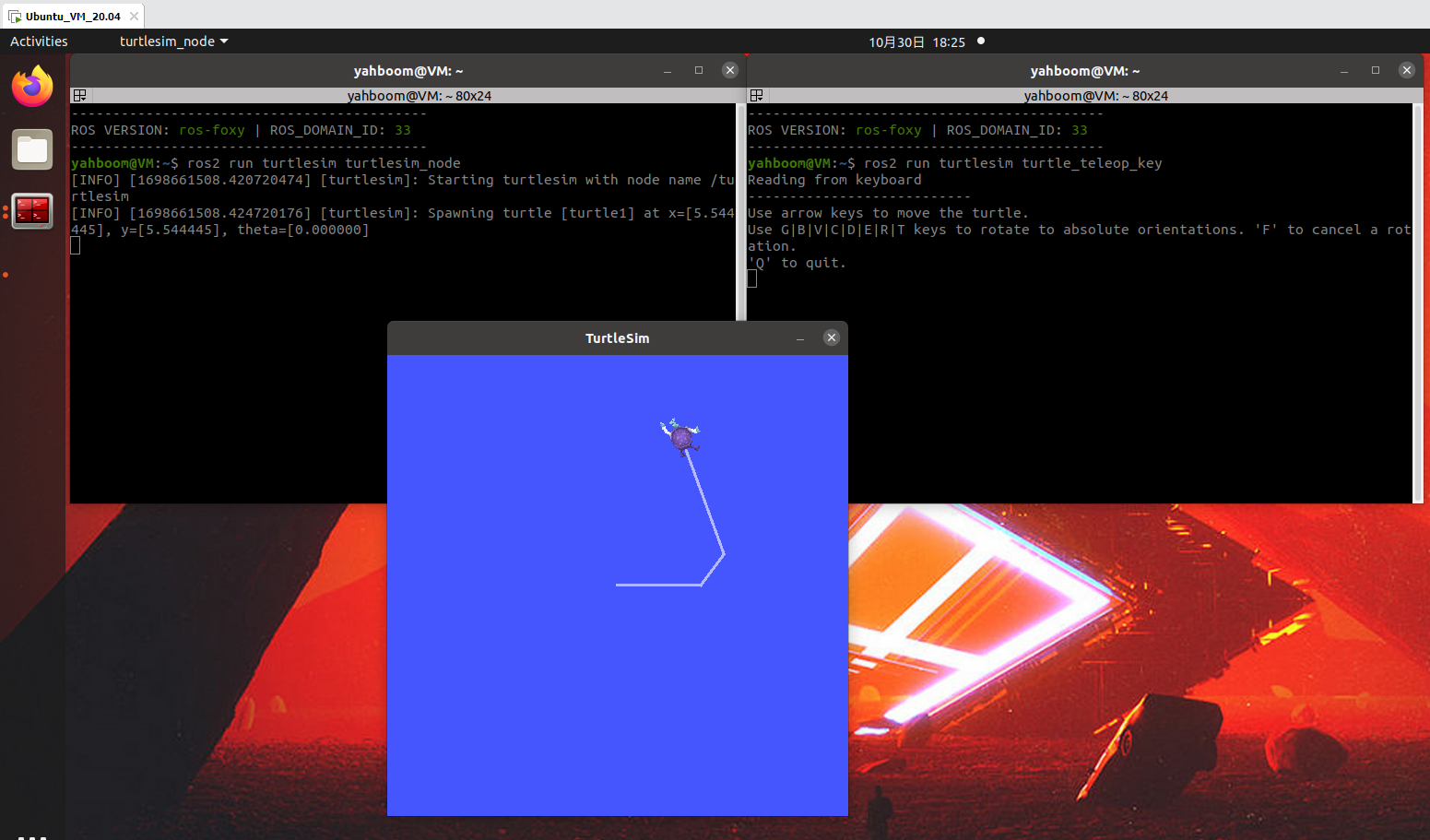
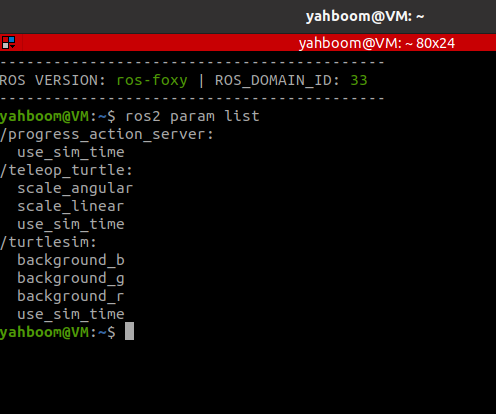
Start a terminal in the virtual machine and use the following command to view the parameter list
xxxxxxxxxxros2 param list
Parameter query and modification
If you want to query or modify the value of a parameter, you can follow the param command with the get or set subcommand:
xxxxxxxxxxros2 param describe turtlesim background_b # View the description information of a parameterros2 param get turtlesim background_b # Query the value of a parameterros2 param set turtlesim background_b 10 # Modify the value of a parameterSaving and loading parameter files
Querying/modifying parameters one by one is too troublesome. Why not try a parameter file? Parameter files in ROS use the yaml format. You can follow the param command with the dump subcommand to save all parameters of a node to a file, or use the load command to load all the content of a parameter file at once:
xxxxxxxxxxros2 param dump turtlesim >> turtlesim.yaml # Save the parameters of a node to a parameter fileros2 param load turtlesim turtlesim.yaml # Load all parameters in a file at once3. Parameter Case
3.1. Creating a New Package
Create a new package in the src directory of the workspace
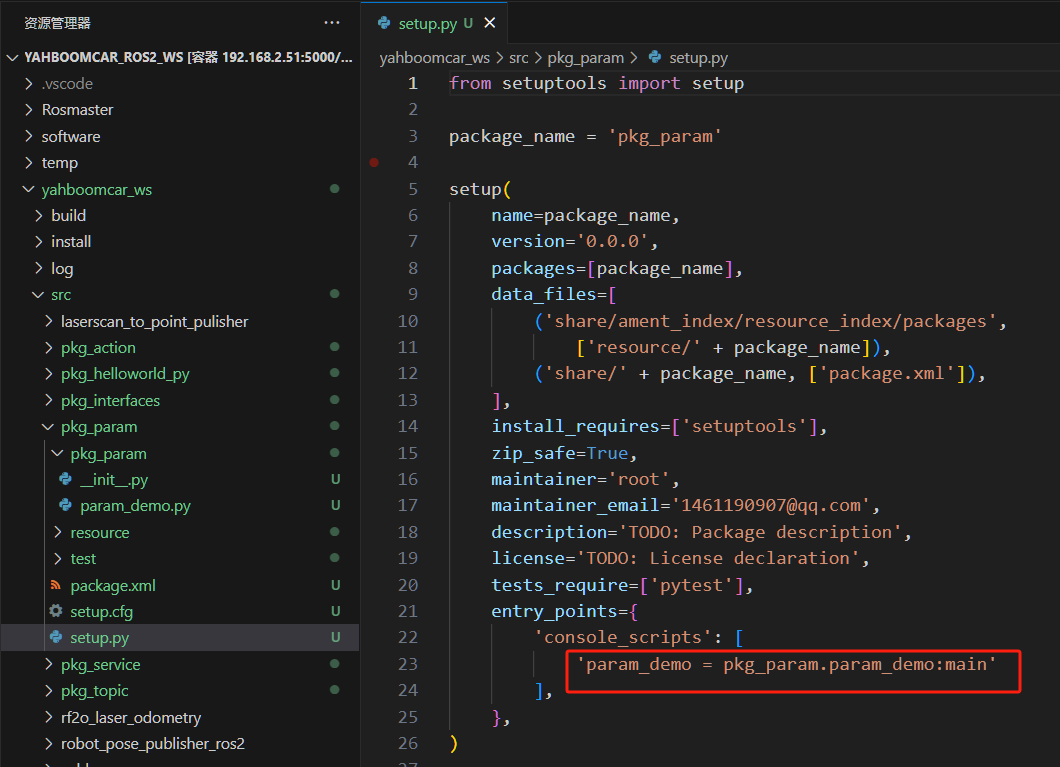
xxxxxxxxxxros2 pkg create pkg_param --build-type ament_python --dependencies rclpy --node-name param_demoAfter executing the above command, the pkg_param package will be created, a param_demo node will also be created, and the relevant configuration files will already be configured.
3.2. Code Implementation
Next, edit 【param_demo.py】 to implement the publisher functionality, and add the following code:
ximport rclpy # ROS2 Python interface libraryfrom rclpy.node import Node # ROS2 node class
class ParameterNode(Node): def __init__(self, name): super().__init__(name) # ROS2 node parent class initialization self.timer = self.create_timer(2, self.timer_callback) # Create a timer (period in seconds, the callback function executed periodically) self.declare_parameter('robot_name', 'muto') # Create a parameter and set the default value of the parameter
def timer_callback(self): # The callback function executed periodically by the timer robot_name_param = self.get_parameter('robot_name').get_parameter_value().string_value # Read the value of the parameter from the ROS2 system self.get_logger().info('Hello %s!' % robot_name_param) # Output log information, printing the read parameter value
def main(args=None): # The main entry function of the ROS2 node rclpy.init(args=args) # ROS2 Python interface initialization node = ParameterNode("param_declare") # Create a ROS2 node object and initialize it rclpy.spin(node) # Loop and wait for ROS2 to exit node.destroy_node() # Destroy the node object rclpy.shutdown() # Shut down the ROS2 Python interface3.3. Compiling the Package
xxxxxxxxxxcolcon build --packages-select pkg_param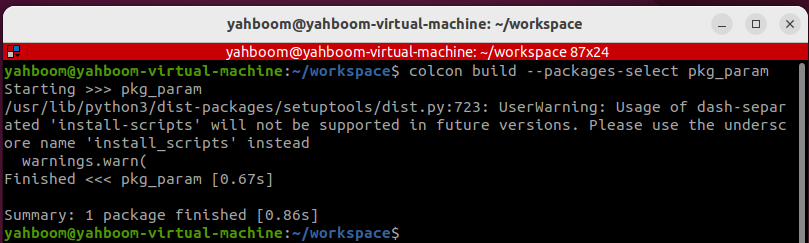
3.4. Running the Program
Refresh the environment variables first, and then run the node
xxxxxxxxxxros2 run pkg_param param_demo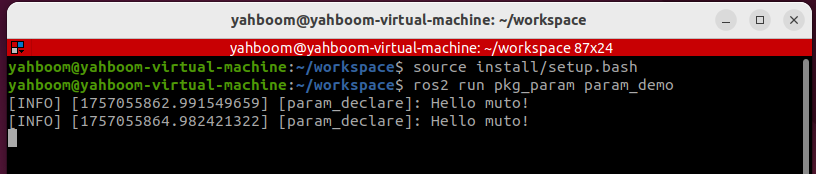
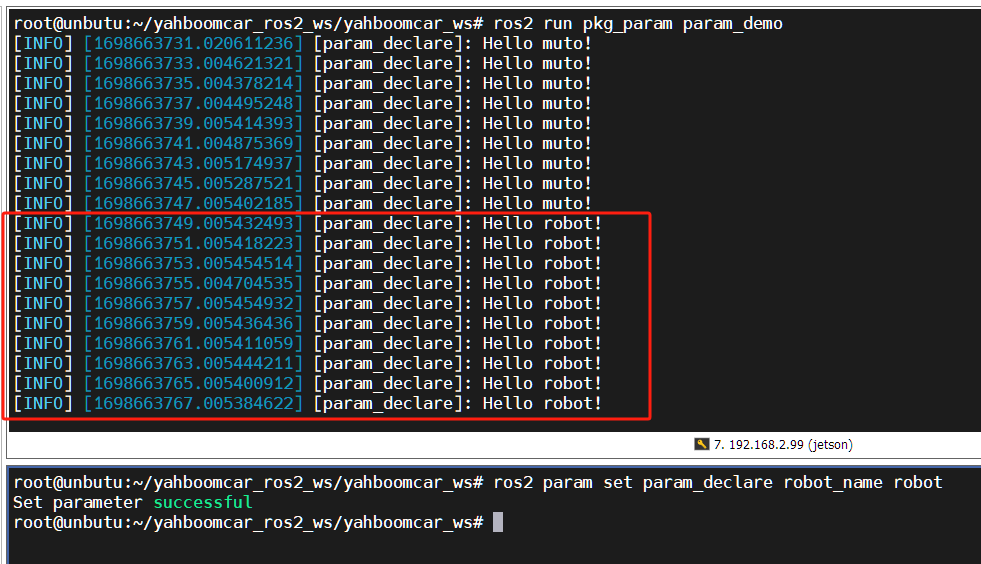
Open another terminal and set robot_name to robot:
xxxxxxxxxxros2 param set param_declare robot_name robotIn the terminal, you can see the log information printed in a loop, in which "muto" is a parameter value we set by default, and the parameter name is "robot_name". After modifying this parameter through the command line, you can see that the terminal changes accordingly.