Welcome to ROSMASTER M1 PRO repository
9.Color Block Tracking and Grasping
Tracking and Grasping Color Blocks
Tracking and Grasping Color Blocks1. Course Content2. Preparation3. Case Demonstration4. Color Block Color Calibration5. Core Source Code Analysis
1. Course Content
The feature implements the program acquiring images through the camera and, by key press, selecting the color block to be tracked and grasped. The program will recognize the target color block in the image. When the color block is moved by hand, the robotic arm follows along. When the robotic arm aligns with the target, the chassis moves into the grasping range, and then the robotic arm goes to grasp the color block and places it in a set position.
Important
The grasping point calculation methods differ between the depth camera and the USB monocular camera: the depth camera obtains the spatial coordinates of the target center point through the depth map, while the monocular camera performs PnP solving to obtain the spatial position of the target center point using a known side length (0.04m)
2. Preparation
The wooden block used in this section: 40x40x40mm color block.
ros2 launch yahboomcar_bringup arm_demo.launch.py demo:=color_follow_grasp
3. Case Demonstration
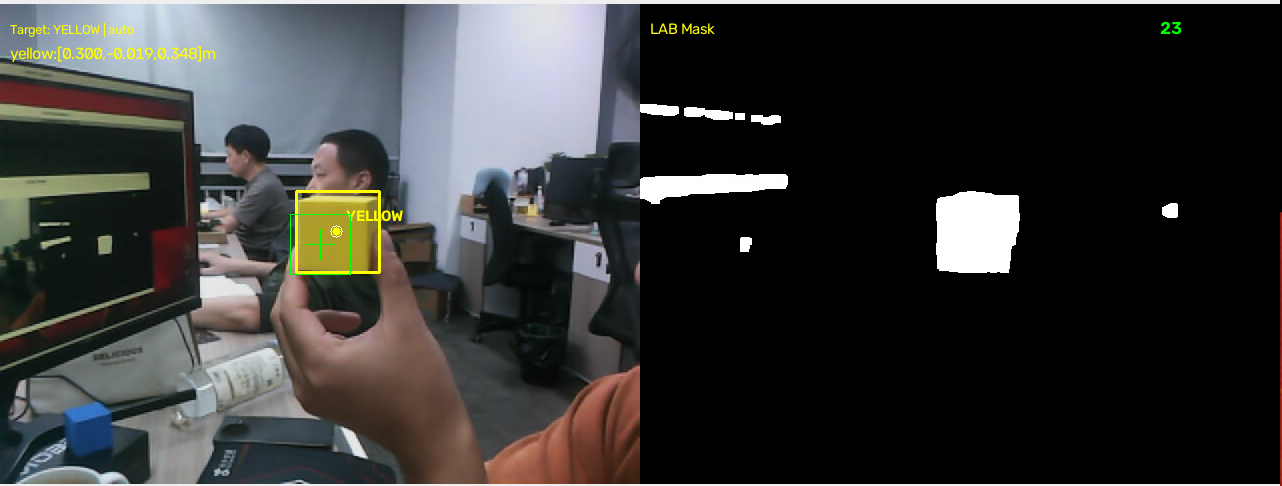
Here, tracking and grasping the yellow block is taken as an example; press Y to detect yellow. As shown in the figure below, after the program runs, hold the 40x40x40mm yellow block provided with the product so that it appears in the image
The robotic arm will first track the target so that the camera crosshair is directly aimed at the color block
After the color block's center stably enters the central target box (the crosshair turns green), the robotic arm camera pose is locked, and the chassis automatically drives smoothly forward toward the color block and performs grasping
4. Color Block Color Calibration
Refer to the color calibration steps in the previous section's tutorial 【Color Block Color Sorting】; the calibration method is the same.
5. Core Source Code Analysis
Program path:
xxxxxxxxxx~/yahboomcar_ros2_ws/yahboomcar_ws/src/common_demo/common_demo/arm_demo/color_follow_grasp.py
_grasp_worker function (grasping worker thread):
This function is the main control thread of the grasping sequence, sequentially completing obtaining the color block pose, angle calculation, inverse kinematics solution, robotic arm motion, gripper closing, placement, and other steps.
time.sleep(0.5): waits for the camera image to stabilize before starting to graspcolor_name = self._target_color: obtains the currently selected target color; returns an error if not setself._latest_blocks: traverses the latest detected color block list, looking for a target whose color matches and that has a measure poseb['color'] == color_name: filters target color blocks by colorb.get('measure_pose'): obtains the 3D pose of the color block in the measure coordinate frame; skips if there is no pose_compute_block_grasp_angle(block['rect']): calculates a signed grasp rotation angle (-45°~45°) from the minimum enclosing rectangle of the color block, used to determine the gripper rotation direction, consistent with the rvec yaw convention of AprilTag graspinggrasp_offset: grasping offset[gx, gy, gz, pitch], compensating for the difference between the camera-detected position and the actual grasping positionarm_kinematics.inverse_kinematics(...): calls the inverse kinematics solver, taking the target position (camera pose + grasping offset) and pitch angle as input, and outputting 5 joint anglesresult.approximate/result.adjusted_pitch: handles the cases of approximate solutions and automatic pitch angle adjustmentjoints[0:3] = round(ik_joints[0:3]): rounds the J1~J4 joint angles obtained from the inverse solution to integers (the low-level firmware only accepts integers)joints[4] = round(90 + angle_norm): the J5 joint angle is adjusted according to the calculated rotation angle, so that the gripper rotation aligns with the color block directionjoints[5] = 30: the J6 gripper angle is set to 30° (open state)pubSix_Arm(joints, runtime=1500): publishes the 6-joint control command, and moves to the grasping poseSingleJoint_pub.publish(ArmJoint(id=6, joint=gripping_angle, time=1000)): controls the gripper to close individuallyAccording to
color_name(red/green/blue/yellow), selects a different placement joint angledown_joint, and places the color block at the placement position of the corresponding colorSingleJoint_pub.publish(ArmJoint(id=6, joint=30, time=1500)): opens the gripper to release the objectpubSix_Arm(observation_pose): returns the robotic arm to the observation posefinally: self._reset_grasp_state(): regardless of success or failure, resets the grasping state at the end
x def _grasp_worker(self): """Worker thread: execute the grasp sequence (IK -> move to target -> close gripper -> place -> return to observation pose)""" try: time.sleep(0.5) # wait for the camera to stabilize # Get the latest block data color_name = self._target_color if color_name is None: self.get_logger().error("No target color set for grasp") return
block = None pose = None for b in self._latest_blocks: if b['color'] == color_name: p = b.get('measure_pose') if p is not None: block = b pose = p break if block is None or pose is None: self.get_logger().error("Color block lost before grasp") return # Compute the signed grasp rotation angle (-45~45 degrees; direction matches the apriltag grasp rvec yaw convention) angle_norm = self._compute_block_grasp_angle(block['rect']) # Apply grasp_offset to the IK target position mx, my, mz = pose gx, gy, gz = self.grasp_offset[0], self.grasp_offset[1], self.grasp_offset[2] self.get_logger().info( f"measure pose: x={mx:.3f}, y={my:.3f}, z={mz:.3f}; " f"IK target: x={mx+gx:.3f}, y={my+gy:.3f}, z={mz+gz:.3f}, pitch={self.grasp_offset[3]:.1f}°" ) result: KinResult = self.arm_kinematics.inverse_kinematics( target_x=mx + gx, target_y=my + gy, target_z=mz + gz, target_pitch=self.grasp_offset[3], seed_angles_deg=None, ) if not result.success: self.get_logger().error(f"Grasp IK failed: {result.message}") return if result.approximate: self.get_logger().warn(f"IK approximate solution, error={result.position_error:.4f}m") if result.adjusted_pitch is not None: self.get_logger().warn(f"IK pitch sweep, adjusted pitch={result.adjusted_pitch:.1f}°") # Build the joint angles ik_joints = result.data joints = [0, 0, 0, 0, 0, 0] joints[0] = round(ik_joints[0]) joints[1] = round(ik_joints[1]) joints[2] = round(ik_joints[2]) joints[3] = round(ik_joints[3]) joints[4] = round(90 + angle_norm) joints[5] = 30 self.get_logger().info(f"Grasp joints: {joints}") self.pubSix_Arm(joints, runtime=1500) time.sleep(3.0) self.SingleJoint_pub.publish(ArmJoint(id=6, joint=self.gripping_angle, time=1000)) time.sleep(3.0) # Move to the color-specific release position if color_name == 'red': down_joint = [180, 35, 70, 5, 60, self.gripping_angle] elif color_name == 'green': down_joint = [180, 35, 60, 0, 90, self.gripping_angle] elif color_name == 'blue': down_joint = [0, 30, 70, 2, 90, self.gripping_angle] elif color_name == 'yellow': down_joint = [0, 43, 48, 6, 90, self.gripping_angle] else: down_joint = [180, 35, 70, 5, 60, self.gripping_angle] self.pubSix_Arm(down_joint) time.sleep(2.5) # Release the gripper self.SingleJoint_pub.publish(ArmJoint(id=6, joint=30, time=1500)) time.sleep(2.0) self.pubSix_Arm(list(self.observation_pose)) time.sleep(2.5) self.get_logger().info("Grasp sequence complete") finally: self._reset_grasp_state()
Parameter file
xxxxxxxxxx~/yahboomcar_ros2_ws/yahboomcar_ws/src/yahboomcar_bringup/param/common.yaml
Parameter Description:
observation_pose: [90, 150, 12, 20, 90, 30]: the 6 joint angles (degrees) of the observation pose, at which the robotic arm has the best field of viewgrasp_offset: [0.0, 0.0, 0.02, 0.0]: grasping offset[x, y, z, pitch], compensating for the difference between the camera-detected position and the actual grasping position; this parameter can be adjusted when there is a grasping deviationgripping_angle: 130: the angle (degrees) when the gripper is closed; the larger the value, the stronger the gripping forcetrack_distance_threshold: 0.2: tracking distance threshold (meters); when the color block distance exceeds this value, the chassis automatically advances toward the targettrack_pixel_tolerance: 30: pixel alignment tolerance; alignment is considered achieved when the deviation between the color block center and the image center is less than this valuegaze_step: 3: the step (degrees) of each joint adjustment; the larger the value, the faster the tracking response but the more likely overshootema_alpha: 0.3: EMA filter coefficient (0~1); the smaller the value, the smoother the filtering but the slower the responsealignment_stable_count: 3: consecutive alignment count threshold; tracking is considered stable only after reaching this count, which can then trigger graspingmin_block_area: 300: minimum color block area (pixels), filtering out noise detection results with too small an areasquare_size: 0.04: the physical side length (meters) of the block in USB monocular mode, used for PnP solving of the target's 3D positionusb_camera_measure: [0.012, 0.0, 0.013]: the pose compensation value (meters) in USB monocular mode, correcting the deviation between the camera mounting position and the origin of the measure coordinate frame
xxxxxxxxxxcolor_follow_grasp ros__parameters observation_pose90 150 12 20 90 30 grasp_offset0.0 0.0 0.02 0.0 # x,y,z axis offset distance and included angle gripping_angle130 # gripper grasping angle, in degrees, integer track_distance_threshold0.2 # tracking distance threshold (meters); the chassis moves when exceeded track_pixel_tolerance30 # pixel alignment tolerance gaze_step3 # joint adjustment step per cycle (degrees) ema_alpha0.3 # EMA filter coefficient (0~1), the smaller the smoother alignment_stable_count3 # consecutive alignment count threshold; considered stable only after reaching it min_block_area300 # minimum color block area (pixels), filtering noise square_size0.04 # block side length in usb monocular mode (meters), default 4x4cm usb_camera_measure0.012 0.0 0.013 # pose compensation in usb monocular mode (meters)