yahboom
HomeTutorialsProduct
Solution
Blog
Online Store
About Us
EN/中文
Store
ROSMASTER A1 PRO📖
00.Configuration and Operation Guide
  • 0. Unboxing and Review
  • 1.Assembly Videos
  • 2.User Manual
  • 3.Enter Docker (For Raspberry Pi)
  • 4.A1Pro Front Wheel Servo Calibration
  • 5.USB Camera Calibration
  • 6.Depth Camera Calibration
  • 7.FAQ
  • 8.Desktop Configuration Center and Remote Control Guide
01.Chassis Control Course
  • 1.Robot Information Publishing
  • 2.Robot Handle Control
  • 3.Robot Keyboard Control
  • 4.Linear Velocity Calibration
  • 5.Angular Velocity Calibration
  • 6.Robot URDF Model
  • 7.Robot EKF State Estimation
02.Lidar Course
  • 1.Lidar Introduction and Use
  • 2.Lidar Obstacle Avoidance
  • 3.Lidar Following
  • 4.Lidar Patrol
  • 5.GMapping-SLAM Mapping
  • 6.Cartographer-SLAM Mapping
  • 7.Slam-Toolbox Mapping
  • 8.Lifelong Mode Mapping
  • 9.Navigation2 Single Point Navigation
  • 10.Navigation2 Multi Point Navigation
  • 11.Cartographer Relocalization Navigation
  • 12.Slam-Toolbox Localization Navigation
  • 13.Synchronous Mapping And Navigation
  • 14.Aruco Visual Relocalization Navigation
  • 15.Mobile App Mapping And Navigation
  • 16.AprilTag Transport
  • 17.Color Block Transport
03.USB Camera-Depth Camera Course
  • 1.USB Camera Introduction
  • 2.USB Camera Intrinsic Calibration
  • 3.Nuwa-HP60C Camera Introduction (Depth Camera Only)
  • 4.Depth Camera Distance Measurement (Depth Camera Only)
  • 5.Depth Pseudo Color Image (Depth Camera Only)
  • 6.Block Volume Calculation (Depth Camera Only)
  • 7.Edge Detection (Depth Camera Only)
  • 8.RTAB-Map SLAM Mapping (Depth Camera Only)
  • 9.RTAB-Map Navigation (Depth Camera Only)
04.Robotic Arm and 3D Space Gripping Course
  • 0.Robotic Arm Basic Usage
  • 1.Robotic Arm Kinematics
  • 2.Robotic Arm Chassis Coordination Control
  • 3.AprilTag ID Sorting
  • 4.AprilTag Height Anomaly Sorting
  • 5.AprilTag Tracking and Grasping
  • 6.Color Block Sorting
  • 7.Color Block Height Anomaly Sorting
  • 8.Color Block Tracking and Grasping
  • 9.Wood Block Shape Sorting
  • 10.KCF Tracking and Grasping Objects
  • 11.Mediapipe Gesture ID Sorting AprilTag
  • 12.Mediapipe Gesture Height Sorting AprilTag
  • 13.Desktop Tracking and Grasping AprilTag
  • 14.3D Spatial Tracking AprilTag
  • 15.Line Following Obstacle Clearing
  • 16.Transformer Model Tracking Algorithm
05.Road Network Planning and Navigation
  • 1.Introduction To Road Network Planning
  • 2.Road Network Annotation
  • 3.Planning And Navigation Between Waypoints
  • 4.Road Network Navigation In Any Pose
  • 5.Path Re-planning
06.OpenClaw Basic Course
  • 1.Introduction to OpenClaw
  • 2.OpenClaw Core Concepts
  • 3.OpenClaw API-KEY Configuration
  • 4.OpenClaw Switch Models
  • 5.OpenClaw System Prompt Words
  • 6.OpenClaw Common CLI Commands
07.OpenClaw Interaction Method
  • 1.OpenClaw Webchat Interaction
  • 2.OpenClaw Tui Interaction
  • 3.OpenClaw Voice Dialogue Interaction
  • 4.OpenClaw WhatsApp Interaction
08.OpenClaw Development
  • 1.OpenClaw Connecting to Robot MCP Service
  • 2.Robot CLI Command Tool
  • 3.robot-control plugin tool
  • 4.reply-bridge plugin tool
  • 5.OpenClaw Multimodal Vision
  • 6.OpenClaw Chassis Control
  • 7.OpenClaw Robotic Arm Control
  • 8.OpenClaw Skills Development
  • 9.OpenClaw Scheduled Tasks
  • 10.OpenClaw Multi-Agent Intelligent Agent
  • 11.OpenClaw Active Interaction
  • 12.OpenClaw Vector Memory
09.OpenClaw Embodied Intelligent Application
  • 1.OpenClaw Target Tracking
  • 2.OpenClaw Arm Tracking And Grasping
  • 3.OpenClaw Arm Fixed-point Placement
  • 4.OpenClaw Waste Sorting
  • 5.OpenClaw SLAM Mapping And Navigation
  • 6.OpenClaw Navigation Transport
  • 7.OpenClaw AprilTag Grasping
  • 8.OpenClaw Color Line Patrol
  • 9.OpenClaw Visual Distance Measurement
10.OpenClaw Scenario Sandbox
  • 1.Map Description and Prop Placement
  • 2.Build Sand Table Map
  • 3.Visual Relocation Markers
  • 4.Map Mapping Markers
  • 5.OpenClaw Scenario Sandbox Comprehensive Case
11.AI Model Basics
  • 1.AI Large Model Types and Principles
  • 2.RAG Retrieval Enhancement and Model Training Samples
  • 3.Embodied Intelligent Robot System Architecture
  • 4.Embodied Intelligent Functions Core Source Code
12.AI Model Development
  • 1.Register a Model Service Provider Aaccount
  • 2.Configuring API-KEY
  • 3.Introduction to Dify
  • 4.Basic Dify Features
  • 5.AI Large Model Development - chatbot
  • 6.Deploy the RAG Knowledge Base
  • 7.RAG Knowledge Base + chatbot
  • 8.AI Agent Workflow
  • 9.Custom Wake-up Response
13.AI Model - Text Version
  • 1.Semantic Understand and Command Follow
  • 2.Multimodal Visual Understand
  • 3.Multimodal Visual Understand + Robotic Arm Gripping
  • 4.Multimodal Visual Understand+SLAM Navigation
  • 5.Robotic Arm Gripping+Multimodal Visual Understand+SLAM Navigation
  • 6.Intention Estimation
14.AI Model - Voice Version
  • 1.Semantic Understand and Command Follow
  • 2.Multimodal Visual Understand
  • 3. Multimodal Large Model+Robotic Arm Gripping
  • 4.Multimodal Visual Understand+SLAM Navigation
  • 5.Robotic Arm Gripping+Multimodal Visual Understand+SLAM Navigation
  • 6.Intention Estimation
15.Mediapipe Visual Course
  • 1.Hand Detection
  • 2.Posture Detection
  • 3.Overall Detection
  • 4.Facial Landmark Detection
  • 5.Face Detection
  • 6.Face Special Effects
  • 7.3D Object Recognition
  • 8.Brush
  • 9.Finger Control
  • 10.Palm Target Positioning
  • 11.Fingertip Trajectory Recognition
  • 12.Fingertip Gesture Control Cobotic Arm
  • 13.Gesture Grabbing and Releasing Objects
  • 14.Finger Control Robotic Arm
  • 15.Medipipe Gesture Control Robotic arm Cction Group
16.MoveIt2 Simulation Course
  • 1.MovelT2 Configuration
  • 2.MovelT2 Simulation-Reality Linkage
  • 3.Random Movement
  • 4.Forward Kinematics Design
  • 5.Inverse Kinematics Design
  • 6.Cartesian Path
  • 7.Scene Design
  • 8.Trajectory Planning
  • 9.Collision Detection
  • 10.3D Perception Obstacle‑Avoidance
17.Multi-vehicle Course
  • 1.Multi-vehicle Control
  • 2.Multi-vehicle Navigation
  • 3.Multi-vehicle Formation
18.YOLO26 Development
  • 1.CLI Use
  • 2.Object Detection
  • 3.Instance Segmentation
  • 4.Pose Estimation
  • 5.Image Classification
  • 6.Oriented Object Detection
  • 7.YOLOv26 + DeepSORT Tracking
  • 8.Monocular Depth Estimation
19.Control Board STM32 Driver Course
  • 0.Notes (Must Read)
  • 1.About Expansion Board
  • 2.STM32 Development Environment
  • 3.Button Control
  • 4.FreeRTOS Application
  • 5.Serial Communication
  • 6.SBUS Model Aircraft Remote Control
  • 7.CAN Bus Communication
  • 8.RGB Colorful Light Bar
  • 9.Timer Interrupt to Control PWM Servo
  • 10.Control Serial Port Servos
  • 11.Nine-axis Attitude Sensor to Obtain Data
  • 12.Control Motor
  • 13.Timer Captures the Encoder Data
  • 14.1 Kinematic Analysis of Mecanum Wheel
  • 14.2 Kinematic Analysis of Ackerman
  • 14.3 Kinematic Analysis of 4WD
  • 15.PID Control Robot Movement
20.Docker Course
  • 1.Docker Introduction and Installation
  • 2.Docker Basic Commands
  • 3.Docker Submission and Multi-Terminal Access
  • 4. Docker Startup Script
  • 5.Docker-Vscode Environment Construction
21.Image Processing Basics Course
  • 1. Introduction to Open Source CV
  • 2. Image reading and display
  • 3. Image writing
  • 4. Image quality
  • 5. Pixel Operation
  • 6. Image zoom
  • 7. Image cutting
  • 8. Image translation
  • 9. Image Mirroring
  • 10. Affine Transformation
  • 11. Image Rotation
  • 12. Perspective Transformation
  • 13. Grayscale processing
  • 14. Image Binarization
  • 15. Edge Detection
  • 16. Line drawing
  • 17. Rectangle and circle drawing
  • 18. Drawing text and pictures
22.Linux System Course
  • 1.Introduction to Linux system
  • 2.Ubuntu file system
  • 3.Ubuntu common commands
  • 4.Ubuntu common editors
  • 5.Ubuntu software operation commands
  • 6.Virtual machine installation
  • 7.SSH remote control
  • 8.VNC remote control
  • 9.Transfer files remotely
  • 10.Driver library and communication
  • 11.Static IP and hotspot mode
  • 12.Bind device ID
  • 13.Capacity expansion and resource allocation
  • 14.Update system software sources
  • 15.Set root user password
  • 16.sudo free password
  • 17.Connect to WiFi network
  • 18.View system version
  • 19.Customized service management
  • 20.Back up system image
23.ROS2 Basic Course
  • 1.Introduction to ROS2
  • 2.ROS2 install Humble
  • 3.ROS2 development environment
  • 4.ROS2 workspace
  • 5.ROS2 function package
  • 6.ROS2 node
  • 7.ROS2 topic communication
  • 8.ROS2 service communication
  • 9.ROS2 action communication
  • 10.ROS2 custom interface message
  • 11.ROS2 parameter service case
  • 12.ROS2 meta-function package
  • 13.ROS2 distributed communication
  • 14.ROS2 DDS
  • 15.ROS2 time related API
  • 16.ROS2 common command tools
  • 17.ROS2 rviz2 use
  • 18.ROS2 rqt toolbox
  • 19.ROS2 Launch startup file configuration
  • 20.ROS2 recording and playback tool
  • 21.ROS2 URDF model
  • 22.ROS2 Gazebo simulation platform
  • 23.ROS2 TF2 coordinate transformation
24.Main Control Course
Jetson Orin Nano_NX
  • 1.Jetson Orin board introduction
  • 2.Restore the factory image system
  • 3.Backup SSD system
  • 4.SSD expansion
  • 5.Network configuration
  • 6.SSH remote login
  • 7.VNC remote control
  • 8.Remote file transfer
  • 9.Jtop tool
  • 10.Exchange space expansion
Raspberry Pi
  • 1. Introduction to Raspberry PI 5
  • 2. Raspberry PI system installation and backup
  • 3. Powering the Raspberry PI 5
  • 4. Startup of Raspberry PI 5
  • 5. Update and upgrade operating system
  • 6. Introduction to raspi-config tool
  • 7. config.txt file description
  • 8. Network Configuration
  • 9. remote access
  • 10. Transfer files remotely
  • 11. Set display resolution and rotation
  • 12. Set screen to sleep
  • 13. Play audio and video
  • 14. Using USB camera
  • 15. Using MIPI camera
  • 16. Get real-time temperature of Raspberry Pi
RDKX5
  • 1.Introduction to RDK X5 board
  • 2.Write system file
  • 3.Hardware interface description
  • 4.Install case and other accessories
  • 5.Network configuration
  • 6.Remote login
  • 7.Update system
  • 8.srpi-config user guide
  • 9.config. txt configuration file
  • 10.Self-startup setting
  • 11.RDK exclusive command usage
  • 12.Linux command usage
  • 13.GPIO readwrite operation
  • 14.Image classification algorithm
  • 15.Use USB camera
  • 16.Use MIPI camera
  • 17.Binocular camera depth algorithm
  • 18. Controlling RGB Cooling Fans
Download
  • SystemFile
  • Code
  • 3D_Model_File
  • Software_Tools
  • Hardware_Info
  • Introduction_Manual
  • Script_File
  • Dify AI Agent
Download ZIP

Welcome to ROSMASTER A1 PRO repository

7.FAQ

A1Pro Robot Common Problem Troubleshooting Guide


1. Bottom Hardware and Serial Communication Problems

Q1.1: Startup driver reports cannot find serial port (like /dev/myserial or /dev/ttyUSB0)

  • Phenomenon: Terminal error could not open port /dev/myserial: [Errno 2] No such file or directory.

  • Reasons:

    1. Type-C/Micro-USB data cable is loose or has poor contact;

    2. Bottom control board is not powered on;

    3. udev serial alias rules have not taken effect.

  • Troubleshooting and resolution:

    1. Check control board power switch and car battery voltage;

    2. Run ls /dev/ttyUSB* or ls /dev/ttyACM*, see if the system recognizes the bottom serial port device;

    3. If device is recognized but no /dev/myserial alias, rebind udev rules or temporarily specify serial port as actual device name in launch/parameters (such as /dev/ttyUSB0).

Q1.2: Driver reports insufficient serial port permissions (Permission denied)

  • Phenomenon: [Errno 13] Permission denied: '/dev/...'.

  • Solution: Grant read-write permissions to the serial port, or add current user to dialout group:

    sudo chmod 777 /dev/ttyUSB* /dev/myserial*
    # Or permanently add to group (need to logout and re-login to take effect):
    sudo usermod -aG dialout $USER

Q1.3: After publishing control command, chassis does not move / reports feedback unavailable

  • Phenomenon: Car has no action, driver terminal prints Rejected motion: feedback unavailable or stop pending.

  • Reasons:

    1. Battery undervoltage protection (chassis communication board will refuse to drive motor when voltage is too low);

    2. Chassis is in emergency stop or stop suspend state;

    3. Publishing angular velocity when linear velocity is 0 (Ackerman car does not support in-place rotation, angular velocity is invalid at zero linear velocity).

  • Solution:

    1. Check battery level, plug in adapter to charge;

    2. Ensure published cmd_vel has non-zero linear.x; can print topic via ROS: ros2 topic echo /cmd_vel;

    3. Try restarting the driver node to reset status.

Q1.4: Car drifts left/right when driving straight

  • Reason: There is tiny deviation in the physical mechanical center of the Ackerman front wheel servo.

  • Solution: Refer to "4.A1Pro Front Wheel Servo Calibration" tutorial for center calibration.


2. Robotic Arm Control and Servo Problems (Including Robotic Arm Grasping Precautions)

Q2.1: Robotic arm droops weakly / cannot rotate via topic

  • Reason: Servo is in powered-off released state (Torque OFF).

  • Solution: Call service to restore servo power-on and lock:

    xxxxxxxxxx
    ros2 service call /arm_driver/set_torque std_srvs/srv/SetBool "{data: true}"

Q2.2: Gripper overheats or makes buzzing stall sound (emergency handling)

  • Danger warning: Servo long-term stall can easily overheat or even burn out the internal motor!

  • Solution and emergency handling:

    1. When stall or abnormal sound occurs, immediately run the following command to release servo torque:

      xxxxxxxxxx
      ros2 service call /arm_driver/set_torque std_srvs/srv/SetBool "{data: false}"
    2. When grasping items, must set gripper angle based on actual item size, never blindly send 180° closing angle.


Q2.3: Robotic Arm Grasping Item Precautions and Gripper Angle Reference Table

Warning

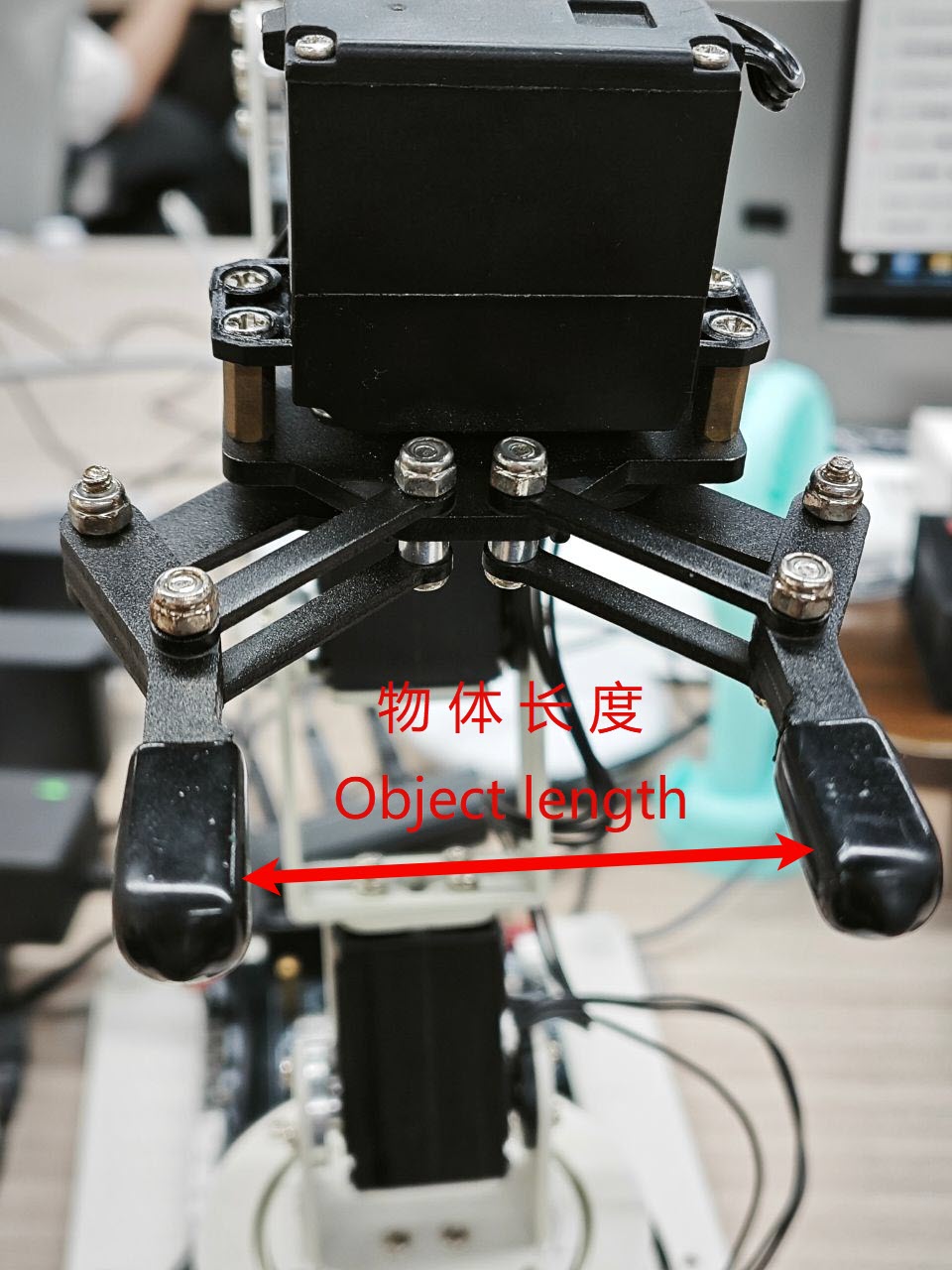
When the robotic arm grasps items, must strictly control gripper angle! Angle too small cannot grasp firmly, angle too large will cause the gripper to close tightly, leading to sustained stall and potential damage to servo #6.

We have compiled a gripper angle corresponding table, recording the approximate servo angle values needed when grasping every 0.5 cm size of object. Please reasonably adjust the target angle in the grasping code according to this table:
MVIMG_20250611_141934

Object Length / Width (cm)Servo #6 Gripper Angle (degrees)Grasping State Description
0 (completely closed)180°Empty grip / completely closed
0.5 cm176°Extremely thin object
1.0 cm168°Thin long object
1.5 cm160°Small size object
2.0 cm152°Standard small wooden block
2.5 cm143°Small-medium size wooden block
3.0 cm134°Standard 3cm cube (Recommended 134°)
3.5 cm125°Medium size
4.0 cm115°Standard 4cm wooden block
4.5 cm105°Larger object
5.0 cm95°Near palm width
5.5 cm80°Large opening angle
6.0 cm57°Extreme grasping width
6.0 ~ 6.4 cm0° ~ 57°Maximum opening angle range

Grasping Example Description:

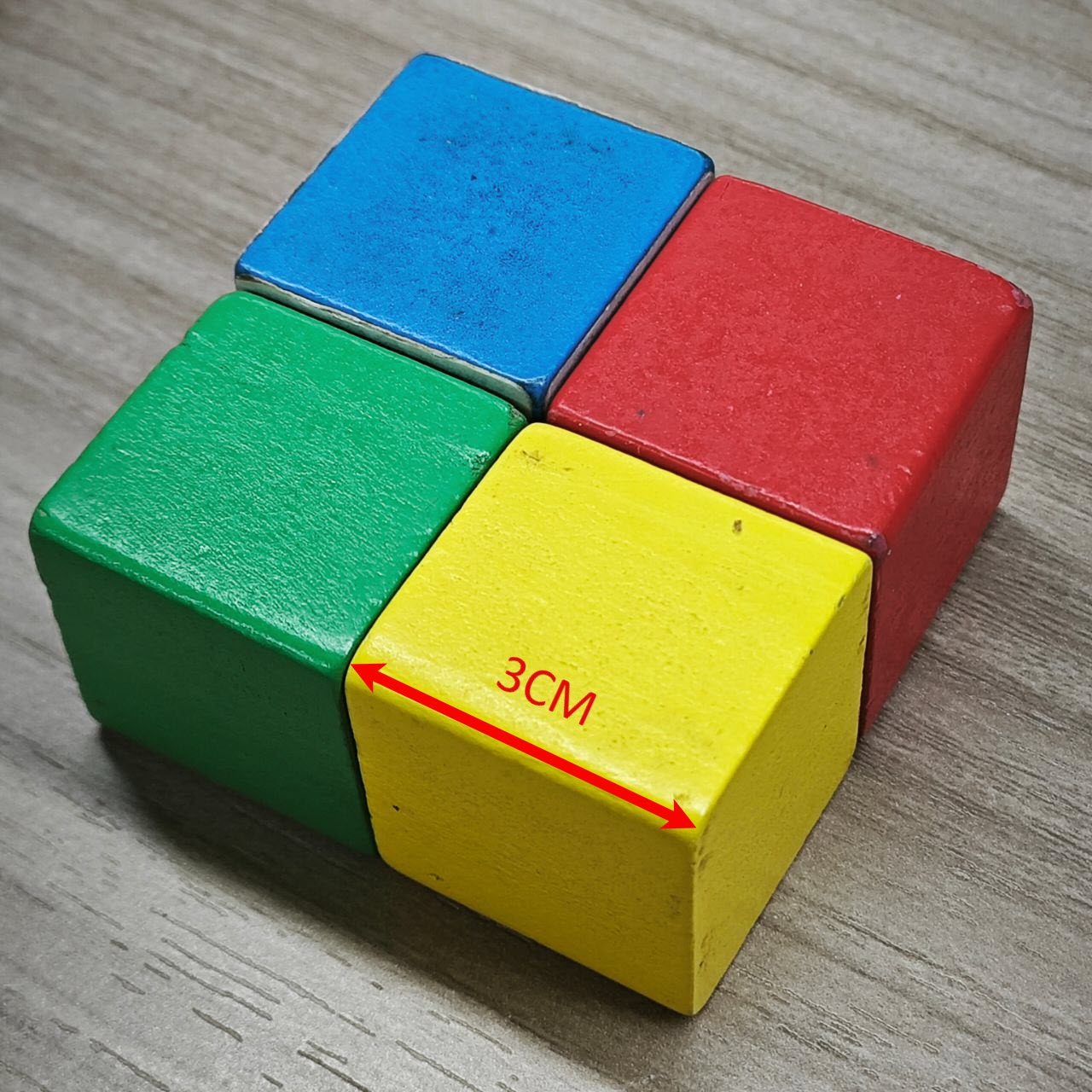
  • For example, the matching 3cm cube with length, width, and height all 3cm, set the servo angle to 134° in the program to firmly grasp, never set exceeding this value, otherwise it will cause motor stall.
MVIMG_20250611_180739

Caution

Important Warning:

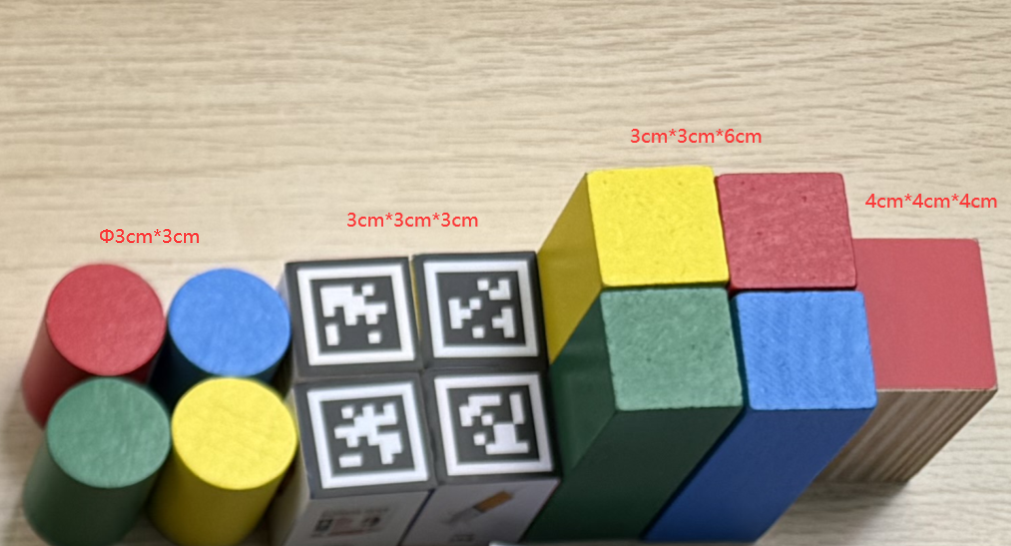
This product provides four different sizes and shapes of wooden blocks, must strictly follow the tutorial's labeled block sizes for grasping.

If the program sets grasping for 3cm cube (angle 134°), but actually places 4cm cube (corresponding to 115° required) for grasping, the gripper forcing to close will directly cause continuous stall and damage servo #6! Before grasping objects of different sizes, be sure to check the size and corresponding angle.
Wooden Block Specifications and Gripper Angle Reference

If stall occurs during grasping larger blocks, you can also modify the grasping angle at the following path:

xxxxxxxxxx
~\yahboomcar_ros2_ws\dofbo_pro_ws\src\dofbot_pro_bringup\config\common.yaml
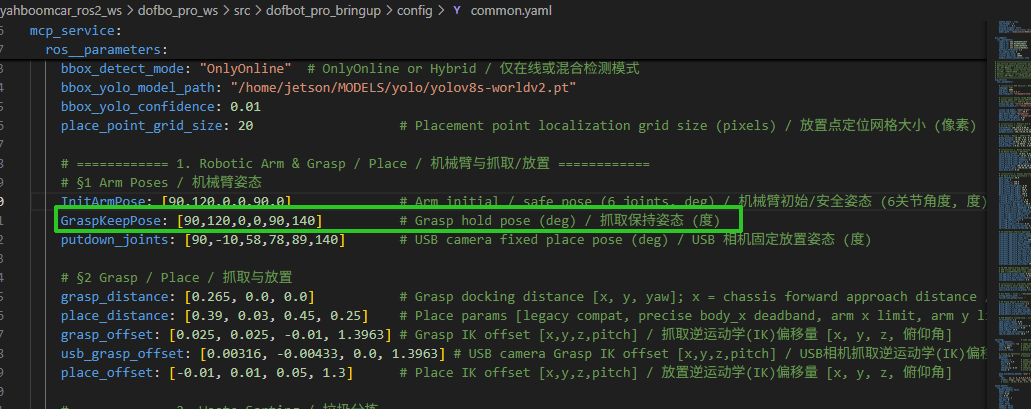
image-20261013145548522

If stall occurs during grasping, decrease the angle (such as 140 or others); if the grip is not tight enough, you can increase it. After modification, compile to take effect:

xxxxxxxxxx
cd ~/yahboomcar_ros2_ws\dofbo_pro_ws
colcon build --packages-select dofbot_pro_bringup

3. LiDAR and Camera Vision Problems

Q3.1: Depth camera (HP60C) has no image or node crashes

  • Reasons:

    1. Camera USB interface bandwidth is limited or is plugged into USB 2.0 port;

    2. Environment variable CAMERA_TYPE is not correctly specified;

    3. Another program is occupying the camera.

  • Solution:

    1. Ensure it is plugged into USB 3.0 (blue) interface;

    2. Check environment variable:

      xxxxxxxxxx
      echo $CAMERA_TYPE
      # If using depth camera, ensure it is not forced to specify as usb:
      unset CAMERA_TYPE
    3. Confirm camera device node exists with ls /dev/video*.

Q3.2: LiDAR does not rotate or no point cloud data (/scan topic has no message)

  • Binding port: /dev/rplidar

  • Reasons:

    1. Radar wiring is loose, power supply insufficient;

    2. Radar serial port /dev/rplidar has insufficient permissions or device not recognized;

    3. Multiple nodes simultaneously grabbing radar serial port.

  • Solution:

    1. Check if serial device exists: ls -l /dev/rplidar, if not, check wiring or rebind udev rules;

    2. Check serial port permissions: sudo chmod 777 /dev/rplidar;

    3. Execute ros2 topic hz /scan to check if there is point cloud data frame rate;

    4. Check for residual radar nodes in background: ps aux | grep lidar, kill extra processes and restart.


4. ROS 2 Communication and Environment Configuration Problems

Q4.1: Terminal command execution reports Package '...' not found

  • Reason: New terminal has not loaded ROS 2 and workspace environment variables.

  • Solution: Run in each new terminal (or write to ~/.bashrc):

    xxxxxxxxxx
    source /opt/ros/humble/setup.bash
    source ~/yahboomcar_ros2_ws/yahboomcar_ws/install/setup.bash
    source ~/yahboomcar_ros2_ws/dofbot_pro_ws/install/setup.bash

Q4.2: PC cannot receive/display car's topics (cross-machine communication failure)

  • Troubleshooting steps:

    1. Check same LAN: Car and PC must be connected to the same router/WiFi, try ping each other's IP addresses;

    2. Check Domain ID: ROS_DOMAIN_ID on both machines must be exactly the same:

      xxxxxxxxxx
      echo $ROS_DOMAIN_ID
      # If inconsistent, set both to the same value (such as 20):
      export ROS_DOMAIN_ID=20
    3. Firewall: Turn off PC system firewall or allow ROS 2 DDS UDP ports.

Q4.3: Starting node reports error Address already in use or serial port already occupied

  • Reason: Previous driver node was Ctrl+C in foreground, but background still has sub-threads or zombie processes that did not exit.

  • Solution: Directly clean up residual processes before starting:

    xxxxxxxxxx
    pkill -f ros

5. Dify & OpenClaw Large Model and Voice Interaction Troubleshooting

Q5.1: Voice interaction module cannot find device / cannot wake up (binding port: /dev/myspeech)

  • Binding port: /dev/myspeech

  • Phenomenon: Starting llm_agent_control.launch.py reports error cannot open serial port or not detected recording device.

  • Troubleshooting and solution:

    1. Check if serial is recognized: ls -l /dev/myspeech, if does not exist, unplug and replug voice module to reconnect;

    2. Check serial port permissions: sudo chmod 777 /dev/myspeech;

    3. Wake-up test: Speaker should be about 0.5 meters from the car, clearly say wake-up word "Hi, yahboomm", after hearing "I'm here" then give control commands.

Q5.2: Microphone recording is overly sensitive (VAD fails to truncate) or insensitive (premature truncation)

  • Reason: Microphone input gain is too large or too small, ambient noise floor affects VAD (Voice Activity Detection).

  • Solution:

    • Open system audio settings, appropriately lower or raise the microphone input volume slider;

    • Avoid voice control in high-noise environment.

Q5.3: Dify local large model no response / connection timeout

  • Troubleshooting steps:

    1. Confirm if Dify is started: Enter in host terminal sh ~/bringup_dify.sh to start;

    2. Check Docker container running status: docker ps, confirm dify-related containers are all in Up running state;

    3. Check network connection and API Key configuration are valid.

Q5.4: OpenClaw agent service exception / dialogue no reply

  • Troubleshooting commands:

    1. Check gateway running status: openclaw gateway status;

    2. Restart gateway service: openclaw gateway restart;

    3. Check model access status: openclaw models status; if prompted unauthorized or key expired, execute openclaw configure to reconfigure API Key;

    4. View enabled skills: openclaw skills list.


Q5.5: Dify, too many incorrect password attempts, need to wait 24 hours before trying correct password again to login to Dify
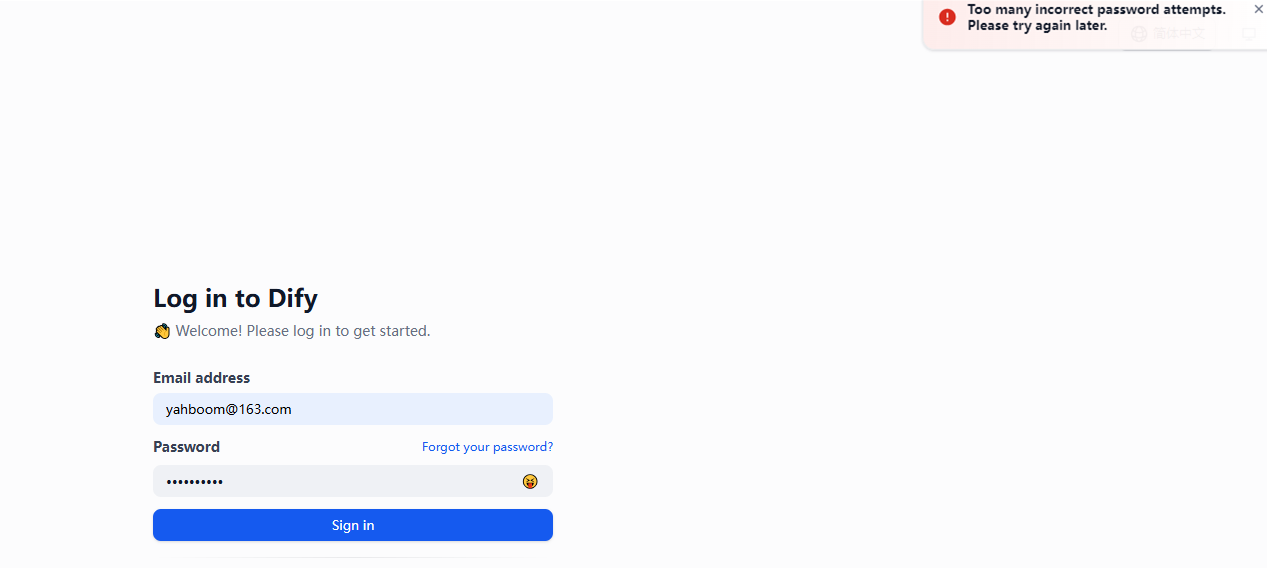
image-20260922093859747


Q5.6: If OpenClaw or Dify voice synthesis reports the error shown below, it is because the official has taken the model offline. You can solve this by changing the voice synthesis model.
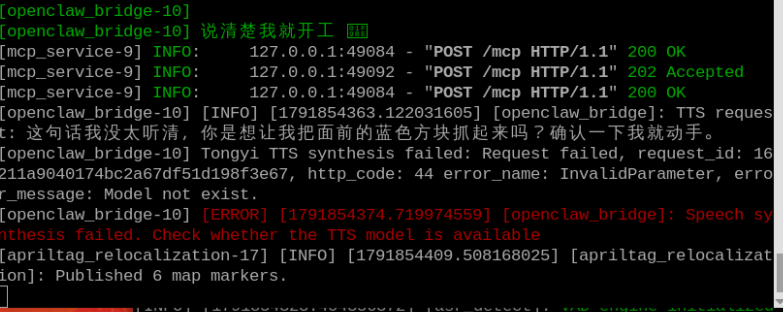
image-20261013145922029

Go to this path to modify the voice synthesis model and voice,

xxxxxxxxxx
~\yahboomcar_ros2_ws\dofbo_pro_ws\src\dofbot_pro_bringup\config\common.yaml

Scroll to the end, find the highlighted area and modify according to the reference.
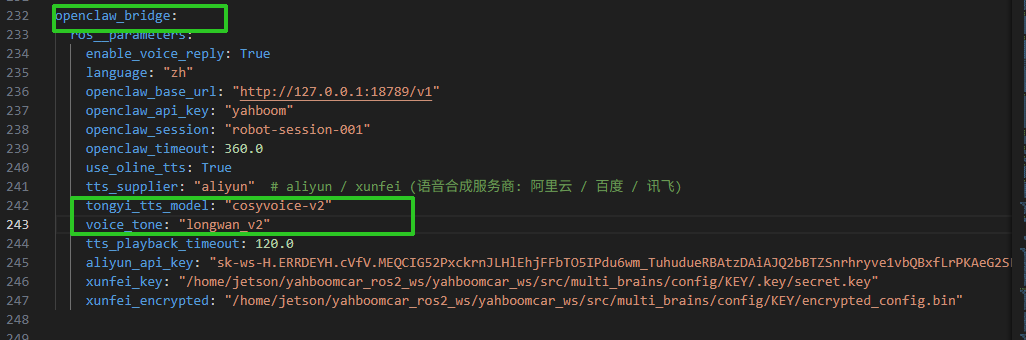
image-20261013150121552

After modification, compile to take effect,

xxxxxxxxxx
cd ~/yahboomcar_ros2_ws\dofbo_pro_ws
colcon build --packages-select dofbot_pro_bringup

Q5.7: If Dify shows voice module busy, check if there is a background process occupying the sound card

xxxxxxxxxx
pgrep -af common_service

If you see residual processes, use the command kill -9 pid to delete them. PID is the corresponding process number.


6. High-Frequency Troubleshooting "Three Board Axe" Quick Reference Commands

Troubleshooting TargetPractical Commands
Check all hardware serial portsls -l /dev/myserial* /dev/rplidar* /dev/myspeech* /dev/video*
Check serial port device permissionssudo chmod 777 /dev/myserial* /dev/rplidar* /dev/myspeech*
Check currently active nodesros2 node list
Check all current topicsros2 topic list
Measure topic publishing frequencyros2 topic hz /scan or ros2 topic hz /arm_status/arm_joint
Real-time print topic contentros2 topic echo /arm_status/arm_joint
Check interface definitionros2 interface show dofbot_pro_interface/msg/ArmJoints
Check Dify container statusdocker ps
Check OpenClaw gatewayopenclaw gateway status
Kill bottom driver residualkillall -9 Ackman_driver_A1P
Kill residual processespkill -f ros
Depth Camera Calibration
Desktop Configuration Center and Remote Control Guide

COMPANY

  • About us
  • Team Style
  • Blog

LEARNING & EXPLORATION

  • Tutorials
  • Edge AI hardware
  • Educational robots
  • Embedded intelligent hardware

WHERE TO BUY

  • Yahboom Online Store
  • Amazon
  • Alibaba
  • AliExpress
  • Mercado

TECHNOLOGY SUPPORT

  • Email: support@yahboom.com

BE A DISTRIBUTOR

  • Email: sales@yahboom.com
QR Code

Copyright © 2017-2026 Yahboom. All Rights Reserved.

EN/中文