yahboom
HomeTutorialsProduct
Solution
Blog
Online Store
About Us
EN/中文
Store
ROSMASTER A1 PRO📖
00.Configuration and Operation Guide
  • 0. Unboxing and Review
  • 1.Assembly Videos
  • 2.User Manual
  • 3.Enter Docker (For Raspberry Pi)
  • 4.A1Pro Front Wheel Servo Calibration
  • 5.USB Camera Calibration
  • 6.Depth Camera Calibration
  • 7.FAQ
  • 8.Desktop Configuration Center and Remote Control Guide
01.Chassis Control Course
  • 1.Robot Information Publishing
  • 2.Robot Handle Control
  • 3.Robot Keyboard Control
  • 4.Linear Velocity Calibration
  • 5.Angular Velocity Calibration
  • 6.Robot URDF Model
  • 7.Robot EKF State Estimation
02.Lidar Course
  • 1.Lidar Introduction and Use
  • 2.Lidar Obstacle Avoidance
  • 3.Lidar Following
  • 4.Lidar Patrol
  • 5.GMapping-SLAM Mapping
  • 6.Cartographer-SLAM Mapping
  • 7.Slam-Toolbox Mapping
  • 8.Lifelong Mode Mapping
  • 9.Navigation2 Single Point Navigation
  • 10.Navigation2 Multi Point Navigation
  • 11.Cartographer Relocalization Navigation
  • 12.Slam-Toolbox Localization Navigation
  • 13.Synchronous Mapping And Navigation
  • 14.Aruco Visual Relocalization Navigation
  • 15.Mobile App Mapping And Navigation
  • 16.AprilTag Transport
  • 17.Color Block Transport
03.USB Camera-Depth Camera Course
  • 1.USB Camera Introduction
  • 2.USB Camera Intrinsic Calibration
  • 3.Nuwa-HP60C Camera Introduction (Depth Camera Only)
  • 4.Depth Camera Distance Measurement (Depth Camera Only)
  • 5.Depth Pseudo Color Image (Depth Camera Only)
  • 6.Block Volume Calculation (Depth Camera Only)
  • 7.Edge Detection (Depth Camera Only)
  • 8.RTAB-Map SLAM Mapping (Depth Camera Only)
  • 9.RTAB-Map Navigation (Depth Camera Only)
04.Robotic Arm and 3D Space Gripping Course
  • 0.Robotic Arm Basic Usage
  • 1.Robotic Arm Kinematics
  • 2.Robotic Arm Chassis Coordination Control
  • 3.AprilTag ID Sorting
  • 4.AprilTag Height Anomaly Sorting
  • 5.AprilTag Tracking and Grasping
  • 6.Color Block Sorting
  • 7.Color Block Height Anomaly Sorting
  • 8.Color Block Tracking and Grasping
  • 9.Wood Block Shape Sorting
  • 10.KCF Tracking and Grasping Objects
  • 11.Mediapipe Gesture ID Sorting AprilTag
  • 12.Mediapipe Gesture Height Sorting AprilTag
  • 13.Desktop Tracking and Grasping AprilTag
  • 14.3D Spatial Tracking AprilTag
  • 15.Line Following Obstacle Clearing
  • 16.Transformer Model Tracking Algorithm
05.Road Network Planning and Navigation
  • 1.Introduction To Road Network Planning
  • 2.Road Network Annotation
  • 3.Planning And Navigation Between Waypoints
  • 4.Road Network Navigation In Any Pose
  • 5.Path Re-planning
06.OpenClaw Basic Course
  • 1.Introduction to OpenClaw
  • 2.OpenClaw Core Concepts
  • 3.OpenClaw API-KEY Configuration
  • 4.OpenClaw Switch Models
  • 5.OpenClaw System Prompt Words
  • 6.OpenClaw Common CLI Commands
07.OpenClaw Interaction Method
  • 1.OpenClaw Webchat Interaction
  • 2.OpenClaw Tui Interaction
  • 3.OpenClaw Voice Dialogue Interaction
  • 4.OpenClaw WhatsApp Interaction
08.OpenClaw Development
  • 1.OpenClaw Connecting to Robot MCP Service
  • 2.Robot CLI Command Tool
  • 3.robot-control plugin tool
  • 4.reply-bridge plugin tool
  • 5.OpenClaw Multimodal Vision
  • 6.OpenClaw Chassis Control
  • 7.OpenClaw Robotic Arm Control
  • 8.OpenClaw Skills Development
  • 9.OpenClaw Scheduled Tasks
  • 10.OpenClaw Multi-Agent Intelligent Agent
  • 11.OpenClaw Active Interaction
  • 12.OpenClaw Vector Memory
09.OpenClaw Embodied Intelligent Application
  • 1.OpenClaw Target Tracking
  • 2.OpenClaw Arm Tracking And Grasping
  • 3.OpenClaw Arm Fixed-point Placement
  • 4.OpenClaw Waste Sorting
  • 5.OpenClaw SLAM Mapping And Navigation
  • 6.OpenClaw Navigation Transport
  • 7.OpenClaw AprilTag Grasping
  • 8.OpenClaw Color Line Patrol
  • 9.OpenClaw Visual Distance Measurement
10.OpenClaw Scenario Sandbox
  • 1.Map Description and Prop Placement
  • 2.Build Sand Table Map
  • 3.Visual Relocation Markers
  • 4.Map Mapping Markers
  • 5.OpenClaw Scenario Sandbox Comprehensive Case
11.AI Model Basics
  • 1.AI Large Model Types and Principles
  • 2.RAG Retrieval Enhancement and Model Training Samples
  • 3.Embodied Intelligent Robot System Architecture
  • 4.Embodied Intelligent Functions Core Source Code
12.AI Model Development
  • 1.Register a Model Service Provider Aaccount
  • 2.Configuring API-KEY
  • 3.Introduction to Dify
  • 4.Basic Dify Features
  • 5.AI Large Model Development - chatbot
  • 6.Deploy the RAG Knowledge Base
  • 7.RAG Knowledge Base + chatbot
  • 8.AI Agent Workflow
  • 9.Custom Wake-up Response
13.AI Model - Text Version
  • 1.Semantic Understand and Command Follow
  • 2.Multimodal Visual Understand
  • 3.Multimodal Visual Understand + Robotic Arm Gripping
  • 4.Multimodal Visual Understand+SLAM Navigation
  • 5.Robotic Arm Gripping+Multimodal Visual Understand+SLAM Navigation
  • 6.Intention Estimation
14.AI Model - Voice Version
  • 1.Semantic Understand and Command Follow
  • 2.Multimodal Visual Understand
  • 3. Multimodal Large Model+Robotic Arm Gripping
  • 4.Multimodal Visual Understand+SLAM Navigation
  • 5.Robotic Arm Gripping+Multimodal Visual Understand+SLAM Navigation
  • 6.Intention Estimation
15.Mediapipe Visual Course
  • 1.Hand Detection
  • 2.Posture Detection
  • 3.Overall Detection
  • 4.Facial Landmark Detection
  • 5.Face Detection
  • 6.Face Special Effects
  • 7.3D Object Recognition
  • 8.Brush
  • 9.Finger Control
  • 10.Palm Target Positioning
  • 11.Fingertip Trajectory Recognition
  • 12.Fingertip Gesture Control Cobotic Arm
  • 13.Gesture Grabbing and Releasing Objects
  • 14.Finger Control Robotic Arm
  • 15.Medipipe Gesture Control Robotic arm Cction Group
16.MoveIt2 Simulation Course
  • 1.MovelT2 Configuration
  • 2.MovelT2 Simulation-Reality Linkage
  • 3.Random Movement
  • 4.Forward Kinematics Design
  • 5.Inverse Kinematics Design
  • 6.Cartesian Path
  • 7.Scene Design
  • 8.Trajectory Planning
  • 9.Collision Detection
  • 10.3D Perception Obstacle‑Avoidance
17.Multi-vehicle Course
  • 1.Multi-vehicle Control
  • 2.Multi-vehicle Navigation
  • 3.Multi-vehicle Formation
18.YOLO26 Development
  • 1.CLI Use
  • 2.Object Detection
  • 3.Instance Segmentation
  • 4.Pose Estimation
  • 5.Image Classification
  • 6.Oriented Object Detection
  • 7.YOLOv26 + DeepSORT Tracking
  • 8.Monocular Depth Estimation
19.Control Board STM32 Driver Course
  • 0.Notes (Must Read)
  • 1.About Expansion Board
  • 2.STM32 Development Environment
  • 3.Button Control
  • 4.FreeRTOS Application
  • 5.Serial Communication
  • 6.SBUS Model Aircraft Remote Control
  • 7.CAN Bus Communication
  • 8.RGB Colorful Light Bar
  • 9.Timer Interrupt to Control PWM Servo
  • 10.Control Serial Port Servos
  • 11.Nine-axis Attitude Sensor to Obtain Data
  • 12.Control Motor
  • 13.Timer Captures the Encoder Data
  • 14.1 Kinematic Analysis of Mecanum Wheel
  • 14.2 Kinematic Analysis of Ackerman
  • 14.3 Kinematic Analysis of 4WD
  • 15.PID Control Robot Movement
20.Docker Course
  • 1.Docker Introduction and Installation
  • 2.Docker Basic Commands
  • 3.Docker Submission and Multi-Terminal Access
  • 4. Docker Startup Script
  • 5.Docker-Vscode Environment Construction
21.Image Processing Basics Course
  • 1. Introduction to Open Source CV
  • 2. Image reading and display
  • 3. Image writing
  • 4. Image quality
  • 5. Pixel Operation
  • 6. Image zoom
  • 7. Image cutting
  • 8. Image translation
  • 9. Image Mirroring
  • 10. Affine Transformation
  • 11. Image Rotation
  • 12. Perspective Transformation
  • 13. Grayscale processing
  • 14. Image Binarization
  • 15. Edge Detection
  • 16. Line drawing
  • 17. Rectangle and circle drawing
  • 18. Drawing text and pictures
22.Linux System Course
  • 1.Introduction to Linux system
  • 2.Ubuntu file system
  • 3.Ubuntu common commands
  • 4.Ubuntu common editors
  • 5.Ubuntu software operation commands
  • 6.Virtual machine installation
  • 7.SSH remote control
  • 8.VNC remote control
  • 9.Transfer files remotely
  • 10.Driver library and communication
  • 11.Static IP and hotspot mode
  • 12.Bind device ID
  • 13.Capacity expansion and resource allocation
  • 14.Update system software sources
  • 15.Set root user password
  • 16.sudo free password
  • 17.Connect to WiFi network
  • 18.View system version
  • 19.Customized service management
  • 20.Back up system image
23.ROS2 Basic Course
  • 1.Introduction to ROS2
  • 2.ROS2 install Humble
  • 3.ROS2 development environment
  • 4.ROS2 workspace
  • 5.ROS2 function package
  • 6.ROS2 node
  • 7.ROS2 topic communication
  • 8.ROS2 service communication
  • 9.ROS2 action communication
  • 10.ROS2 custom interface message
  • 11.ROS2 parameter service case
  • 12.ROS2 meta-function package
  • 13.ROS2 distributed communication
  • 14.ROS2 DDS
  • 15.ROS2 time related API
  • 16.ROS2 common command tools
  • 17.ROS2 rviz2 use
  • 18.ROS2 rqt toolbox
  • 19.ROS2 Launch startup file configuration
  • 20.ROS2 recording and playback tool
  • 21.ROS2 URDF model
  • 22.ROS2 Gazebo simulation platform
  • 23.ROS2 TF2 coordinate transformation
24.Main Control Course
Jetson Orin Nano_NX
  • 1.Jetson Orin board introduction
  • 2.Restore the factory image system
  • 3.Backup SSD system
  • 4.SSD expansion
  • 5.Network configuration
  • 6.SSH remote login
  • 7.VNC remote control
  • 8.Remote file transfer
  • 9.Jtop tool
  • 10.Exchange space expansion
Raspberry Pi
  • 1. Introduction to Raspberry PI 5
  • 2. Raspberry PI system installation and backup
  • 3. Powering the Raspberry PI 5
  • 4. Startup of Raspberry PI 5
  • 5. Update and upgrade operating system
  • 6. Introduction to raspi-config tool
  • 7. config.txt file description
  • 8. Network Configuration
  • 9. remote access
  • 10. Transfer files remotely
  • 11. Set display resolution and rotation
  • 12. Set screen to sleep
  • 13. Play audio and video
  • 14. Using USB camera
  • 15. Using MIPI camera
  • 16. Get real-time temperature of Raspberry Pi
RDKX5
  • 1.Introduction to RDK X5 board
  • 2.Write system file
  • 3.Hardware interface description
  • 4.Install case and other accessories
  • 5.Network configuration
  • 6.Remote login
  • 7.Update system
  • 8.srpi-config user guide
  • 9.config. txt configuration file
  • 10.Self-startup setting
  • 11.RDK exclusive command usage
  • 12.Linux command usage
  • 13.GPIO readwrite operation
  • 14.Image classification algorithm
  • 15.Use USB camera
  • 16.Use MIPI camera
  • 17.Binocular camera depth algorithm
  • 18. Controlling RGB Cooling Fans
Download
  • SystemFile
  • Code
  • 3D_Model_File
  • Software_Tools
  • Hardware_Info
  • Introduction_Manual
  • Script_File
  • Dify AI Agent
Download ZIP

Welcome to ROSMASTER A1 PRO repository

8.OpenClaw Color Line Patrol

OpenClaw Color Line Patrol

OpenClaw Color Line Patrol1. Course ContentCourse OverviewLearning Objectives2. On-site Color Calibration (Pre-preparation)2.1 On-site Environment Graphical Color Calibration (colorSelect)3. Preparation4. Color Line Patrol Case PracticeStep 1: Issue Line Patrol CommandStep 2: Hand-Eye Downward View and Real-time Debug Window5. Core Source Code AnalysisFollowLine() — Semantic Mapping and Independent Subprocess High-frequency Control

1. Course Content

Course Overview

In modern warehouse logistics AGV (Automated Guided Vehicle) and inspection robots, visual line following (Visual Line Following) is an autonomous tracking solution with extremely low cost and extremely flexible deployment. The robot only needs colored tape (such as red, green, blue, yellow tracks) laid on the ground, and it can travel smoothly along the established route.

In computer vision, there are two core keys to achieving highly robust line following:

  1. Why not use RGB, but must convert to HSV color space? Ordinary RGB color mode tightly mixes "color" with "lighting brightness". The same red tape, when illuminated strongly, will appear pinkish white, and in shadows will appear dark grayish black, with vastly different RGB values, easily causing the car to get lost and "derail". However, HSV space (H Hue, S Saturation, V Value) completely separates "color's own attribute (Hue)" from "ambient brightness (Value)"! Even when lights are turned on/off or passing through sunlight-shadow boundaries, the red hue value almost remains unchanged, allowing the robot to stably and precisely extract the color line contour.

  2. High-frequency closed-loop and independent subprocess decoupling architecture: Line following requires the chassis to calculate deviation and correct front wheel steering angle at extremely high frequencies above 30Hz. The system cleverly uses an independent subprocess to drive the algorithm, ensuring smooth line-following driving while not blocking the MCP large model's monitoring of other commands.
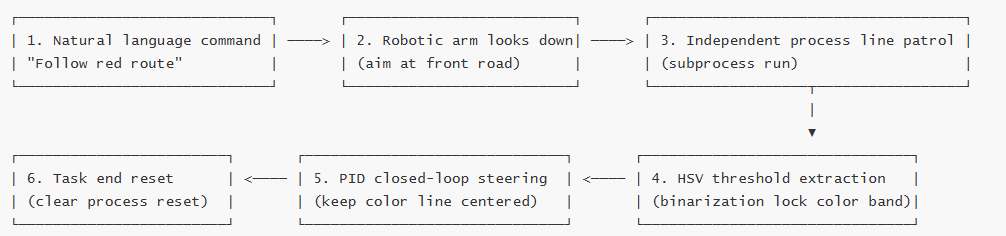
image-20261009182901284

Learning Objectives

  1. Skilled in using colorSelect graphical tool to complete on-site environment HSV threshold pre-calibration.

  2. Master the method of starting red, green, blue, yellow four-color automatic line following through OpenClaw dialogue using FollowLine tool.

  3. Understand HSV color space anti-interference mechanism for target extraction under complex ambient light.

  4. Master multi-process management and master-slave asynchronous communication design philosophy.


2. On-site Color Calibration (Pre-preparation)

Before running the line patrol program, it is recommended to complete the color tape HSV calibration based on the on-site ambient lighting. Although the device has default calibration parameters from the factory, if your classroom/lab lighting is warm-toned, or the ground material reflections cause inaccurate recognition, please use the dedicated graphical tool for quick calibration.

  • Color HSV threshold configuration file path:

~/yahboomcar_ros2_ws/dofbot_pro_ws/src/ackermann_mcp/config/followlineHSV.text

2.1 On-site Environment Graphical Color Calibration (colorSelect)

Enter the following command in the terminal to start the graphical calibration tool:

xxxxxxxxxx
ros2 launch dofbot_pro_bringup colorSelect.launch.py
  • After the program starts, a Color Selector interaction window will pop up on the screen:
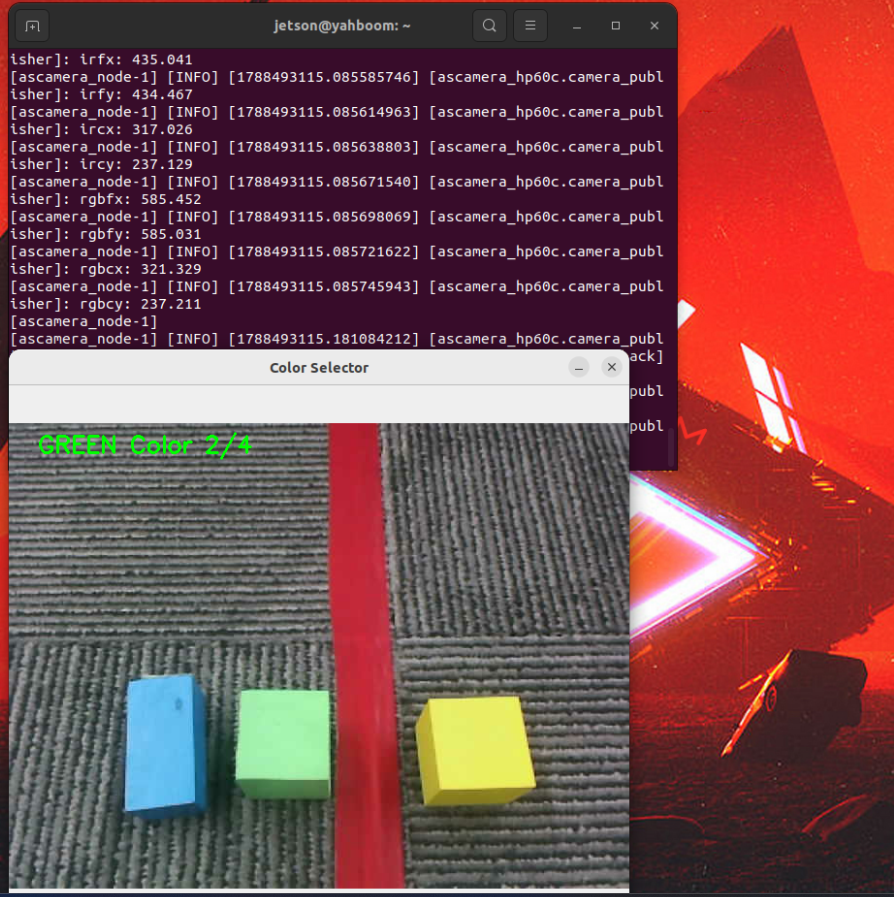
image-20260904113956936

  • Drag and select an area of pure color that needs calibration in the window using the mouse (note: don't mix floor tile background colors into the selection):
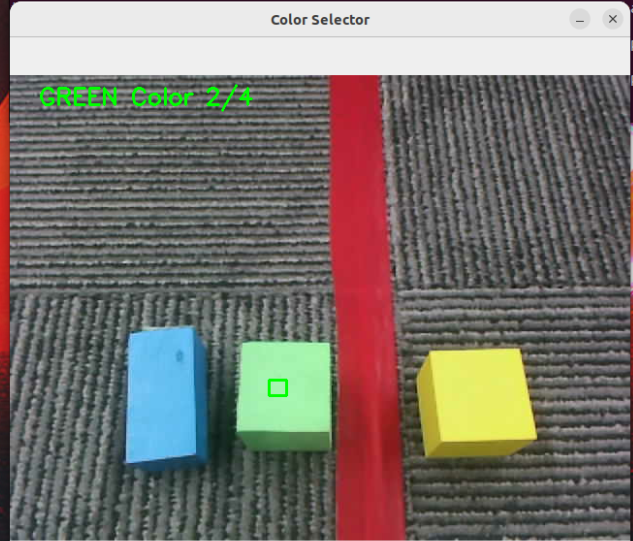
image-20260904114043272

  • After selection, press the Space key on the keyboard, and the system will automatically calculate the maximum and minimum HSV range of the colors in the selection and persistently write to followlineHSV.text;

  • After confirming the terminal prompt for successful saving, press Ctrl + C to exit the calibration program:

image-20260904114105720

Note
After calibration saving is complete, be sure to first press Ctrl + C to close the colorSelect calibration node, then proceed with starting the line patrol main service, to avoid camera resource occupation conflicts.


3. Preparation

After completing color calibration and exiting the calibration tool, start core nodes such as odometry, TF transformation, robotic arm assistance, camera node, and MCP service:

xxxxxxxxxx
ros2 launch dofbot_pro_bringup mcp_service.launch.py
  • If you need voice replies, you can use the command with the launch_openclaw_bridge parameter, otherwise you can simply use the basic command above:

xxxxxxxxxx
ros2 launch dofbot_pro_bringup mcp_service.launch.py   launch_openclaw_bridge:=true 
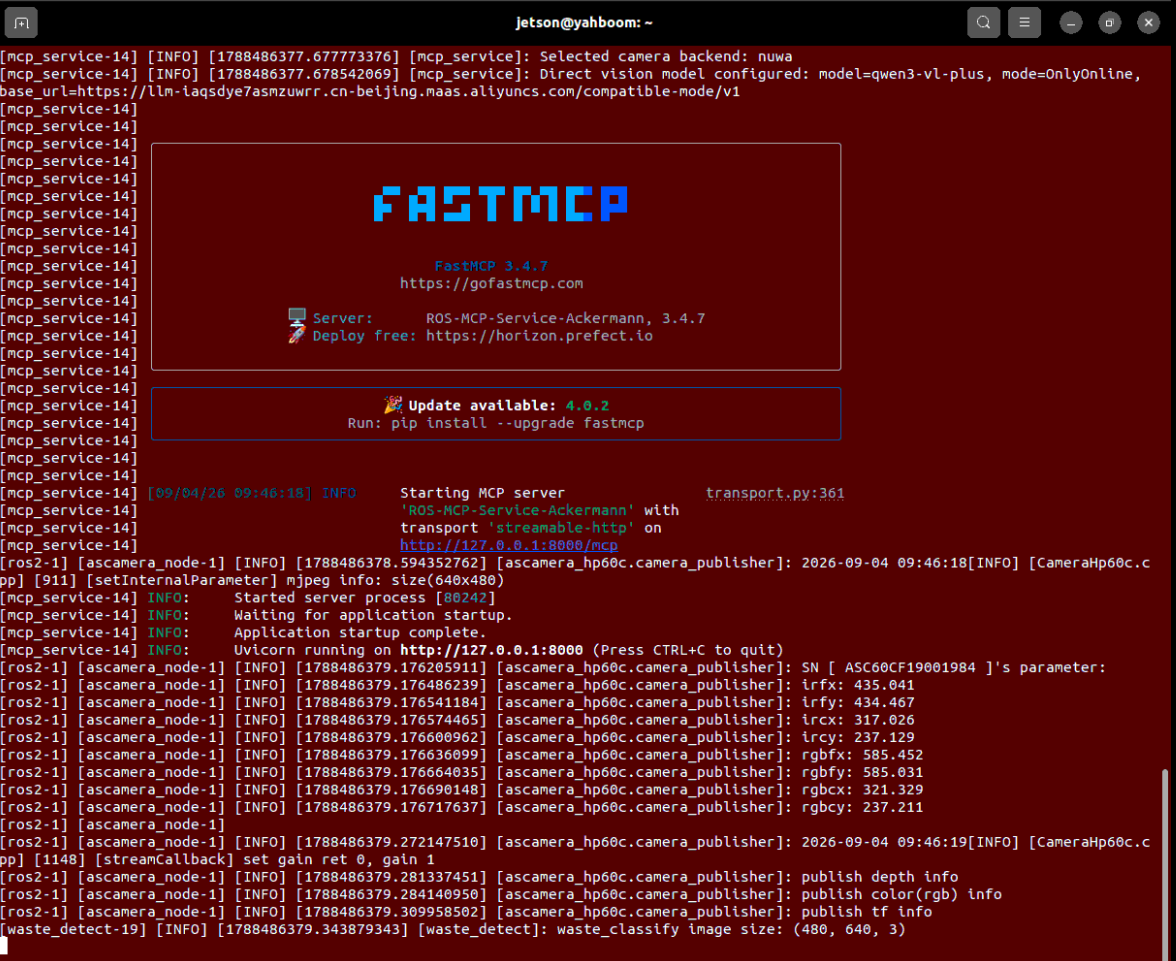
image-20260904094627705

  • For voice dialogue interaction, you can run the following command (choose either the WebChat web interface or voice wake-up interaction):

xxxxxxxxxx
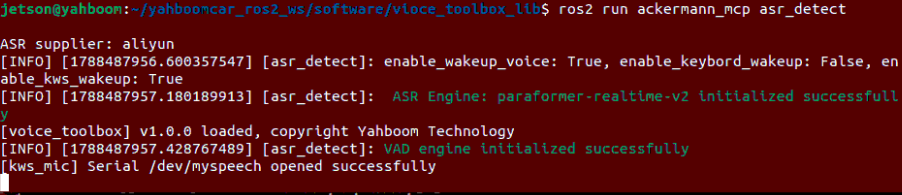
ros2 run ackermann_mcp asr_detect

image-20260904101250184

After shouting the wake-up word Hi,yahboom, the indicator light turns on, and you can then speak the content you want to discuss.


4. Color Line Patrol Case Practice

Tip
Instructions can be expressed naturally according to your actual needs. Here is a case demonstration; you can choose either interaction method. This example uses the WebChat web interface.

Core calling tool:

Tool NameInput ParametersCore Function
FollowLine--color (supports: red, green, blue, yellow)Start chassis to automatically follow the ground-specified color tape track for patrol driving

Step 1: Issue Line Patrol Command

Enter the line patrol command in the WebChat interface, for example:

"Follow the red line" or "Start green line patrol"
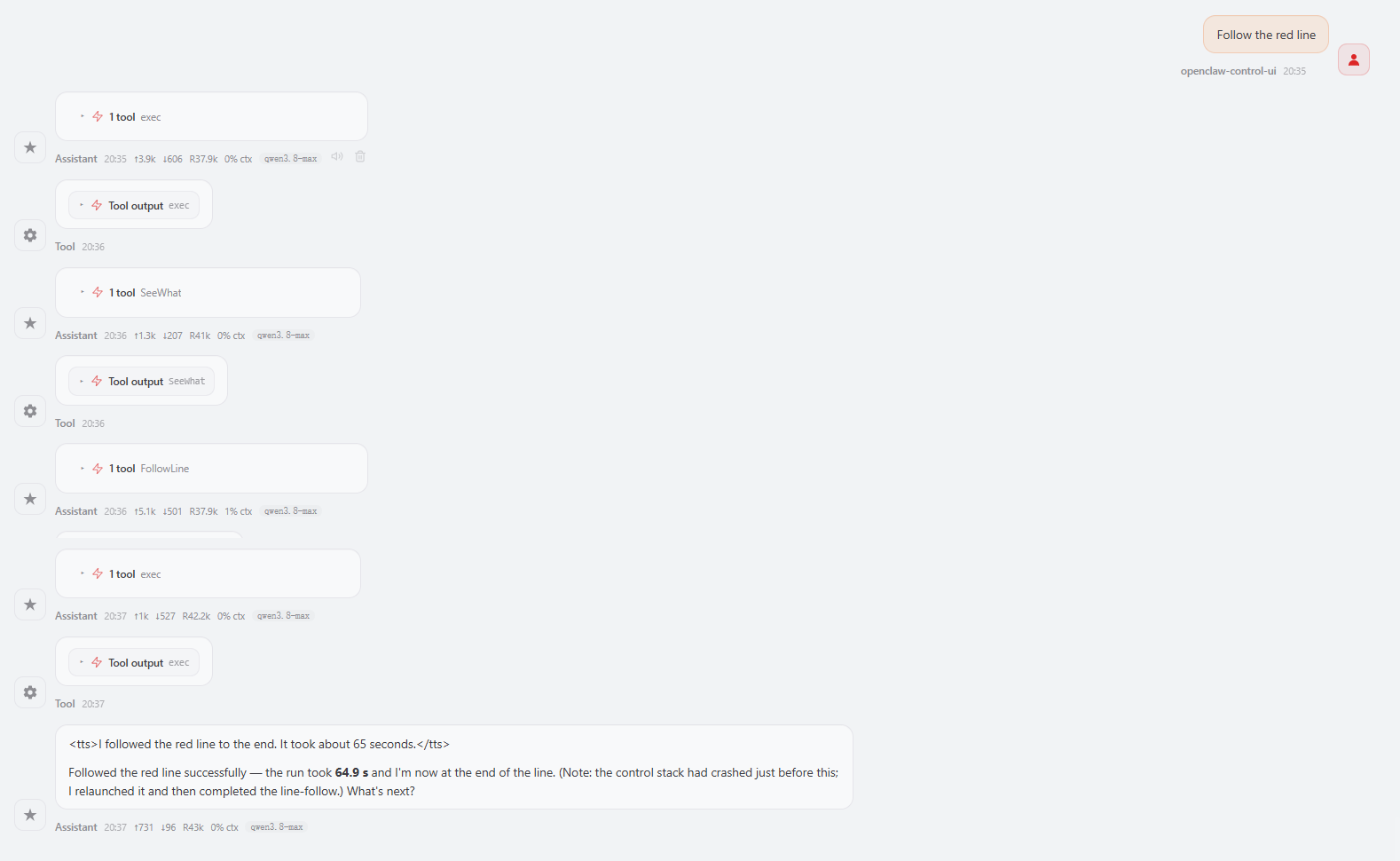
image-20260904112024020

Step 2: Hand-Eye Downward View and Real-time Debug Window

  • The robotic arm quickly adjusts to the dedicated downward-looking posture, so the camera faces the road directly in front of the car;

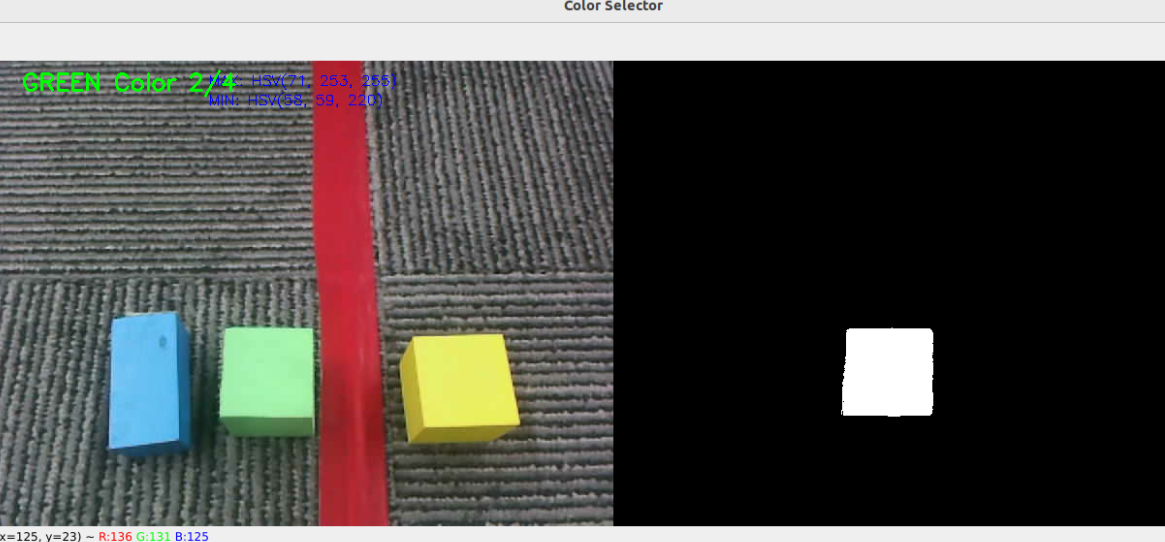
  • The line patrol monitoring window can optionally be enabled or disabled depending on your board's performance; the left side shows the original RGB color image, and the right side shows the black and white binarized image after HSV threshold filtering:
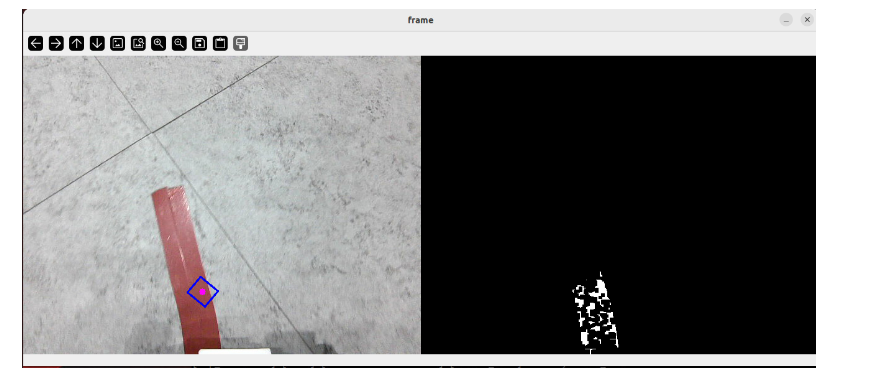
image-20260904111907563

Image observation technique:
In the right binarization window, only the selected target color tape is displayed as pure white, all other background areas are pure black with no noise interference. The Ackermann chassis dynamically controls front wheel left-right steering based on the white area's geometric center deviation, guiding the car to travel stably as if on rails.


5. Core Source Code Analysis

  • Source code file path:

xxxxxxxxxx
~/yahboomcar_ros2_ws/dofbot_pro_ws/src/ackermann_mcp/ackermann_mcp/action_controller.py

FollowLine() — Semantic Mapping and Independent Subprocess High-frequency Control

​x
def FollowLine(self, color: str) -> bool:
    '''Main entry for starting color line patrol task'''
    import subprocess
    # 1. Move robotic arm to preset observation posture, ensuring camera line of sight is vertically downward to car front ground
    self._pubSix_Arm(self.waste_detect_pose)

    self.follow_line_future = Future()  
    color = color.strip("'\"").lower()  
    
    # 2. Map natural language color string understood by large model to the underlying algorithm's agreed digital enum ID
    color_map = {'red': 1.0, 'green': 2.0, 'blue': 3.0, 'yellow': 4.0}
    if color not in color_map:
        error_msg = f"不支持的颜色: '{color}'. 可选颜色: red, green, blue, yellow"
        self.get_logger().error(error_msg)
        return [False, error_msg]
    target_color = color_map[color]

    # 3. Core design: Start line patrol algorithm node as independent subprocess (Subprocess)!
    self.follow_line_process = subprocess.Popen([
        'ros2', 'run', 'ackermann_mcp', 'follow_line',
        '--ros-args', '-p', f'color:={target_color}'
    ])
    
    # 4. Asynchronously listen for line patrol task end signal (triggered by chassis detecting end transverse line or manual interruption)
    while not self.follow_line_future.done():
        time.sleep(0.1)
    self.follow_line_clear_future = None
    
    # 5. After task ends, thoroughly clean up subprocess tree, and restore robotic arm initial posture
    kill_process_tree(self.follow_line_process.pid)
    self.InitArmPose()
    return [True, "Follow line finished"]

Line patrol source code:

xxxxxxxxxx
~\yahboomcar_ros2_ws\dofbot_pro_ws\src\ackermann_mcp\ackermann_mcp\external_action\follow_line.py
#usb camera
~\yahboomcar_ros2_ws\dofbot_pro_ws\src\ackermann_mcp\ackermann_mcp\vision\usb_backend.py

Find display_windows in the depth camera line patrol source code to decide whether to enable visualization:

xxxxxxxxxx
self.declare_parameter('colcor', 2.0)
self.colcor_type = int(self.get_parameter('colcor').get_parameter_value().double_value)
self.declare_parameter('display_windows', False)
self.display_windows = self.get_parameter('display_windows').get_parameter_value().bool_value
self.declare_parameter('max_angular', 0.35)
self.max_angular = self.get_parameter('max_angular').get_parameter_value().double_value

Find display_windows in the USB camera line patrol source code to choose whether to enable visualization.
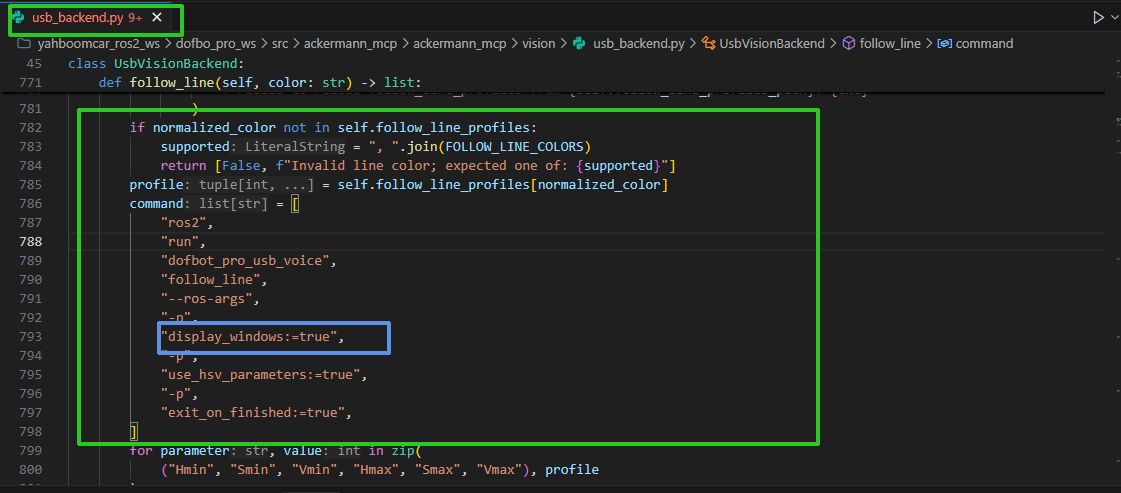
image-20261020095451143

OpenClaw AprilTag Grasping
OpenClaw Visual Distance Measurement

COMPANY

  • About us
  • Team Style
  • Blog

LEARNING & EXPLORATION

  • Tutorials
  • Edge AI hardware
  • Educational robots
  • Embedded intelligent hardware

WHERE TO BUY

  • Yahboom Online Store
  • Amazon
  • Alibaba
  • AliExpress
  • Mercado

TECHNOLOGY SUPPORT

  • Email: support@yahboom.com

BE A DISTRIBUTOR

  • Email: sales@yahboom.com
QR Code

Copyright © 2017-2026 Yahboom. All Rights Reserved.

EN/中文