Welcome to ROSMASTER A1 PRO repository
2.Multimodal Visual Understand
2. Multimodal Visual Understanding (Text Version)
1. Course Content
Learn the large model's multimodal visual perception, image semantic understanding, and logical conditional judgment capabilities;
Learn advanced applications such as issuing visual queries to the large model through the text terminal, summarizing the functions of environmental objects, and executing conditional actions (nodding/shaking the head);
2. Preparation
2.1 Content Description
This lesson applies to controllers such as Raspberry Pi 5, Jetson Orin NANO, and D-Robotics RDK X5:
Raspberry Pi 5: You must first enter the Docker container before running ROS 2 related commands. Refer to [3.Enter Docker (For Raspberry Pi)] in the [Robot Configuration and Operation Guide];
Orin / RDK X5: Run commands directly in the onboard terminal; there is no need to enter Docker.
2.2 Start the Local Dify Large-Model Environment
Enter the following command in the host terminal to start the Dify service:
sh ~/bringup_dify.sh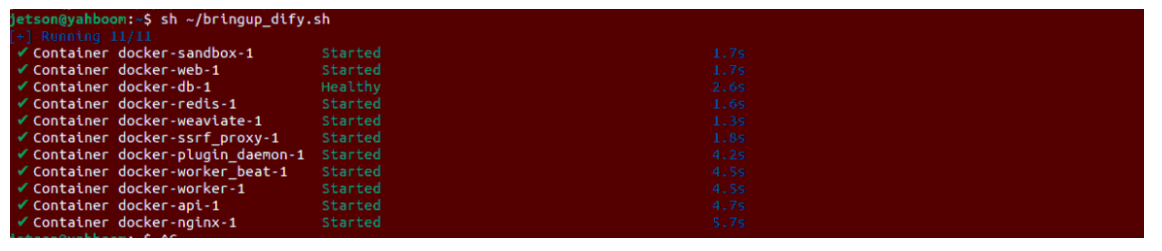
3. Running Examples
3.1 Start the Embodied Intelligence Master Control Service
Enter the following command in the onboard terminal to start the text-mode large-model embodied control system:
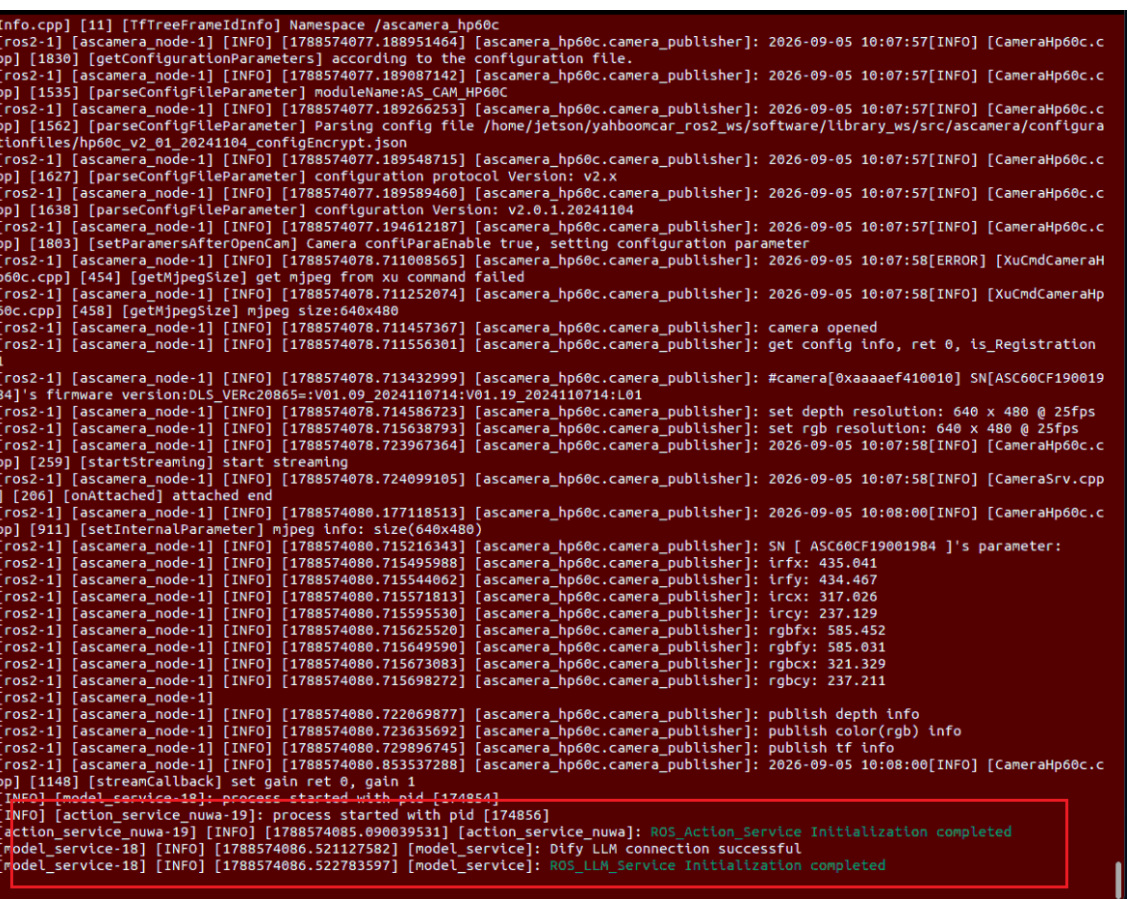
xxxxxxxxxxros2 launch multi_brains llm_agent_control.launch.py text_chat_mode:=TrueAfter the system finishes initializing, the terminal prints the ready log:
3.2 Start the Text Interaction Control Terminal
Use remote SSH to open a terminal for text interaction:
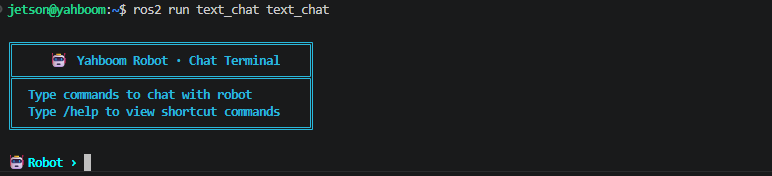
xxxxxxxxxxros2 run text_chat text_chatAfter startup, the terminal enters the real-time text interaction interface, waiting for the user to enter commands:
Tip
Chinese Input Tip:
It is recommended to connect from a computer using an SSH remote tool (such as MobaXterm or VSCode Terminal), so that Chinese can be typed seamlessly.
3.3 Classic Test Cases (Visual Perception and Conditional Following)
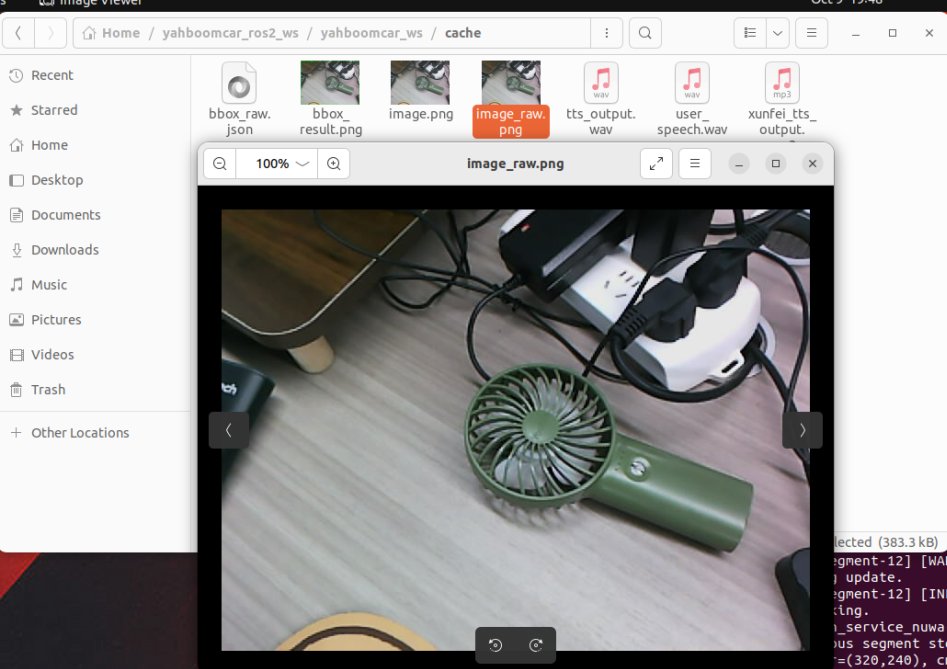
Case 1: Multimodal Recognition of Environmental Objects and Description of Their Functions
Enter the test statement in the terminal:
xxxxxxxxxxPlease take a look at the items in front of you and tell me what each of them is used for.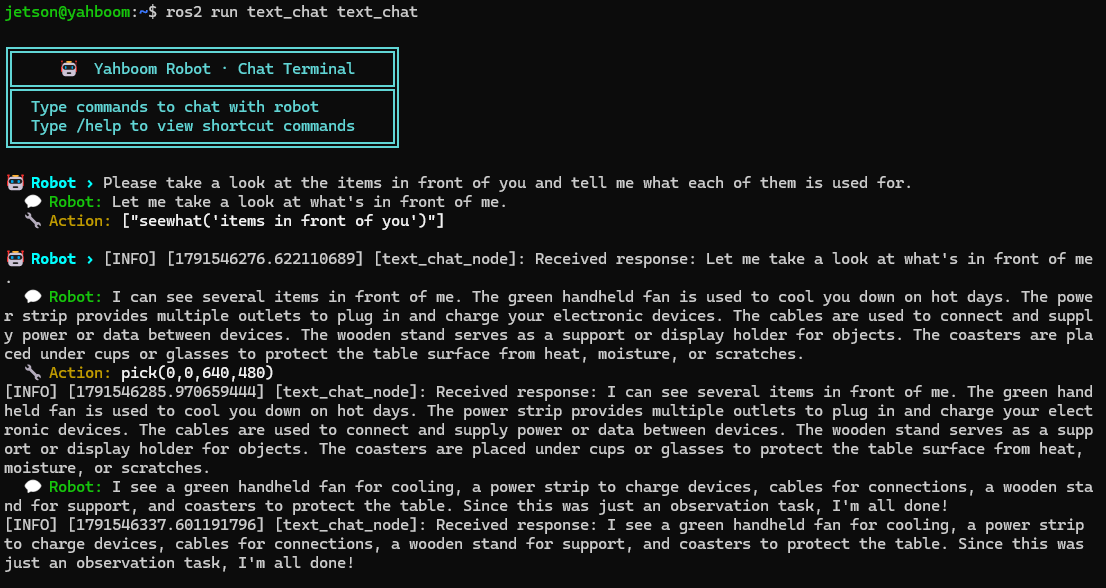
For cases involving photo capture, view the captured photos in this path
~/yahboomcar_ros2_ws/yahboomcar_ws/cache/image_raw.png
Case 2: Multi-Target Existence Judgment and Anthropomorphic Body-Language Feedback
Enter the test statement in the terminal:
xxxxxxxxxxPlease look at the items in front of you - do you see a blue square and a pack of tissues? If you do, nod your head; if not, shake your head.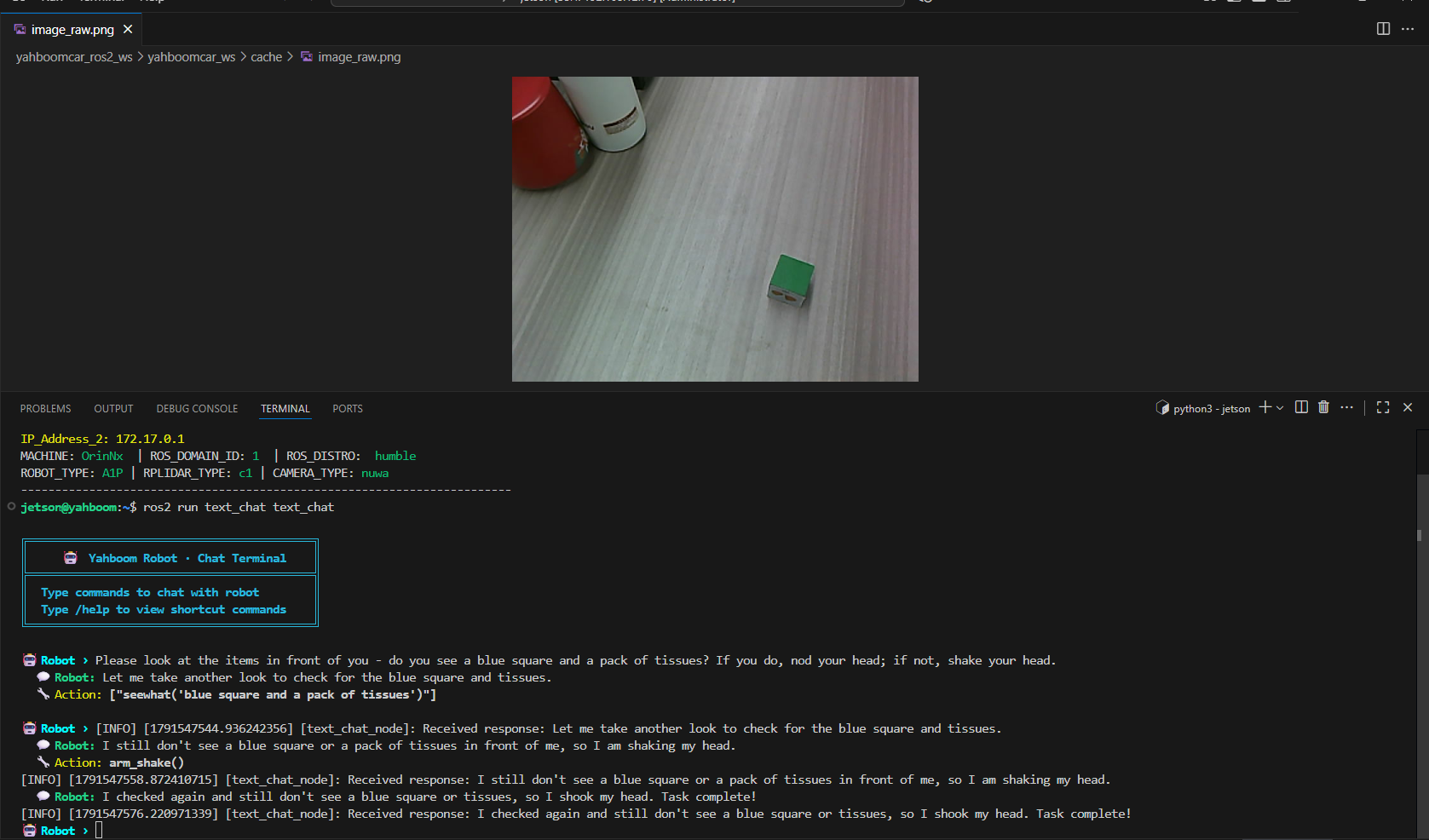
Execution Process and Behavior:
The robot calls
seewhatto capture a photo of the current field of view;The multimodal large model determines whether a "blue block" and a "pack of tissues" exist at the same time in the image;
If the condition holds, the large model issues the
arm_nod(nod) action, and the robotic arm pitches twice in succession to nod; if the condition does not hold, it triggers thearm_shake(shake) action, and the base servo of the robotic arm swings left and right to signal "no".
4. Core Source Code Analysis
Source package path:
~/yahboomcar_ros2_ws/yahboomcar_ws/src/multi_brains
The system has built-in dual-scheme compatibility support for a 3D depth camera (Nuwa scheme) and a USB monocular camera (USB scheme). The master control launch script llm_agent_control.launch.py automatically loads the corresponding action service node according to the environment variable CAMERA_TYPE (default nuwa, optional usb):
3D depth camera scheme: loads
action_service_nuwa.py, which by default subscribes to/ascamera_hp60c/camera_publisher/rgb0/image;USB camera scheme: loads
action_service_usb.py, which by default subscribes to/usb_cam/image_raw.
4.1 Visual Capture and Image Cache Processing (action_service_nuwa.py / action_service_usb.py)
In multimodal visual understanding tasks, the visual perception mechanisms of the two schemes are highly unified. When the large model needs to observe the surrounding environment, both call the seewhat action to capture the latest frame from the current camera Topic and store it in a normalized form:
xxxxxxxxxxdef seewhat(self): """ Save the current view image and feed the result back to the agent large model """ if self.save_single_image(): self._feedback(self.actionlog.get_text("image_feedback")) return None self._feedback("Image capture failed, grid image unavailable") return NoneInside the save_single_image() function, image resizing, grid drawing, and local caching are implemented:
xxxxxxxxxxdef save_single_image(self, image_msg=None): """ Save the 640x480 high-definition original image as well as a grid image with a 20px coordinate ruler """ image_msg = self.image_msg if image_msg is None else image_msg if image_msg is None: self.get_logger().warning("No camera image data has been received yet.") return False try: # Convert the ROS Image message to OpenCV BGR8 format cv_image = self.bridge.imgmsg_to_cv2(image_msg, "bgr8") if cv_image.shape[:2] != (480, 640): cv_image = cv2.resize(cv_image, (640, 480), interpolation=cv2.INTER_AREA) os.makedirs(self.image_cache_dir, exist_ok=True) # Draw the coordinate grid used for spatial reference gridded = self._draw_coordinate_grid(cv_image) # Save the high-definition original photo (for multimodal semantic recognition by the large model and viewing by the user) self._write_cache_image(self.raw_image_cache_path, cv_image) # Save the grid photo (for localization reference) self._write_cache_image(self.image_cache_path, gridded) return True except Exception as e: self.get_logger().error(f"Image save exception: {e}") return FalseCache path: the original photo is saved at
~/yahboomcar_ros2_ws/yahboomcar_ws/cache/image_raw.png; the user can directly view the high-definition field-of-view image currently captured by the robot in this directory.
4.2 Multimodal Image Upload and Visual Question Answering (model_service.py)
In model_service.py, when a multimodal request is triggered, the node uploads the captured image to the Dify platform for deep semantic understanding:
x# Multimodal vision request handlingif image_path is not None: upload_files = [] # raw-picture lets the large model identify rich details such as the category, color, and function of objects # grid-picture lets the large model reference the coordinate scale for name, path in ( ("raw-picture", raw_image_path), ("grid-picture", image_path), ): if not path: continue with open(path, "rb") as file: response = self.client.file_upload("yahboom", {"file": (name, file, "image/png")}) response.raise_for_status() file_id = response.json().get("id") upload_files.append({"type": "image", "transfer_method": "local_file", "upload_file_id": file_id})
# Attach the image files to the question-answering request and send them to the multimodal large model kwargs["files"] = upload_filesThe large model combines the uploaded high-definition image with the user's natural-language question (such as "tell me what the objects are used for") to perform comprehensive reasoning and return a text answer.
4.3 Visual Conditional Judgment and Anthropomorphic Action Feedback (action_service_nuwa.py)
When the user requests "nod if present, shake if absent," after completing the visual judgment the large model outputs an arm_nod or arm_shake action, and the robotic arm performs intuitive body-language feedback:
xxxxxxxxxxdef arm_nod(self):    """ The robotic arm performs a nodding action """    for i in range(3):        if self.interrupt_event.is_set():            self.pubSix_Arm(self.init_joints)            return None        # Pitch joint lowers the head        tar_arm_joint = [90, 130, 0, 95, 90, 0]        self.pubSix_Arm(tar_arm_joint)        time.sleep(1.0)        # Restore the initial posture        self.pubSix_Arm(self.init_joints)        time.sleep(1.0)    return True
def arm_shake(self):    """ The robotic arm performs a shaking action """    for i in range(3):        if self.interrupt_event.is_set():            self.pubSix_Arm(self.init_joints)            return None        # Base pan-tilt swings left        tar_arm_joint = [140, 130, 0, 5, 90, 0]        self.pubSix_Arm(tar_arm_joint)        time.sleep(1.0)        # Base pan-tilt swings right        tar_arm_joint = [40, 130, 0, 5, 90, 0]        self.pubSix_Arm(tar_arm_joint)        time.sleep(1.0)    self.pubSix_Arm(self.init_joints)    return True
Action reset: after the action is completed, the robotic arm automatically returns to the folded safe pose
init_joints, ensuring it does not block the line of sight and keeps the body stable.