Welcome to ROSMASTER A1 PRO repository
2.RAG Retrieval Enhancement and Model Training Samples
RAG Retrieval Enhancement and Model Training Samples
RAG Retrieval Enhancement and Model Training Samples1. Course Content2. What Is Large-Model Hallucination? Why Does It Occur?3. RAG Retrieval Enhancement and Model Training Samples3.1 RAG Retrieval Enhancement3.2 Model Training Samples4. The Role of RAG Retrieval Enhancement and Training Samples in the Robot4.1 Reducing Large-Model Hallucination4.2 Increasing the Robot's Scenario Generalization Capability
1. Course Content
Understand the three concepts of large-model hallucination, RAG retrieval enhancement, and model training samples, which is the content covered in this course.
Tip
This section is a purely theoretical course. If you want to quickly get hands-on experience with the features, you may skip this section for now.
2. What Is Large-Model Hallucination? Why Does It Occur?
RAG retrieval enhancement and model training samples mainly serve to reduce large-model hallucination, so let us first understand what large-model hallucination is.
Hallucination in large models refers to the situation where the model, when understanding the environment, generating instructions, or planning actions, outputs content that is inconsistent with real-world facts or logic, causing the robot to perform wrong behaviors or causing the results to deviate greatly from user expectations.
Why does hallucination occur in large models? A large model is essentially a probabilistic prediction system trained on massive amounts of text. In certain specialized domains or unknown task scenarios, the training data may lack sufficient samples, causing the model to "fabricate" content to fill in the gaps.
3. RAG Retrieval Enhancement and Model Training Samples
3.1 RAG Retrieval Enhancement
RAG is an architecture that combines a retrieval system with a generative model and aims to solve the limitations of traditional generative models in scenarios such as open-domain knowledge question answering and real-time information querying (e.g., outdated knowledge, factual hallucinations, long-text dependencies). Its core logic is: to obtain relevant knowledge through retrieval and incorporate it into the prompt, so that the large model can reference the relevant knowledge, achieving a "retrieve first, generate later" approach.
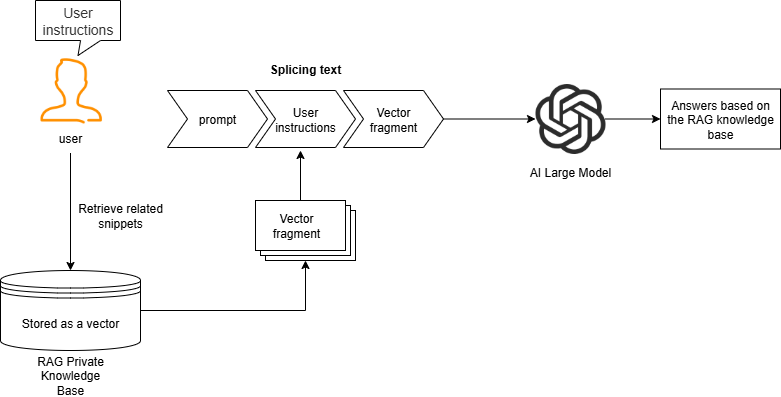
3.2 Model Training Samples
Model training samples are stored in the RAG knowledge base. At the factory, the robot is preconfigured with two knowledge bases: an action function library and model training samples. The training samples include the training examples from the course case scenarios and provide the large model with ideas for decision-making and planning in specific scenarios. The chapter 【AI Model Development \ Deploy the RAG knowledge base】 will explain how to configure and expand a proprietary knowledge base and training samples.
4. The Role of RAG Retrieval Enhancement and Training Samples in the Robot
4.1 Reducing Large-Model Hallucination
When a large model encounters a domain it has never been exposed to or special user requirements, it may give a plausible result based on its existing training data. However, this result may differ from what the user expects, or it may not meet the requirements of a particular scenario.
4.2 Increasing the Robot's Scenario Generalization Capability
The ROSMASTER-A1PRO robot is preconfigured at the factory with training samples related to the course cases (which will be explained in detail in the large-model configuration course). These training samples provide the large model with reference information for specific scenarios, and users can also add their own training samples to customize their own dedicated robot so as to adapt to different application domains.